Home
Class 11
PHYSICS
Calculate the net acceleration produced ...

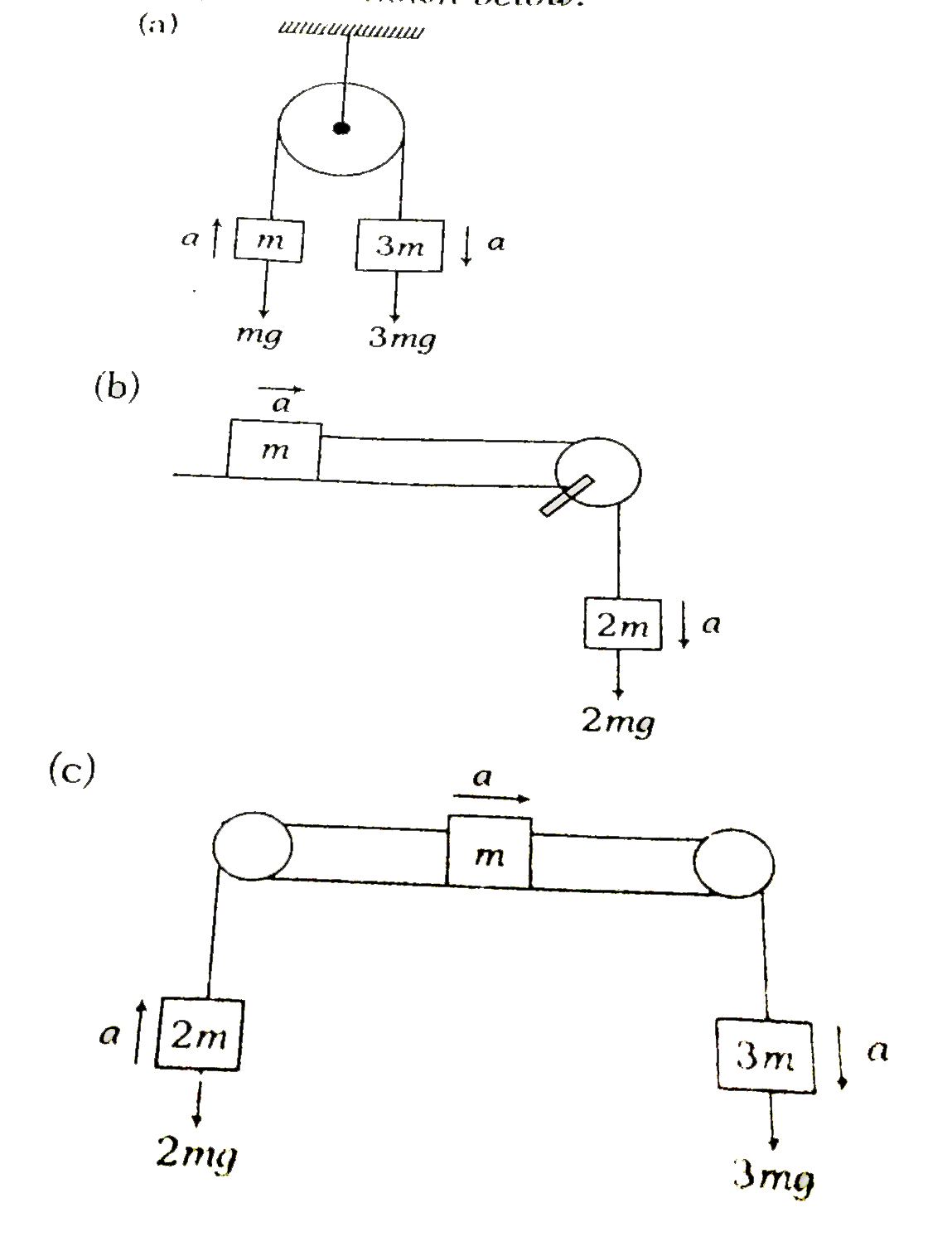
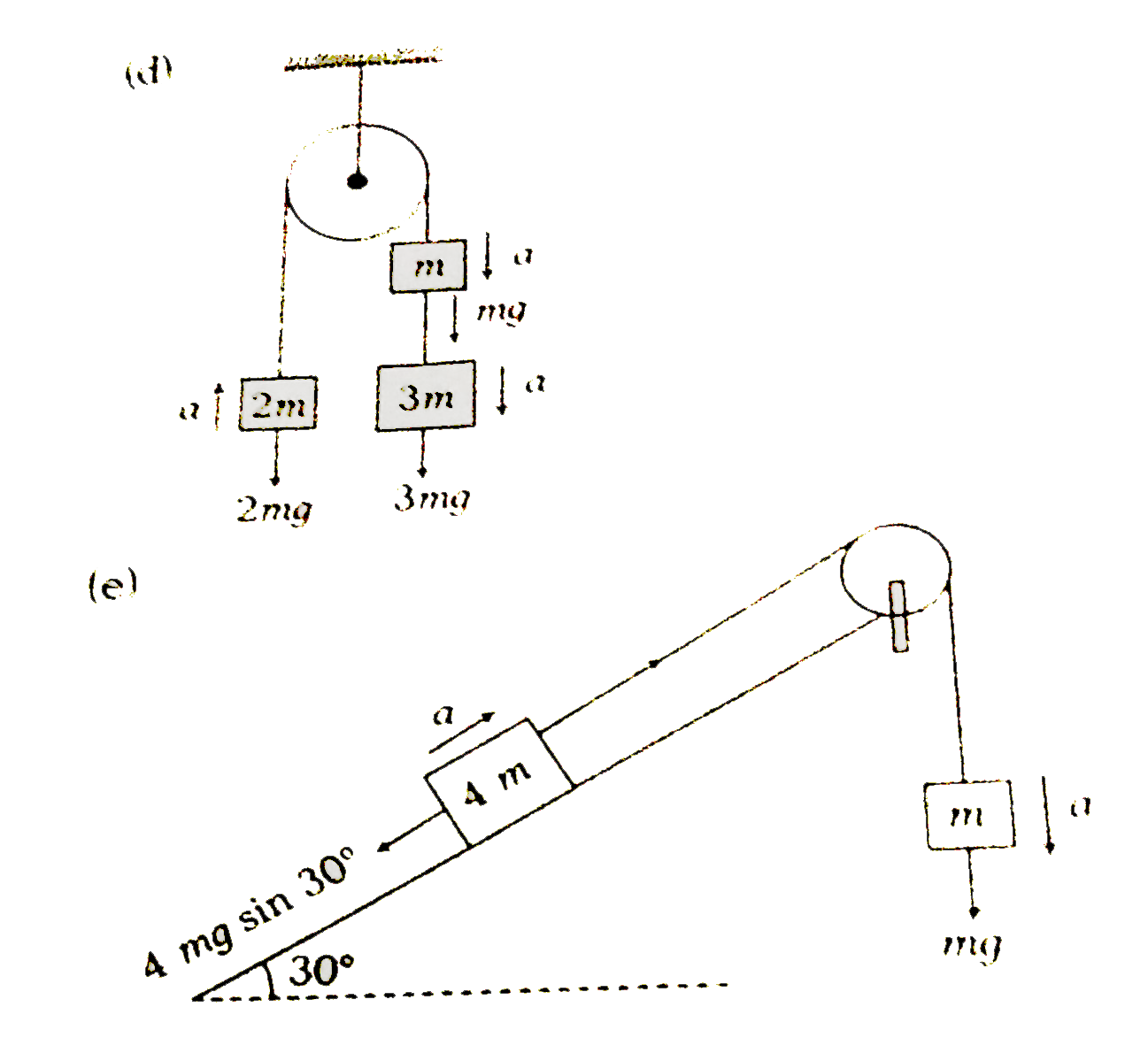
Calculate the net acceleration produced in the arrangement shown below.

Text Solution

Verified by Experts

(a) Net pulling force =3 mg-mg=2mg
Total mass =3m+m=4m
`a=(2mg)/(4m)=(g)/(2) `
(b) Pulling force= 2mg
Total mass =3m
`a=(2 mg)/(3m)=(2g)/(3)`
(c ) Net pulling force= 3mg-2mg=mg
Total mass =3m+m+2m=6 m
`a=(mg)/(6mg)=(g)/(6)`
(d) Net pulling force= 3 mg +mg-2 mg= 2 mg
Total mass =3m+m+2m=6m
`a=(2g)/(6mg)=(g)/(5)`
(e) Net pulling force = 4 mg `sin 30^(@)-mg`=mg
Total mass =4m+m= 5m
`implies a=(mg)/(5m)=(g)/(5)`
Promotional Banner

Similar Questions

Explore conceptually related problems

Find the accelerations of rod A and wedge B in the arrangement shown in figure if the ratio of the mass of the wedge to that of the rod equals eta , and the friction between all contact surfaces is negligible.

A rod of mass m is supported on a wedge of mass M shown in fig. Find the accelerations of rod and wedge in the arrangement. The friction between all contact surfaces in negligible.

Calculate the net force acting on the charge present at the origin.

The velocity-time graph of an object is given below. Calculate the average acceleration of the object in the time interval of 4 s to 6 s.

The acceleration of 3 kg block in the arrangement shown in the diagram ,when the given system is released from rest is

If the acceleration of wedge in the shown arrangement is a ms^(-2) towards left, then at this instant, acceleration of the block (magnitude only) would be

Calculate the distance from the surface of the earth at which above the surface, acceleration due to gravity is the same as below the earth.

Two blocks 'A' and 'B' having masses m_(A) and m_(a) , respectively are connectd by an arrangement shown in the figure. Calculate the downward acceleration of the block B. Assume the pulleys to be massless. Under what condition will block A have downward acceleration?

The magnetic moment of the arrangment shown in the figure is

The magnitud of difference in accelerations of blocks of mass m in . Both the cases shown below is
