Home
Class 11
PHYSICS
In the adjoining figure, the coefficient...

In the adjoining figure, the coefficient of friction between wedge (of mass `M`) and block (of mass `m`) is `mu`.
Find the minimum horizontal force `F` required to keep the block stationary with respect to wedge.

Text Solution

Verified by Experts
Such problems can be solved with or without using the concepte of pseudo force. Let us, solve the problem by both the methods.
a= Acceleration of ( wedge+ block ) in horizontal direction `= (F)/(M+m).`
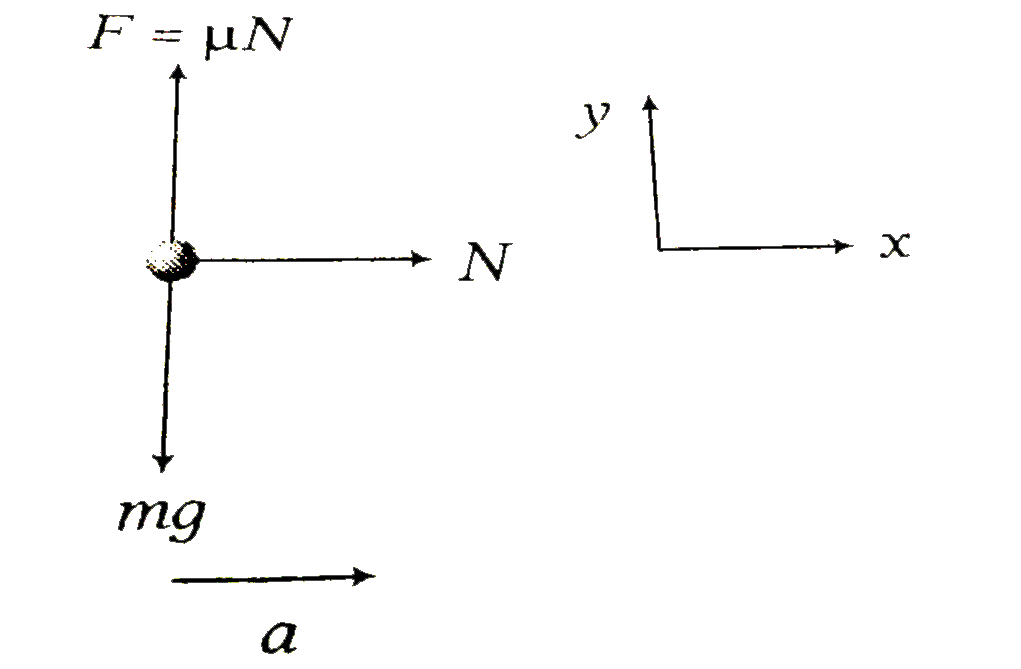
(i) Inertial frame of reference ( ground) FBD of block with respect to ground ( only real forces have to be applied) with respect to ground block is moving with an acceleration a.

Therefore,
` sumF_(y)=0 " and " sum F_(x)=ma`
`mg= muN " and " N=ma`
`therefore a=(g)/(mu)`
`therefore F= (M+m)a=(M+m)(g)/(mu)`
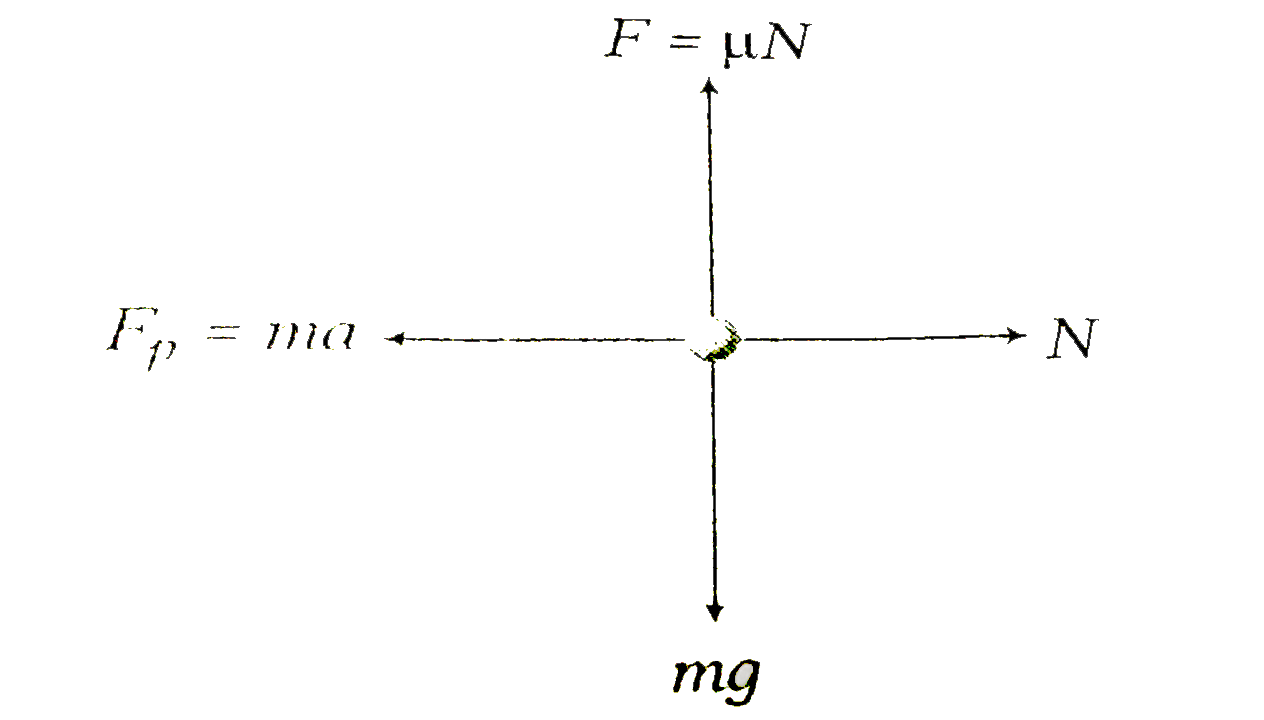
(ii) Non- inertial frame of reference ( wedge ) FBD of m with respect to wedge ( real + one pseudo force ) with respect to wedge block is stationary.

`therefore sumF_(x)=0=sumF_(y)`
`therefore mg=muN`
and N= ma
`therefore a=(g)/(mu)` and `F=(M+m)a=(M+m)(g)/(mu)`
From the above discussion, we can see that from both the methods results are same.
Promotional Banner

Similar Questions

Explore conceptually related problems

A bar of mass m is placed on a triangular block of mass M as shown in figure The friction coefficient between the two surface is mu and ground is smooth find the minimum and maximum horizontal force F required to be applied on block so that the bar will not slip on the inclined surface of block

A block of mass m is placed over the wedge as shown in figue Coefficent of frition mu is half the minimum value required to keep it in this postion. what is the minimum value of accleration of wedge to keep the blok statinary with respect to the wedge in either of the four cases?

The block of mass m is kept on plank of mass M. The block is given velocity V_(0) as shown. The coefficient of friction between the block of mass m and plank of mass M is mu and its value is such that block becomes stationary with respect to plank before it reaches the other end. Then:

A block of mass m is at rest on a rough inclined plane of angle of inclination theta . If coefficient of friction between the block and the inclined plane is mu , then the minimum value of force along the plane required to move the block on the plane is

A block of mass m is placed on another block of mass M which itself is lying on a horizontal surface .The coefficient of friction between two blocks is mu_(1) and that between the block of mass M and horizontal surfece is mu_(2) What maximum horizontal force can be applied to the lower block move without separation?

The coefficient of static friction between the two blocks shown in figure is mu and the table is smooth. What maximum horizontal forced F can be applied to he block of mass M so that the block move together?

The coefficient of static friction between the two blocks shown in figure is mu and the table is smooth. What maximum horizontal forced F can be applied to he block of mass M so that the block move together?

A block A of mass m which is placed a rough inclined face of a wedge of same mass being pulled through light string and with force F as shown in figure The coefficient of friction between inclined face and block A is mu while there is no friction between the ground and wedge it the whole system moves with same acceleration then find the value of F

A cart of mass M has a block of mass m in contact with it as shown in the figure-2.133. The coefficient of friction between the block and the cart is mu . What is the minimum acceleration of the cart so that the block m does not fall ?

A wedge B of mass 2 m is placed on a rough horizontal suface. The coefficient of friction between wedge and the horizontal surface is mu_(1) . A block of mass m is placed on wedge as shown in the figure. The coefficient of friction between block and wedge is mu_(2) . The block and wedge are released from rest. Q. Suppose the inclined surface of the wedge is at theta=37^(@) angle from horizontal and mu_(2)=0.9 then the wedge: