Home
Class 11
PHYSICS
A rod AB rests with the end A on rough h...

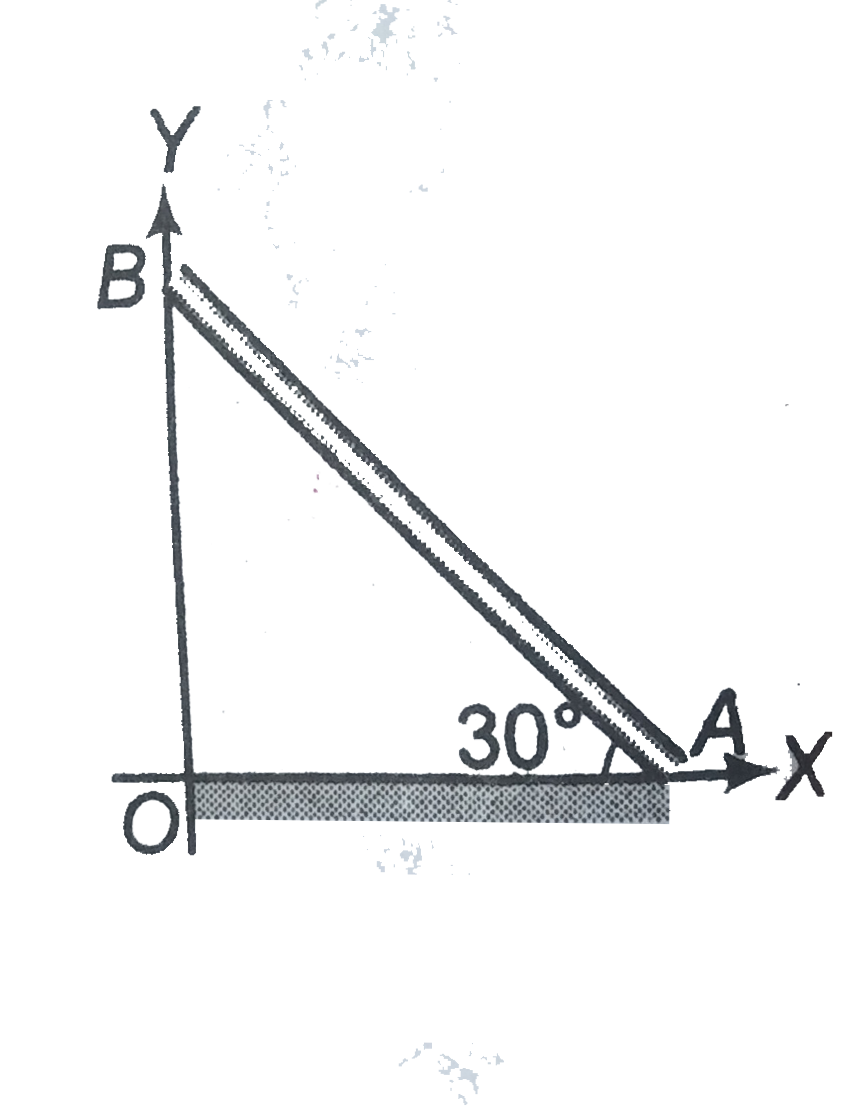
`A` rod `AB` rests with the end `A` on rough horizontal ground and the end `B` against a smooth vertical wall. The rod is uniform and of weight w. If the rod is in equilibrium in the position shown in figure.Find
(a)frictional force shown at `A`
(b) normal reaction at `A`
(c) normal reaction at `B`.

Text Solution

Verified by Experts
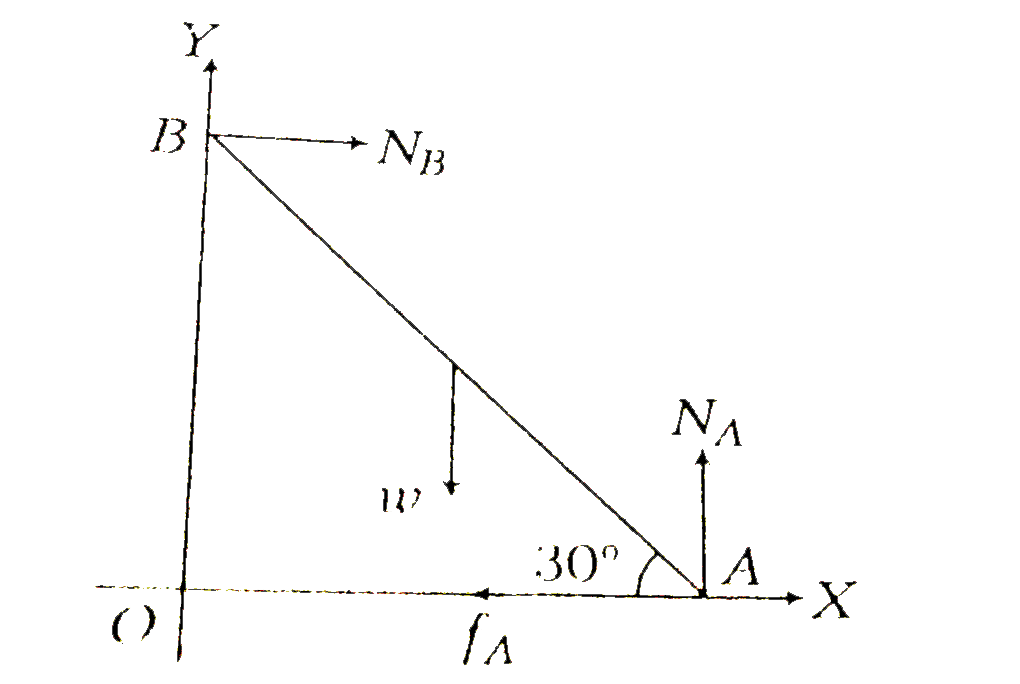
Let length of the rod is 2l. Using the three conditions of equilibrium. Anti- clockwise moment is taken as positive.

(i) `sumF_(x)=0`
`therefore N_(B)-f_(A)=0`
or `N_(B)=f_(A)`……….(i)
(ii)` sumF_(y)=0 `
`therefore N_(A)-w=0`
or `N_(A)=w`........(ii)
(iii) `sum tau_(0)=0`
`thereforeN_(A)(2l cos 30^(@))-N_(B)(2l sin 30^(@))-w(l cos 30^(@))=0`
or `sqrt(3)N_(A)-N_(B)-(sqrt(3))/(2)w=0`........(iii)
Solving these three equations, we get
(a)`f_(A)= (sqrt(3))/(2)w` (b) `N_A)=w`
(c ) `N_(B)=(sqrt(3))/(2)w`
Promotional Banner

Similar Questions

Explore conceptually related problems

A rod AB rests with the end A on rough horizontal ground and the end B against a smooth vertical wall. The rod is uniform and of weight w. If the rod is in equilibrium in the position shown in figure.Find (a)frictional shown at A (b) normal reaction at A (c) normal reaction at B .

A uniform ladder of mass 10 kg leans against a smooth vertical wall making an angle of 53^0 with it. The other end rests on a rough horizontal floor. Find the normal force and the frictional force that the floor exerts on the ladder

A rod bent at right angle along its centre line is placed on a rough horizontal fixed cylinder of radius R as shown in the figure. Mass of the rod is 2m and the rod is in equilibrimu. Assume that the friction force on rod at A and B is equal in magnitude.

A uniform rod AB hinged about a fixed point P is initially vertical. A rod is released from vertical position. When rod is in horizontal position: The acceleration of end B of the rod is

A rod of length I leans by its upper end against a smooth vertical wall, while its other end leans against the floor. The end that leans against the wall moves uniformly downward. Then:

A rod AB of mass M and length L is shown in figure. End A of rod is hinged and end B is lying on the ground. Find the Normal reaction by ground on the rod

A thin, uniform rod with negligible mass and length 0.200m is attached to the floor by a frictionless hinge at point P (as shown in fig) A horizontal spring with force constant k=4.80Nm^-1 connects the other end of the rod to a vertical wall. The rod to a vertical wall. The rod is in a uniform magnetic field B=0.340T directed into the plane of the figure. There is current I=6.50 A in the rod, in the direction shown. Calculate the torque due to the magnetic force on the rod, for an axis at P.

A uniform rod of length L pivoted at the bottom of a pond of depth L//2 stays in stable equilibrium as shown in the figure. Find the force acting at the pivoted end of the rod in terms of mass m of the rod.

A rod of mass m and length L is hinged at its top end. If the rod is in equilibrium making an angle of 30^(@) with the vertical when a horizontal force F is applied as shown in figure, then the value of F is:

A uniform rod is resting freely over a smooth horizontal plane. A particle moving horizontally strikes at one end of the rod normally and gets stuck. Then

