Home
Class 11
PHYSICS
In the arrangment shown in figure, m(A)=...

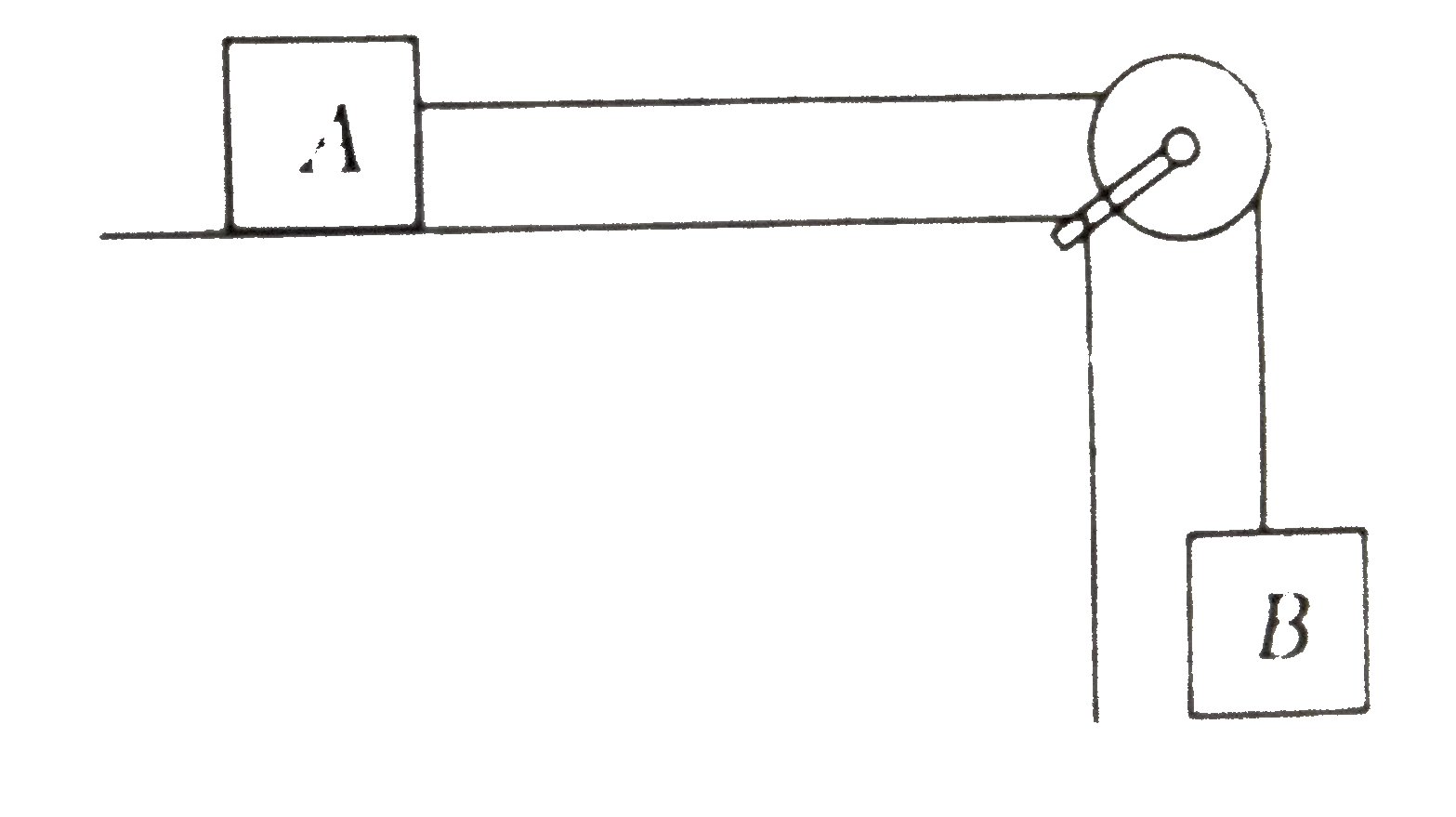
In the arrangment shown in figure, `m_(A)`=1 kg, `m_(B)`=4 kg. String is light and inextensible while pulley is smooth. Coefficient of friction between block A and the table is `mu`=0.2. Find the speed of both the blocks when block B has descended a height h=1 m. (Take ,g=10 `ms^(-2)`)

Text Solution

Verified by Experts

From constraint relation, we see that
`v_(A)=v_(B)=v`
Force of friction between block A and table will be
`f=mum_(A)g=(0.2)(1)(10)=2N`
`:. W_(nc)=DeltaU+DeltaK`
`:. -fs=-m_(B)gh+(1//2)(m_(A)+m_(B))v^(2)`
or `" " (-2)(1)=-(4)(10)(1)+(1)/(2)(4+1)v^(2)`
`-2=-40+2.5 v^(2) " or " 2.5 v^(2)=38`
`:. v^(2)=15.2 m^(2) s^(-2) " or " v=3.9 ms^(-1)`
Promotional Banner

Topper's Solved these Questions

  • WORK, ENERGY AND POWER

    DC PANDEY ENGLISH|Exercise CHECK POINT 6.1|20 Videos
  • WORK, ENERGY AND POWER

    DC PANDEY ENGLISH|Exercise CHECK POINT 6.2|20 Videos
  • WORK, ENERGY & POWER

    DC PANDEY ENGLISH|Exercise Level 2 Comprehension Based|2 Videos
  • WORK, POWER AND ENERGY

    DC PANDEY ENGLISH|Exercise E Integer Type Questions|11 Videos

Similar Questions

Explore conceptually related problems

In the arrangement shown in Figure, m_A=2kg and m_B=1kg . String is light and inextensible. Find the acceleration of centre of mass of both the blocks. Neglect friction everywhere.

In the arrangement shown in Figure, m_A=2kg and m_B=1kg . String is light and inextensible. Find the acceleration of centre of mass of both the blocks. Neglect friction everywhere.

In the arrangement shown in figure. The strings are light and inextensible. The surface over which block are placed is smooth.Find (a) the acceleration of each block, (b) the tension in each string.

A force of 200N is applied as shown in the figure on block of 3 kg. The coefficient of friction between the block and the wall is 0.3. Find the friction acting on the block. (in N) {Take g = 10 m//s^(2)

If coeffiecient of friction between the block of mass 2kg and table is 0.4 then out acceleration of the system and tension in the string. (g=10m//s^(2))

In the arrangement shown in figure, string is light and inextensible and friction is absent every where. The speed of both blocks after the block 'A' has ascend a height of 1m will be (g=10 m//s^(2))

Consider the system shown in the figure. Coefficient of friction between the block and table is mu=0.5. The system is released from rest. Find the work done by friction, when the speed of block is 10 m/s (m=1kg)

Two masses m_(1) =10 Kg and m_(2)=5kg are connected by an ideal string as shown in the figure. The coefficient of friction between m_(1) and the surface is mu=0.2 Assuming that the system is released from rest calculate the velocity of blocks when m_(2) has descended by 4m . (g=10 m//s^(2)) .

A trolley of mass 20 kg is attached to a block of mass 4kg by massless string passing over a frictionless pulley as shown in the figure. If the coefficient of kinetic friction between trolley and the surface is 0.02, then the accderal ion of the trolley and block system is ("Take" g=10ms^(-2))

Block B of mass m_(B) = 0.5 kg rests on block A, with mass m_(A) = 1.5kg which in turn is on a horizontal tabletop (as shown in figure) .The coefficient of kinetic friction between block A and the tabletop is mu_(k) = 0.4 and the coefficient of static friction between block A and blockB is mu_(s) = 0.6 A light string attached block A passes over a frictionless, massless pulley and block C is suspeneded from the other end of the string. What is the largest mass m_(c) (in kg) that block C can have so that block A and B still slide together when the system is relaced from rest?

DC PANDEY ENGLISH-WORK, ENERGY AND POWER-MEDICAL ENTRACES GALLERY
  1. In the arrangment shown in figure, m(A)=1 kg, m(B)=4 kg. String is lig...

    Text Solution

    |

  2. A body of mass 1 kg begins to move under the action of a time depende...

    Text Solution

    |

  3. A particle of mass 10 g moves along a circle of radius 6.4 cm with a c...

    Text Solution

    |

  4. A block of mass 10 kg, moving in x-direction with a constant speed of ...

    Text Solution

    |

  5. A particle of mass m is driven by a machine that delivers a constant p...

    Text Solution

    |

  6. A block of ,mass m =11.7 kg is to be pushed a distance of s=4.65 m. A...

    Text Solution

    |

  7. A force F=(10+0.50x) acts on a particle in the x direction, where F is...

    Text Solution

    |

  8. An elevator weighing 500 kg is to be lifted up at a constant velocity ...

    Text Solution

    |

  9. The distance of closest approach of an alpha-particle fired at nucleus...

    Text Solution

    |

  10. Two bodies of different masses are moving with same kinetic energy. Th...

    Text Solution

    |

  11. Two bodies of masses 1 kg and 2 kg moving with same velocities are sto...

    Text Solution

    |

  12. One moving electron when comes closer to other stationary electron, th...

    Text Solution

    |

  13. A body of mass m, accelerates uniformly from rest to V(1) in time t(1)...

    Text Solution

    |

  14. A uniform chain of length l is placed on a smooth horizontal table, su...

    Text Solution

    |

  15. The kinetic energy of a body of mass 4 kg and momentum 6 N-s will be

    Text Solution

    |

  16. A body of mass m=3.90 kg slides on a horizontal frictionless table wit...

    Text Solution

    |

  17. A string of length L and force constant k is stretched to obtain exten...

    Text Solution

    |

  18. A body is initially at rest. It undergoes one dimensional motion with ...

    Text Solution

    |

  19. If two person A and B take 2 s and 4 s, respectively to lift an object...

    Text Solution

    |

  20. If , a machine gun fires n bullets per second each with kinetic energy...

    Text Solution

    |

  21. A uniform force of (3hati+hatj) N acts on a particle of mass 2kg. Henc...

    Text Solution

    |
