Home
Class 11
PHYSICS
A pendulum of length 2 m lift at P . Whe...

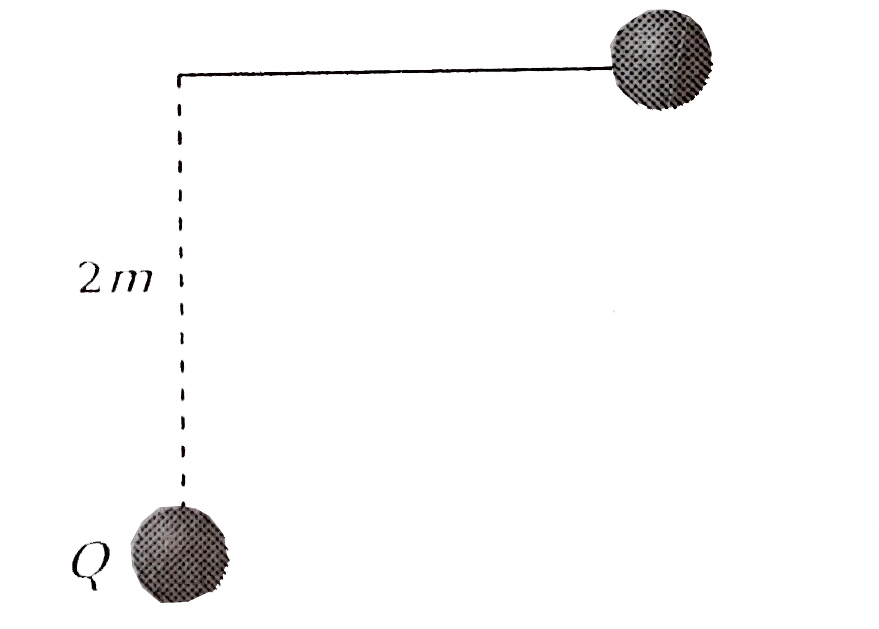
A pendulum of length 2 m lift at P . When it reaches Q , it losses 10% of its total energy due to air resistance. The velocity at Q is

A

`6 ms^(-1)`

B

`1 ms^(-1)`

C

`2 ms^(-1)`

D

`8 ms^(-1)`

Text Solution

Verified by Experts

The correct Answer is:

C

(c ) Gain in KE =Loss in PE
` implies " " (1)/(2)mv^(2)=(0.1)(mgh)`
`:. " " v=sqrt(0.2gh)=sqrt(0.2xx10xx2)=2 ms^(-1)`
Promotional Banner

Topper's Solved these Questions

  • WORK, ENERGY AND POWER

    DC PANDEY ENGLISH|Exercise CHECK POINT 6.3|10 Videos
  • WORK, ENERGY AND POWER

    DC PANDEY ENGLISH|Exercise EXERCISES(TAKING IT TOGETHER)|83 Videos
  • WORK, ENERGY AND POWER

    DC PANDEY ENGLISH|Exercise CHECK POINT 6.1|20 Videos
  • WORK, ENERGY & POWER

    DC PANDEY ENGLISH|Exercise Level 2 Comprehension Based|2 Videos
  • WORK, POWER AND ENERGY

    DC PANDEY ENGLISH|Exercise E Integer Type Questions|11 Videos

Similar Questions

Explore conceptually related problems

A simple pendulum of length 1 oscillates aboμt the mean position as shown in the figure. If the total energy of the pendulum is E, the velocity of the pendulum bob of mass m at point P is:

The bob of a pendulum is released from a horizontal position. If the length of pendulum is 2 m, what is the speed with which the bob arrives at the lower most point. Assume that 10% of its energy is dissipated against air resistance. (Take g = 10 m s^(-2) )

A satellite of mass m is orbiting the earth in a circular orbit of radius r . It starts losing energy due to small air resistance at the rate of C J//s . Then the time teken for the satellite to reach the earth is...........

A body of mass 10 kg moving at a height of 2 m, with uniform speed of 2 m/s. Its total energy is

A particle slides with a speed of 3m s^(-1) at P. When it reaches Q ,it acquires a speed of 4m s^(-1) after describing an angle of 60^(@) at O as shown in figure .Find the changes in the velocity of the particle between P and Q . Assume that the path followed by the particle is circular from P to Q

The bob A of a simple pendulum is released from a horizontal position A as shownin in figure. If the length of the pendulum is 1.5m , what is the speed with which the bob arrives at the lowermost point B, given that it dissipates 5% of its initial energy against air resistance ?

A ball falls under gravity from a height of 10 m with an initial downward velocity u. It collides with the ground, losses 50% of its energy in collision and then rises back to the same height. The initial velocity u is

Consider an elliptically shaped rail PQ in the vertical plane with OP = 3 m and OQ = 4 m. A block of mass 1 kg is pulled along the rail from P to Q with a force of 18 N, which is always parallel to line PQ (see the figure given). Assuming no frictional losses, the kinetic energy of the block when it reaches Q is: (n xx 10) joules. The value of n is (take acceleration due to gravity = 10 ms^(-2) ) https://haygot.s3.amazonaws.com/questions/113759.jpg

A wire of mass m length I, density d, and area of cross section A is stretched in such a way that is length increases by 10% of its original value, Expresss the changed resistance in percentage.

A pendulum of length 1 m hangs from an inclined wall. Suppose that this pendulum is released at an initial angle of 10^(@) and it bounces off the wall elastically when it reaches an angle of -5^(@) as shown in the figure. Take g = pi^(2) m//s^(2) . The period of this pendulum is (in second)

DC PANDEY ENGLISH-WORK, ENERGY AND POWER-CHECK POINT 6.2
  1. If the force acting on a body is inversely proportional to its speed, ...

    Text Solution

    |

  2. If the speed of a vehicle is increased by 1 ms^(-1), its kinetic energ...

    Text Solution

    |

  3. A running man has half the KE that a body of half his mass has. The ma...

    Text Solution

    |

  4. Two bodies of different masses m(1) and m(2) have equal momenta. Their...

    Text Solution

    |

  5. If the linear momentum is increased by 50%, then KE will be increased...

    Text Solution

    |

  6. The graph betwee sqrt(E) and (1)/(p) is (E=kinetic energy and p= momen...

    Text Solution

    |

  7. The KE acquired by a mass m in travelling a certain distance d, starti...

    Text Solution

    |

  8. Under the action of a force, a 2 kg body moves such that its position ...

    Text Solution

    |

  9. An object of mass 5 kg is acted upon by a force that varies with posit...

    Text Solution

    |

  10. A block of mass 20 kg is moving in x-direction with a constant speed o...

    Text Solution

    |

  11. Velocity-time graph of a particle of mass (2 kg) moving in a straight ...

    Text Solution

    |

  12. A particle of mass 0.01 kg travels along a space curve with velocity g...

    Text Solution

    |

  13. A mass of 1 kg is acted upon by a single force F=(4hati+4hatj)N. Under...

    Text Solution

    |

  14. A body of mass 5 kg is raised vertically to a height of 10 m by a forc...

    Text Solution

    |

  15. A body of mass 0.1 g moving with a velocity of 10 m/s hits a spring (f...

    Text Solution

    |

  16. A block of mass 2 kg is dropped from a height of 40 cm on a spring who...

    Text Solution

    |

  17. In which of the following cases the, potential energy is defined?

    Text Solution

    |

  18. The potential energy of a system increased if work is done

    Text Solution

    |

  19. A pendulum of length 2 m lift at P . When it reaches Q , it losses 10%...

    Text Solution

    |

  20. A body of mass m thrown vertically upwards attains a maximum height h....

    Text Solution

    |
