Home
Class 11
PHYSICS
Two identical springs of spring constant...

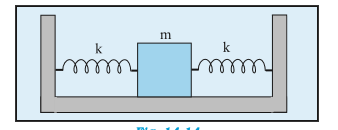
Two identical springs of spring constant k are attached to a block of mass m and to fixed supports as shown in Fig. 14.14. Show that when the mass is displaced from its equilibrium position on either side, it executes a simple harmonic motion. Find the period of oscillations.

Text Solution

Verified by Experts
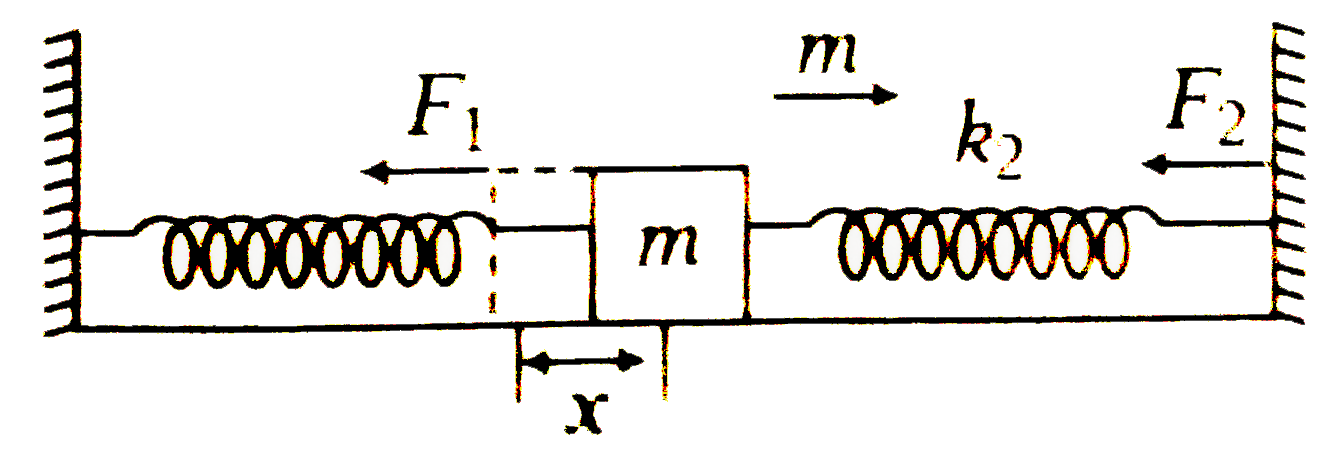
Let the mass displaced by a small distance x to the right side of the equilibrium position, as shown in the figure. Under this situation , the spring on the left side gets elongated by a length equal to x and that on the right side gets compressed by the same length . The forces acting on the mass are then, lt brgt
`F_(1)=-kx` (force exerted by the spring on the left side, trying to pull the mass towards the mean position)
`F_(2)=-kx` (force exerted by the spring on the right side , trying to push the mass towards the mean position)
The net force F acting on the mass is proportional to the displacement and is directed towards the mean position therefore, the motion executed by the mass is simple harmonic. The time period of oscillation is `T=2pisqrt((m)/(2k))`
Promotional Banner

Similar Questions

Explore conceptually related problems

Two identical springs of spring constant k are attached to a block of mass m and to fixed supports as shown in figure . Show that when the mass is displaced from its equilibrium position on either side, it executes a simple harmonic motion. Find the period of oscillation.

Two identical springs of spring constant k are attached to a block of mass m and to fixed supports as shown in the figure. The time period of oscillation is

Tow identical springs of spring constant k are attached to a block of mass m and to fixed supports as shown in figure. When the mass is displaced from equilibrum position by a distance x towards right, find the restoring force.

A block of mass m hangs from a vertical spring of spring constant k. If it is displaced from its equilibrium position, find the time period of oscillations.

A mass of 1.5 kg is connected to two identical springs each of force constant 300 Nm^(-1) as shown in the figure. If the mass is displaced from its equilibrium position by 10cm, then the period of oscillation is

Two blocks each of mass m are connected with springs each of force constant K as shown in fig. The mass A is displaced to the left & B to the right by the same amount and released then the time period of oscillation is -

A body of mass m is suspended from three springs as shown in figure. If mass m is displaced slightly then time period of oscillation is

Two springs, each of spring constant k , are attached to a block of mass m as shown in the figure. The block can slide smoothly alongs a horizontal platform clamped to the oppsite walls of the trolley of mass M . If the block is displaced by x cm and released, the period of oscillaion is :

A 100 g block is connected to a horizontal massless spring of force constant 25.6(N)/(m) As shown in Fig. the block is free to oscillate on a horizontal frictionless surface. The block is displaced 3 cm from the equilibrium position and , at t=0 , it is released from rest at x=0 It executes simple harmonic motion with the postive x-direction indecated in Fig. The position time (x-t) graph of motion of the block is as shown in Fig. Q. When the block is at position B on the graph its.

Spring of spring constant k is attached with a block of mass m_(1) , as shown in figure. Another block of mass m_(2) is placed angainst m_(1) , and both mass masses lie on smooth incline plane. Find the compression in the spring when lthe system is in equilibrium.

