Home
Class 11
PHYSICS
In case of a simple pendulum, time perio...

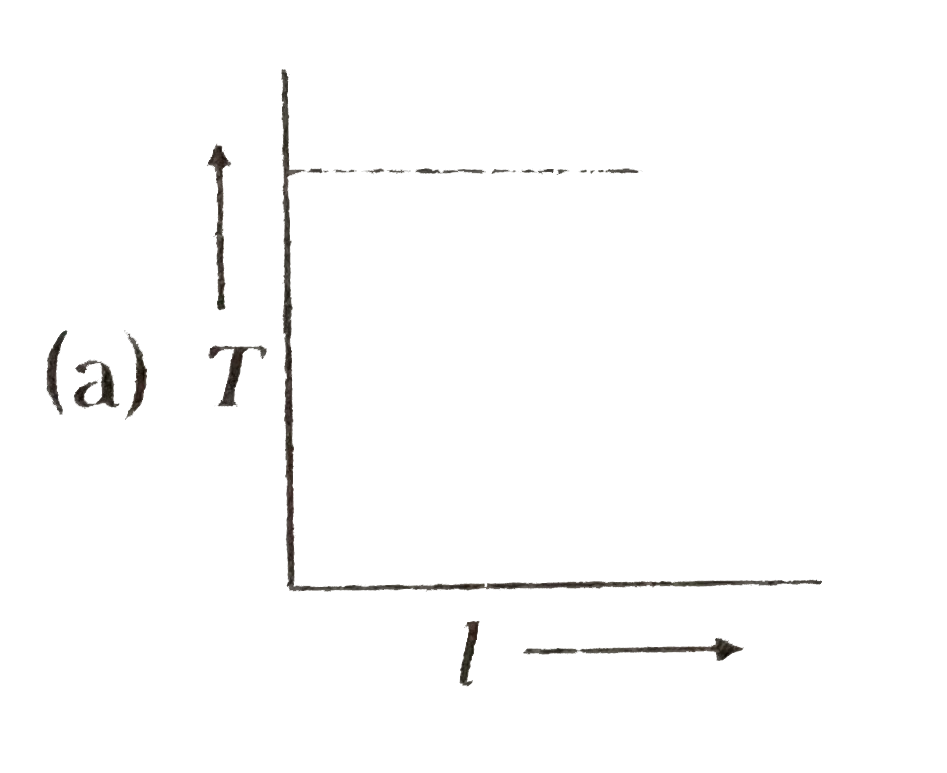
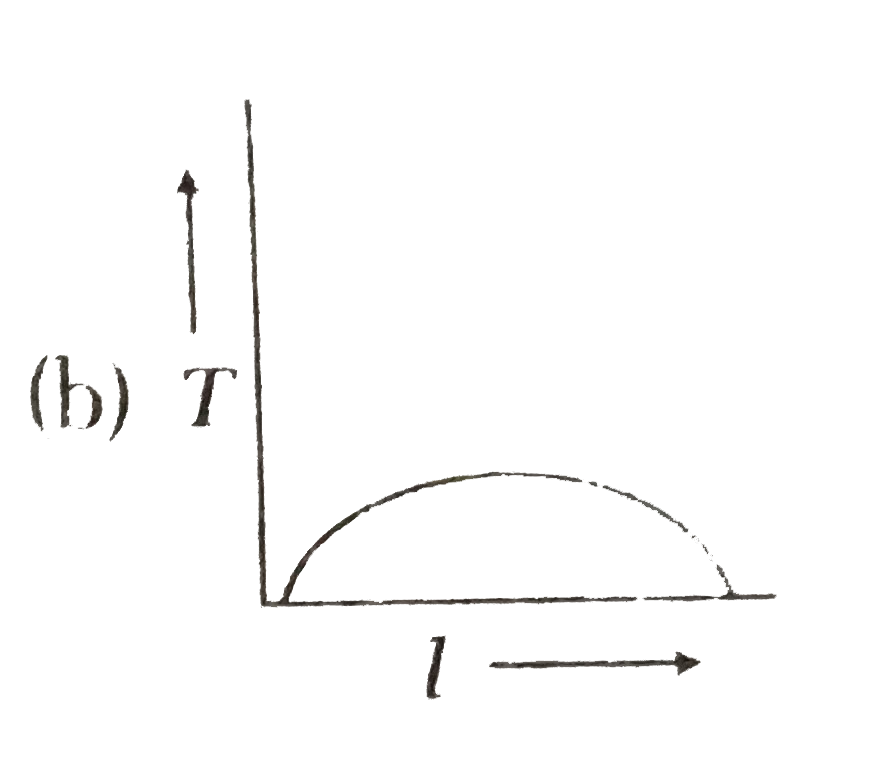
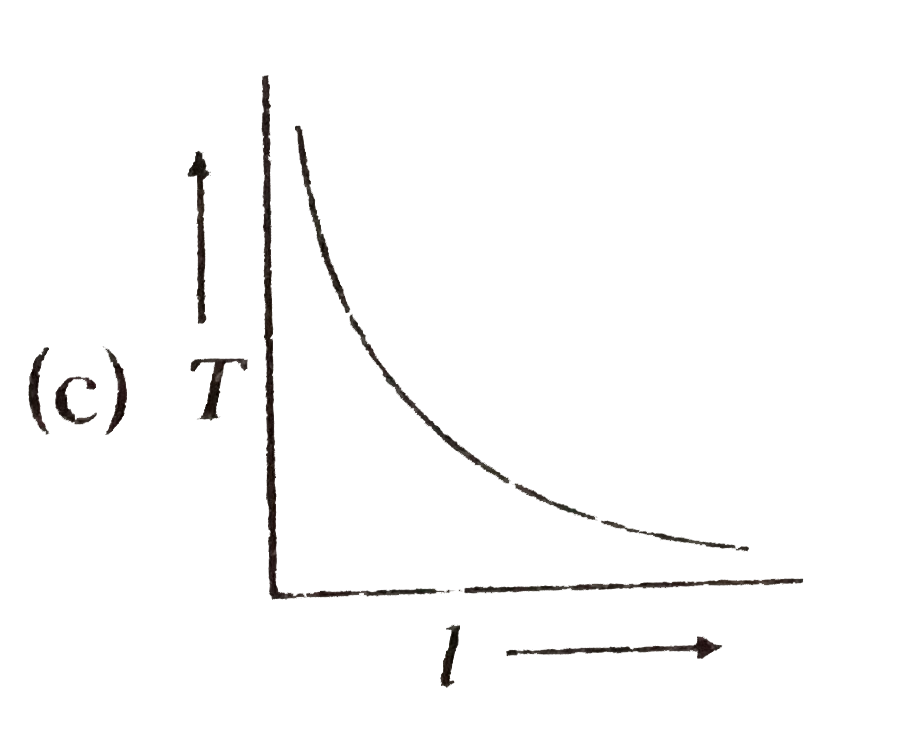
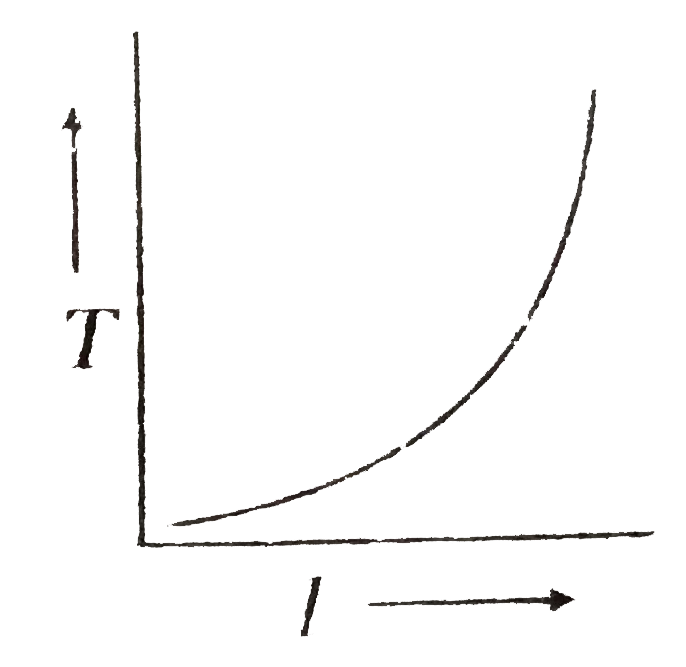
In case of a simple pendulum, time period versus length is depicted by

A

B

C

D

Text Solution

AI Generated Solution

The correct Answer is:

To find the relationship between the time period (T) and the length (L) of a simple pendulum, we start with the formula for the time period of a simple pendulum: \[ T = 2\pi \sqrt{\frac{L}{g}} \] Where: - \( T \) is the time period, - \( L \) is the length of the pendulum, - \( g \) is the acceleration due to gravity (approximately \( 9.8 \, \text{m/s}^2 \)). ### Step 1: Rearranging the Formula We can express the time period \( T \) in terms of \( L \): \[ T = 2\pi \sqrt{\frac{L}{g}} \] ### Step 2: Identifying Variables In this equation: - \( T \) is the dependent variable (y-axis), - \( L \) is the independent variable (x-axis). ### Step 3: Expressing T in Terms of L We can rewrite the equation to highlight the relationship between \( T \) and \( L \): \[ T = 2\pi \cdot \frac{1}{\sqrt{g}} \cdot \sqrt{L} \] ### Step 4: Identifying the Form of the Equation This equation can be expressed in the form of \( y = mx^{1/2} \), where: - \( y = T \), - \( x = L \), - \( m = 2\pi \cdot \frac{1}{\sqrt{g}} \). ### Step 5: Squaring Both Sides To find a linear relationship, we can square both sides: \[ T^2 = \left(2\pi \cdot \frac{1}{\sqrt{g}}\right)^2 \cdot L \] This gives us: \[ T^2 = \frac{4\pi^2}{g} \cdot L \] ### Step 6: Identifying the Graph This equation \( T^2 = kL \) (where \( k = \frac{4\pi^2}{g} \)) is a linear equation in terms of \( T^2 \) and \( L \). However, if we plot \( T \) versus \( L \), it will yield a parabolic shape because \( T \) is proportional to the square root of \( L \). ### Conclusion Thus, the graph of the time period \( T \) versus the length \( L \) of a simple pendulum is a parabola opening upwards in the first quadrant. The correct answer is option B, which depicts a parabolic relationship. ---

To find the relationship between the time period (T) and the length (L) of a simple pendulum, we start with the formula for the time period of a simple pendulum: \[ T = 2\pi \sqrt{\frac{L}{g}} \] Where: - \( T \) is the time period, - \( L \) is the length of the pendulum, - \( g \) is the acceleration due to gravity (approximately \( 9.8 \, \text{m/s}^2 \)). ...
Promotional Banner

Similar Questions

Explore conceptually related problems

The time period of oscillations of a simple pendulum is 1 minute. If its length is increased b 44% then its new time period of oscillation will be

The time period of a simple pendulum is 2s. If its length is increased by 4 times, then its period becomes (a) 16s (b) 12s (c) 8s (d) 4s

The time period of oscillation of a simple pendulum is sqrt(2)s . If its length is decreased to half of initial length, then its new period is

State how does the time period of a simple pendulum depend on length of pendulum.

How would the time period of a simple pendulum be affected if (a) the length is doubled (b) the amplitude is doubled ?

What is the period of a simple pendulum whose length is 50 cm?

The time period of a simple pendulum of length 9.8 m is

In a simple pendulum the period of oscillation (T) is related to the length of the pendulum (L) as

A simple pendulum of length L has a period T. If length is changed by Delta L , the change in period Delta T is proportional to

In an experiment of simple pendulum, the errors in the measurement of length of the pendulum (L) and time period (T) are 3% and 2% respectively. The maximum percentage error in the value of L//T^(2) is
