Home
Class 11
PHYSICS
A particle of mass 2 kg moves in simple ...

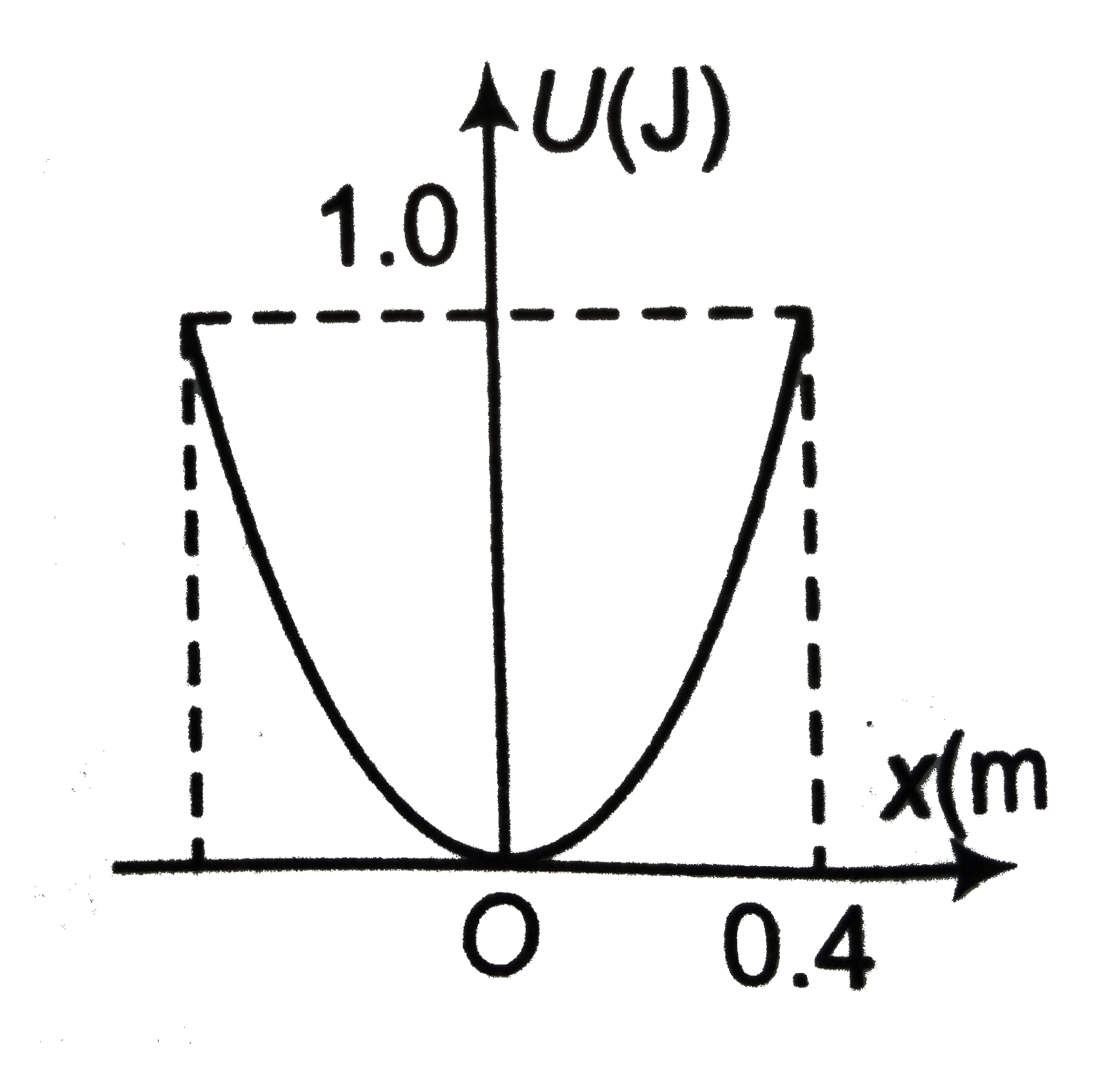
A particle of mass `2 kg` moves in simple harmonic motion and its potential energy `U` varies with position `x` as shown. The period of oscillation of the particle is

A

`(2pi)/(5)` s

B

`(2sqrt(2)pi)/(5) s`

C

`(sqrt(2)pi)/(5)` s

D

`(4pi)/(5)` s

Text Solution

Verified by Experts

The correct Answer is:

D

(d) `(1)/(2)kA^(2)=1J`
`therefore k=(2)/(A^(2))=(2)/((0.4)^(2))=(25)/(2) Nm^(-1)`
`T=2pisqrt((m)/(k))=2pisqrt((2)/((25//2)))=(4pi)/(5)s`
Promotional Banner

Similar Questions

Explore conceptually related problems

A particle of mass = 2kg moves in simple harmonic motion and its potential energy U varies with position x as shown. The period of oscillation of the particle is (npi)/5 second. Find value of n.

A particle of mass 4kg moves simple harmonically such that its PE (U) varies with position x, as shown. The period of oscillations is :-

In simple harmonic motion,the particle is

The variation of force (F) acting on a particle of mass 800 g with position (x) is as shown in figure. The time period of oscillation of the particles is

A particle is executing simple harmonic motion. Its total energy is proportional to its

When a particle oscillates in simple harmonic motion, both in potential energy and kinetic energy vary sinusoidally with time. If v be the frequency of the motion of the particle, the frequency associated with the kinetic energy is :

A particle of mass m moves in the potential energy U shoen above. The period of the motion when the particle has total energy E is

A particle of mass 3 kg , attached to a spring with force constant 48Nm^(-1) execute simple harmonic motion on a frictionless horizontal surface. The time period of oscillation of the particle, is seconds , is

A particle of mass 4 kg moves along x axis, potential energy ( U ) varies with respect to x as U = 20 + ( x-4)^(2) , maximum speed of paritcle is at

The displacement of a particle executing simple harmonic motion is given by y = 4 sin(2t + phi) . The period of oscillation is
