Home
Class 11
PHYSICS
A body of mass 0.01 kg executes simple h...

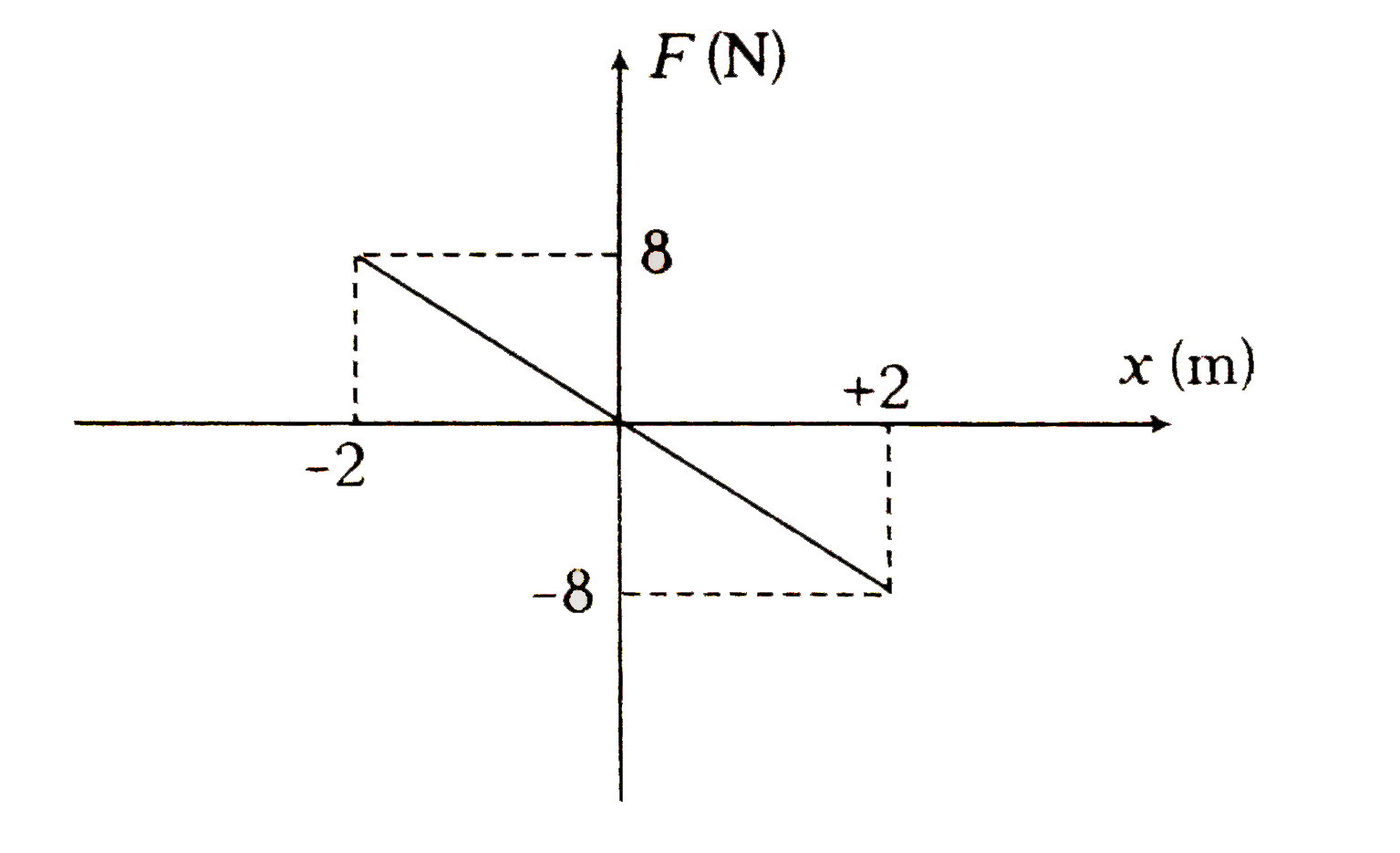
A body of mass 0.01 kg executes simple harmonic motion (SHM) about x=0 under the influence of a force shown in the figure. The period of the SHM is

A

1.05 s

B

0.52 s

C

0.25 s

D

0.31 s

Text Solution

Verified by Experts

The correct Answer is:

D

(d) From graph, slope `K=(F)/(x)=(8)/(2)=4`
`T=2pisqrt((m)/(k))impliesT=2pisqrt((0.01)/(4))=0.31s `
Promotional Banner

Similar Questions

Explore conceptually related problems

A body of mass 0.01 kg executes simple harmonic motion about x = 0 under the influence of a force as shown in figure. The time period of SHM is

A block of mass 5 kg executes simple harmonic motion under the restoring force of a spring. The amplitude and the time period of the motion are 0.1 m and 3.14 s respectively. Find the maximum force exerted by the spring on the block.

A body executes simple harmonic motion under the action of a force F_1 with a time period (4)/(5)s . If the force is changed to F_(2) , it executes SHM with time period (3)/(5)s . If both the forces F_(1) and F_(2) act simultaneously in the same direction on the body, its time period (in seconds) is

A particle of mass 0.50 kg executes a simple harmonic motion under a force F=-(50Nm^-1)x . If it crosses the centre of oscillation with a speed of 10ms^-1 , find the amplitude of the motion.

A particle of mass 40 g executes a simple harmonic motion of amplitude 2.0 cm. If the time period is 0.20 s, find the total mechanical energy of the system.

A particle of mass 40 g executes a simple harmonic motion of amplitude 2.0 cm. If the time period is 0.20 s, find the total mechanical energy of the system.

A particle executes simple harmonic motion under the restoring force provided by a spring. The time period is T. If the spring is divided in two equal parts and one part is used to continue the simple harmonic motion, the time period will

A partical of mass 0.2 kg executes simple harmonic motion along a path of length 0.2 m at the rate of 600 oscillations per minute. Assum at t = 0 . The partical start SHM in positive direction. Find the kinetic potential energies in joules when the displacement is x = A//2 where, A stands for the amplitude.

A particle of mass 2 kg moves in simple harmonic motion and its potential energy U varies with position x as shown. The period of oscillation of the particle is

A particle of mass 2 kg moves in simple harmonic motion and its potential energy U varies with position x as shown. The period of oscillation of the particle is
