Home
Class 11
PHYSICS
A mass M=5 kg is attached to a string as...

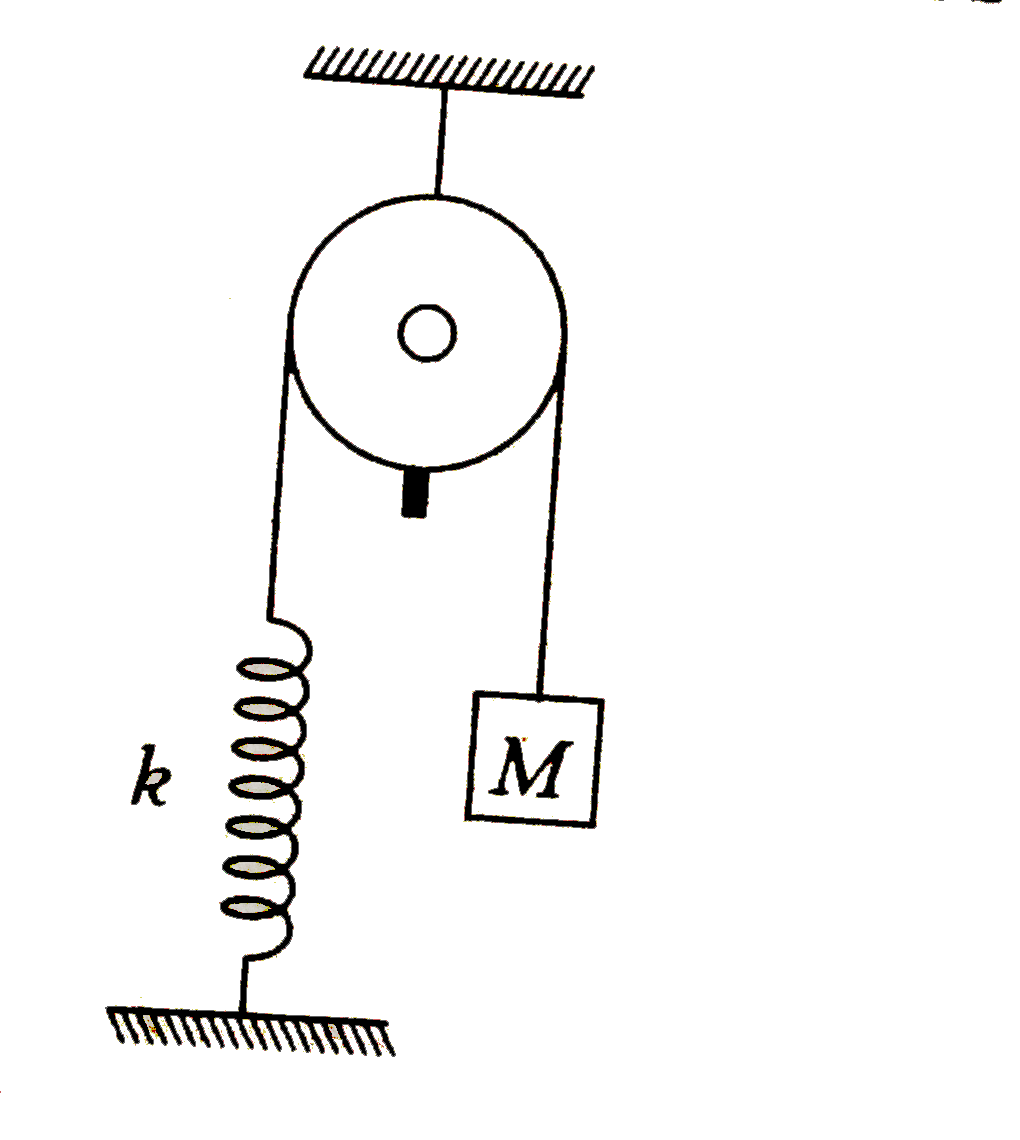
A mass M=5 kg is attached to a string as shown in the figure and held in position so that the spring remains unstretched. The spring constant is `200 Nm^(-1)` . The mass M is then released and begins to undergo small oscillations. The amplitude of oscillation is

A

0.5 m

B

0.25 m

C

0.2 m

D

0.1 m

Text Solution

Verified by Experts

The correct Answer is:

B

(b) Amplitude of oscillation , `A=(mg)/(k)=(5 xx 10)/(200)=0.25 m`
Promotional Banner

Similar Questions

Explore conceptually related problems

A mass m = 8kg is attached to a spring as shown in figure and held in positioin so that the spring remains unstretched. The spring constant is 200 N/m. The mass m is then released and begins to undergo small oscillations. The maximum velocity of the mass will be (g=10m/ s^(2))

Two masses 8 kg 4 kg are suspended together by a massless spring of spring constant 1000 Nm^(-1) . When the masses are in equilibrium 8 kg is removed without disturbing the system . The amplitude of oscillation is

Find the time period of oscillation of block of mass m. Spring, and pulley are ideal. Spring constant is k.

Two masses m and 2m are attached to two ends of an ideal spring as shown in figure. When the spring is in the compressed state, the energy of the spring is 60 J, if the spring is released, then at its natural length

A block of mass 0.01 kg is attached to a spring of force constant 10^(-1)Nm^(-1) . If the energy of oscillation is 10^(-5) J, find the angular frequency and amplitude of oscillation.

A block of mass m is attached to one end of a light inextensible string passing over a smooth light pulley B and under another smooth light pulley A as shown in the figure. The other end of the string is fixed to a ceiling. A and B are held by spring of spring constants k_(1) and k_(2) . Find angular frequency of small oscillations of small oscillations of the system.

A light pulley is suspended at the lower end of a spring of constant k_(1) , as shown in figure. An inextensible string passes over the pulley. At one end of string a mass m is suspended, the other end of the string is attached to another spring of constant k_(2) . The other ends of both the springs are attached to rigid supports, as shown. Neglecting masses of springs and any friction, find the time period of small oscillations of mass m about equilibrium position.

Figure a) shows a spring of force constant k clamped rigidly at once end and a mass m attached to its free end. A force F applied at the free end stretches the spring. Figure b) shows the same spring with both ends free and attached to a mass m at either end. Each end of the spring in figure is stretched by the same force F. (a) What is the maximum extension of the spring in the two cases ? (b) If the mass in figure and the two masses in figure are released free, what is the period of oscillation in each case?

Figure a) shows a spring of force constant k clamped rigidly at once end and a mass m attached to its free end. A force F applied at the free end stretches the spring. Figure b) shows the same spring with both ends free and attached to a mass m at either end. Each end of the spring in figure is stretched by the same force F. (a) What is the maximum extension of the spring in the two cases ? (b) If the mass in figure and the two masses in figure are released free, what is the period of oscillation in each case?

A body of mass m is attached ot one end of a massless spring which is suspended vertically form a fixed point. The mass is held in hand, so that the spring is neither stretched nor compressed. The lowest position attained by the mass during oscillation is 4 cm below the point, where it was held in hand. (a) What is the amplitude of oscillation? (b) Find the frequency of oscillation?
