Home
Class 11
PHYSICS
A particle of mass m oscillates with sim...

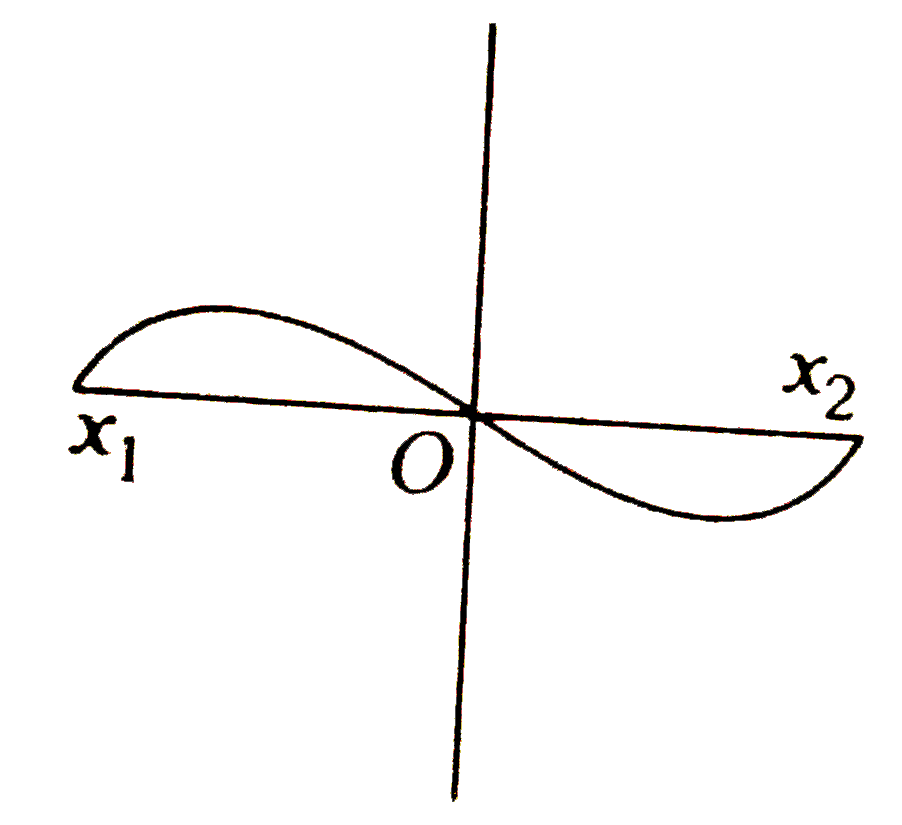
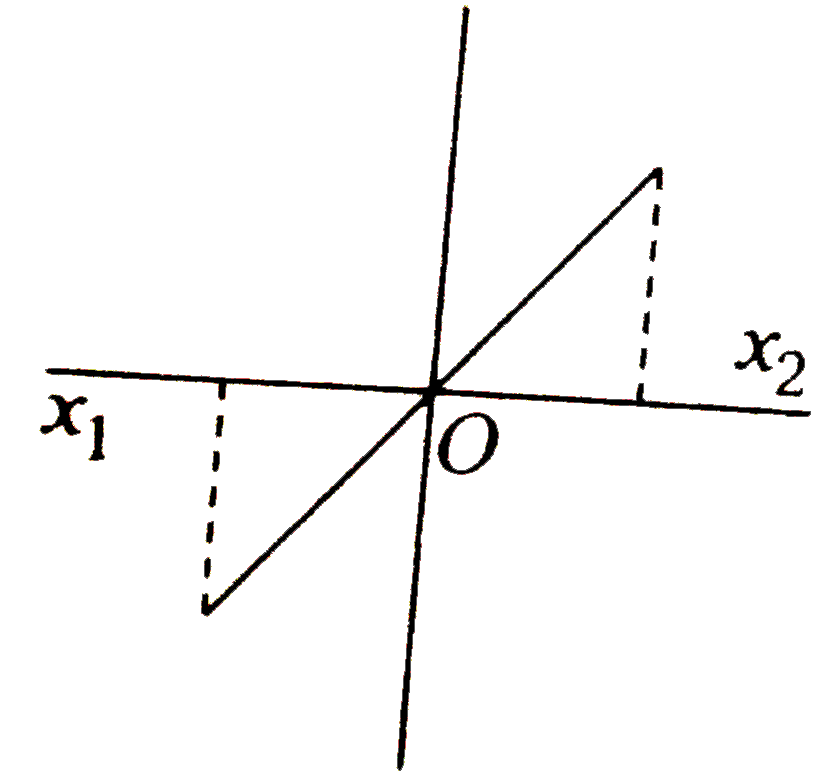
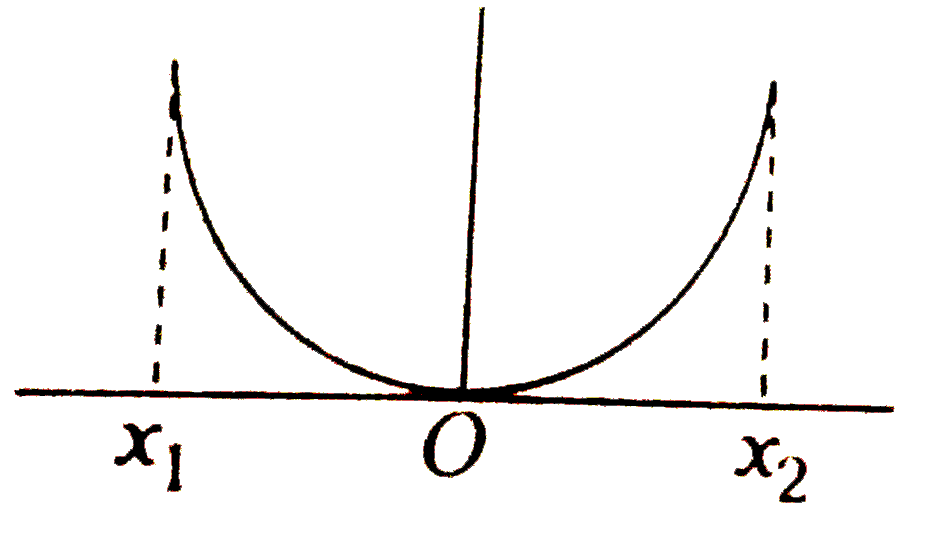
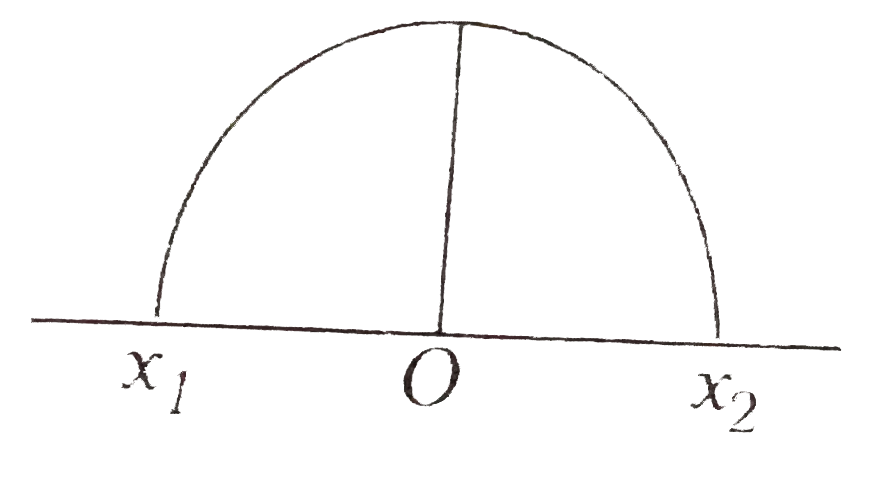
A particle of mass m oscillates with simple harmonic motion between points `x_(1)` and `x_(2)`, the equilibrium position being O. Its potential energy is plotted. It will be as given below in the graph

A

B

C

D

Text Solution

AI Generated Solution

The correct Answer is:

To solve the problem of determining the correct graph for the potential energy of a particle oscillating in simple harmonic motion (SHM) between points \( x_1 \) and \( x_2 \) with the equilibrium position at \( O \), we can follow these steps: ### Step 1: Understand the Potential Energy in SHM The potential energy \( U \) of a particle in simple harmonic motion is given by the formula: \[ U = \frac{1}{2} m \omega^2 x^2 \] where: - \( m \) is the mass of the particle, - \( \omega \) is the angular frequency, - \( x \) is the displacement from the equilibrium position. ### Step 2: Analyze the Formula From the formula, we can observe that: - The potential energy \( U \) is proportional to the square of the displacement \( x \). - This means that as \( x \) increases (either positively or negatively), the potential energy increases. ### Step 3: Identify the Shape of the Graph Since \( U \) is proportional to \( x^2 \), the graph of potential energy versus displacement will be a parabola that opens upwards. The vertex of this parabola will be at the equilibrium position \( O \) (where \( x = 0 \)), and the potential energy at this point will be zero. ### Step 4: Determine the Characteristics of the Graph - At the equilibrium position \( O \) (i.e., \( x = 0 \)), the potential energy \( U \) is zero. - As the particle moves towards \( x_1 \) and \( x_2 \), the potential energy will increase, reflecting the quadratic relationship. ### Step 5: Evaluate the Given Options Based on the characteristics of the potential energy graph: - The correct graph should show a parabola opening upwards with the lowest point (minimum potential energy) at the equilibrium position \( O \). - The potential energy should be zero at \( x = 0 \) and increase as \( x \) moves away from zero in either direction. ### Conclusion After analyzing the options provided in the question, the graph that matches the described characteristics (a parabola opening upwards with the vertex at the equilibrium position) is the correct answer. ### Final Answer The correct option is **Option 3**, which represents the potential energy of the particle in simple harmonic motion. ---

To solve the problem of determining the correct graph for the potential energy of a particle oscillating in simple harmonic motion (SHM) between points \( x_1 \) and \( x_2 \) with the equilibrium position at \( O \), we can follow these steps: ### Step 1: Understand the Potential Energy in SHM The potential energy \( U \) of a particle in simple harmonic motion is given by the formula: \[ U = \frac{1}{2} m \omega^2 x^2 \] where: ...
Promotional Banner

Similar Questions

Explore conceptually related problems

A particle oscillates simple harmonic motion with a period of 16 s . Two second after crossing the equilibrium position its velocity becomes 1 m//s . The amplitude is

A particle is vibrating in a simple harmonic motion with an amplitude of 4 cm . At what displacement from the equilibrium position, is its energy half potential and half kinetic

A particle executes simple harmonic motion with an amplitude of 10 cm. At what distance from the mean position are the kinetic and potential energies equal?

A particle starts oscillating simple harmonically from its equilibrium position then, the ratio of kinetic energy and potential energy of the particle at the time T//12 is: (T="time period")

A particle executing harmonic motion is having velocities v_1 and v_2 at distances is x_1 and x_2 from the equilibrium position. The amplitude of the motion is

A particle of mass 2 kg moves in simple harmonic motion and its potential energy U varies with position x as shown. The period of oscillation of the particle is

A particle of mass 2 kg moves in simple harmonic motion and its potential energy U varies with position x as shown. The period of oscillation of the particle is

The total energy of a particle, executing simple harmonic motion is. where x is the displacement from the mean position, hence total energy is independent of x.

A particle of mass = 2kg moves in simple harmonic motion and its potential energy U varies with position x as shown. The period of oscillation of the particle is (npi)/5 second. Find value of n.

A particle of mass 4kg moves simple harmonically such that its PE (U) varies with position x, as shown. The period of oscillations is :-
