Home
Class 11
PHYSICS
In the figure, the block of mass m, atta...

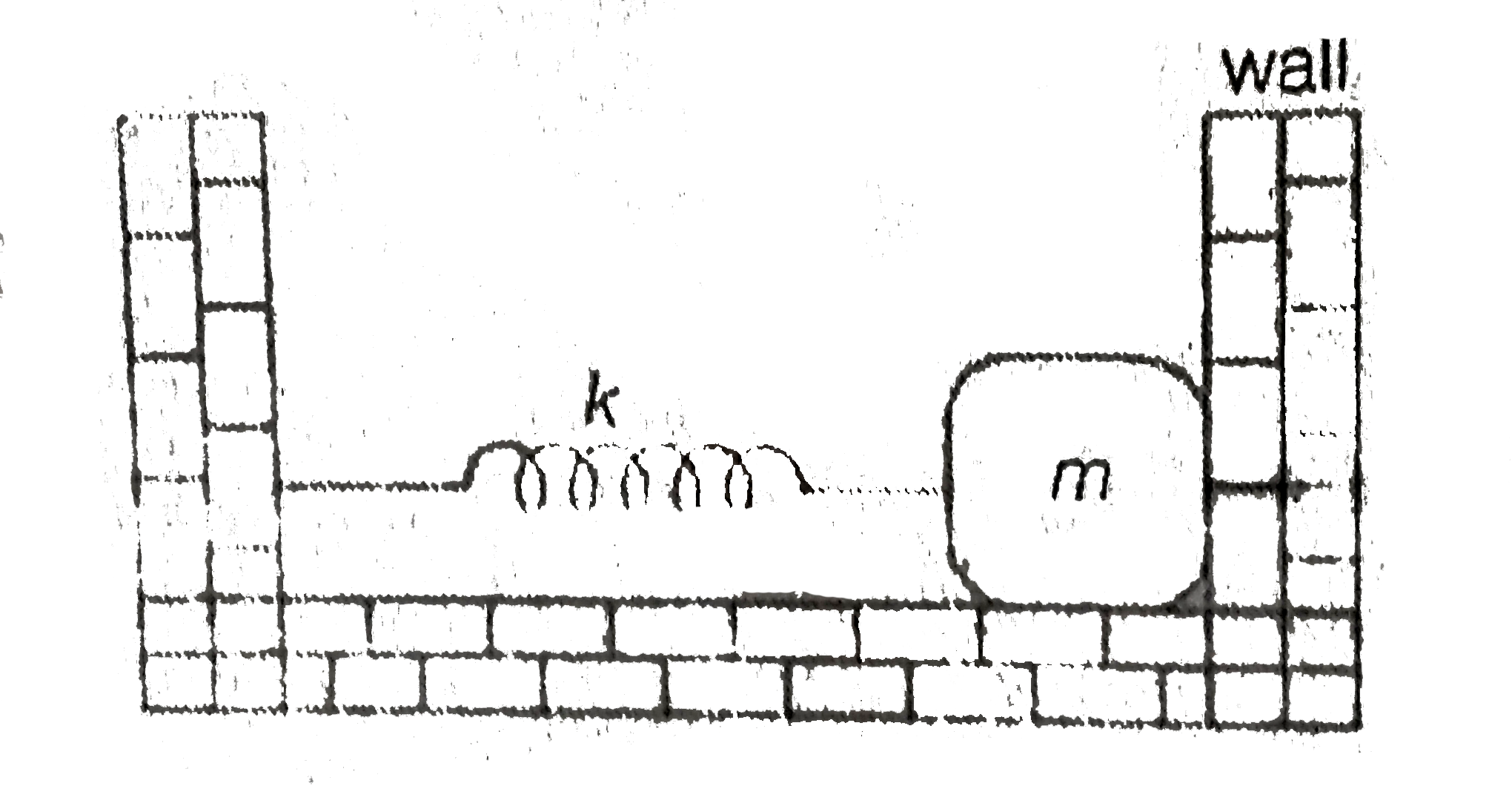
In the figure, the block of mass m, attached to the spring of stiffness k is in correct with the completely elastic wall, and the compression in the spring is e. The spring is compressed further by e by displacing the block towards left and is then released. If the collision between the block and the wall is completely eleastic then the time period of oscillation of the block will be

A

`(2pi)/(3)sqrt((m)/(k))`

B

`2pisqrt((m)/(k))`

C

`(pi)/(3)sqrt((m)/(k))`

D

`(pi)/(6)sqrt((m)/(k))`

Text Solution

Verified by Experts

The correct Answer is:

A

(a) From e to `2e` or `(A)/(2)` to A, `t=(T)/(6)`
`therefore` Time period of oscillation `=2t=(T)/(3)=(2pi)/(3)sqrt((m)/(k))`
Promotional Banner

Similar Questions

Explore conceptually related problems

A block of mass 100 g attached to a spring of stiffness 100 N//m is lying on a frictionless floor as shown. The block is moved to compress the spring by 10 cm and released. If the collision with the wall is elastic then find the time period of oscillations.

Find the elastic potential energy stored in each spring shown in figure, when the block is in equilibrium. Also find the time period of vertical oscillation of the block.

The block of mass m is released when the spring was in its natrual length. Spring constant is k. Find the maximum elongation of the spring.

Figure shown a block P of mass m resting on a smooth horizontal surface, attached to a spring of force constant k which is rigidly fixed on the wall on left side, shown in the figure . At a distance l to the right of the block there is a rigid wall. If block is pushed towards left so that spring is compressed by a distance 5l//3 and when released, if will starts its oscillations. If collision of block with the wall is considered to be perfectly elastic. Find the time period of oscillation of the block.

In the figure, a block of mass m is rigidly attached to two identical springs of stiffness k each. The other ends of the springs are connected to the fixed wall. When the block is in equilibrium, length of each spring is b, which is greater than the natural length of the spring. The time period of the oscillation of the block if it is displaced by small distance perpendicular to the length of the springs and released. Space is gravity free.

A block of mass m hangs from three springs having same spring constant k. If the mass is slightly displaced downwards, the time period of oscillation will be

A block of mass m is suddenly released from the top of a spring of stiffness constant k. a. Find the acceleration of block just after release. b. What is the compression in the spring at equilibrium. c. What is the maximum compression in the spring. d. Find the acceleration of block at maximum compression in the spring.

Assertion: A block of small mass m attached to a stiff spring will have large oscillation frequency. Reason: Stiff springs have high value of spring constant.

A block of mass 0.9 kg attached to a spring of force constant k is lying on a frictionless floor. The spring is compressed to sqrt(2) cm and the block is at a distance 1//sqrt(2) cm from the wall as shown in the figure. When the block is released, it makes elastic collision with the wall and its period of motion is 0.2 sec . Find the approximate value of k

The spring is compressed by a distance a and released. The block again comes to rest when the spring is elongated by a distance b . During this
