Home
Class 11
PHYSICS
A mass M is attached to a horizontal spr...

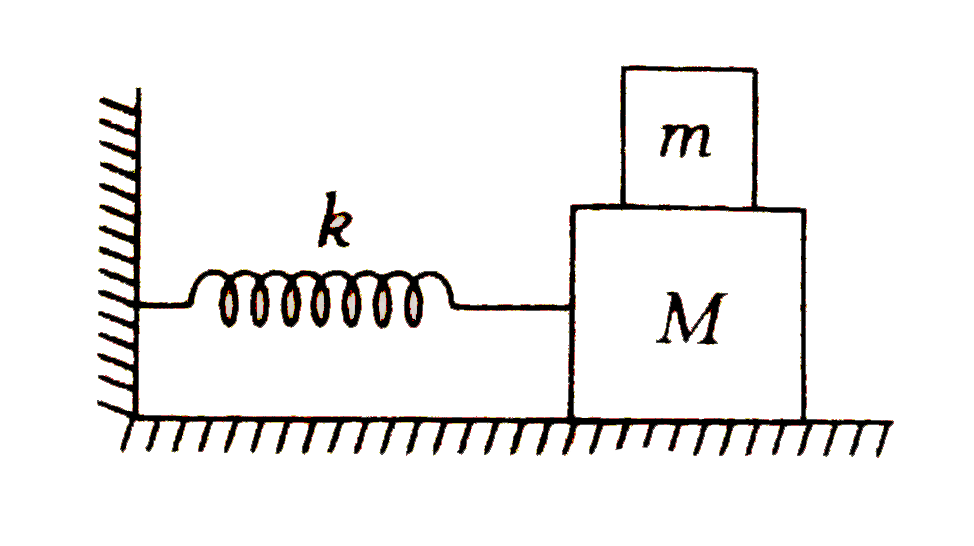
A mass M is attached to a horizontal spring of force constant k fixed one side to a rigid support as shown in figure. The mass oscillates on a frictionless surface with time period T and amplitude A. When the mass M is in equilibrium position, another mass m is gently placed on it. When will be the new amplitude of ocillation?

A

`sqrt(((M+m))/(M))A`

B

`sqrt(((M-m))/(M))A`

C

`sqrt((M)/((M+m)))A`

D

`sqrt((M)/((M-m)))A`

Text Solution

Verified by Experts

The correct Answer is:

C

(c) `(P_(i)=P_(f))`
Law of conservation of momentum
`Mv_("max")=(m+M)v`
`impliesv_("max")=(Mv_("max"))/((m+M))`
`because v_("max")=A'omega'`
`implies (M.A)/((m+M))sqrt((k)/(M))=A'sqrt((k)/((m+M)))`
`implies A'=Asqrt((M)/((m+M)))`
Promotional Banner

Similar Questions

Explore conceptually related problems

Two identical springs of spring constant k are attached to a block of mass m and to fixed supports as shown in the figure. The time period of oscillation is

The mass M shown in figure ocillates in simple harmonic motion with amplitude A. The amplitude of the point P is

A 2kg mass is attached to a spring of force constant 600 N//m and rests on a smooth horizontal surface. A second mass of 1kg slides along the surface toward the first at 6m//s . (a) Find the amplitude of oscillation if the masses make a perfectly inelastic collision and remain together on the spring. what is the period of oscillation ? (b) Find the amplitude and period of oscillation if the collision is perfectly elastic. ( c) For each case , write down the position x as a function of time t for the mass attached to the spring, assuming that the collision occurs at time t = 0 . What is the impulse given to the 2kg mass in each case ?

A block of mass 0.2 kg is attached to a mass less spring of force constant 80 N/m as shown in figure. Find the period of oscillation. Take g=10 m//s^(2) . Neglect friction

A block of mass 0.2 kg is attached to a mass less spring of force constant 80 N/m as shown in figure. Find the period of oscillation. Take g=10 m//s^(2) . Neglect friction

A mass m is suspended from a spring of force constant k and just touches another identical spring fixed to the floor as shown in the fig. The time period of small oscillations is

A block of mass m is suspended by different springs of force constant shown in figure.

A block with mass M attached to a horizontal spring with force constant k is moving with simple harmonic motion having amplitude A_(1) . At the instant when the block passes through its equilibrium position a lump of putty with mass m is dropped vertically on the block from a very small height and sticks to it. (a) Find the new amplitude and period. (b) Repeat part (a) for the case in which the putty is dropped on the block when it is at one end of its path.

A block with mass M attached to a horizontal spring with force constant k is moving with simple harmonic motion having amplitude A_(1) . At the instant when the block passes through its equilibrium position a lump of putty with mass m is dropped vertically on the block from a very small height and sticks to it. (a) Find the new amplitude and period. (b) Repeat part (a) for the case in which the putty is dropped on the block when it is at one end of its path.

Find the time period of mass M when displaced from its equilibrium position and then released for the system shown in figure.
