Home
Class 11
PHYSICS
Four pendulums A, B, C and D are suspend...

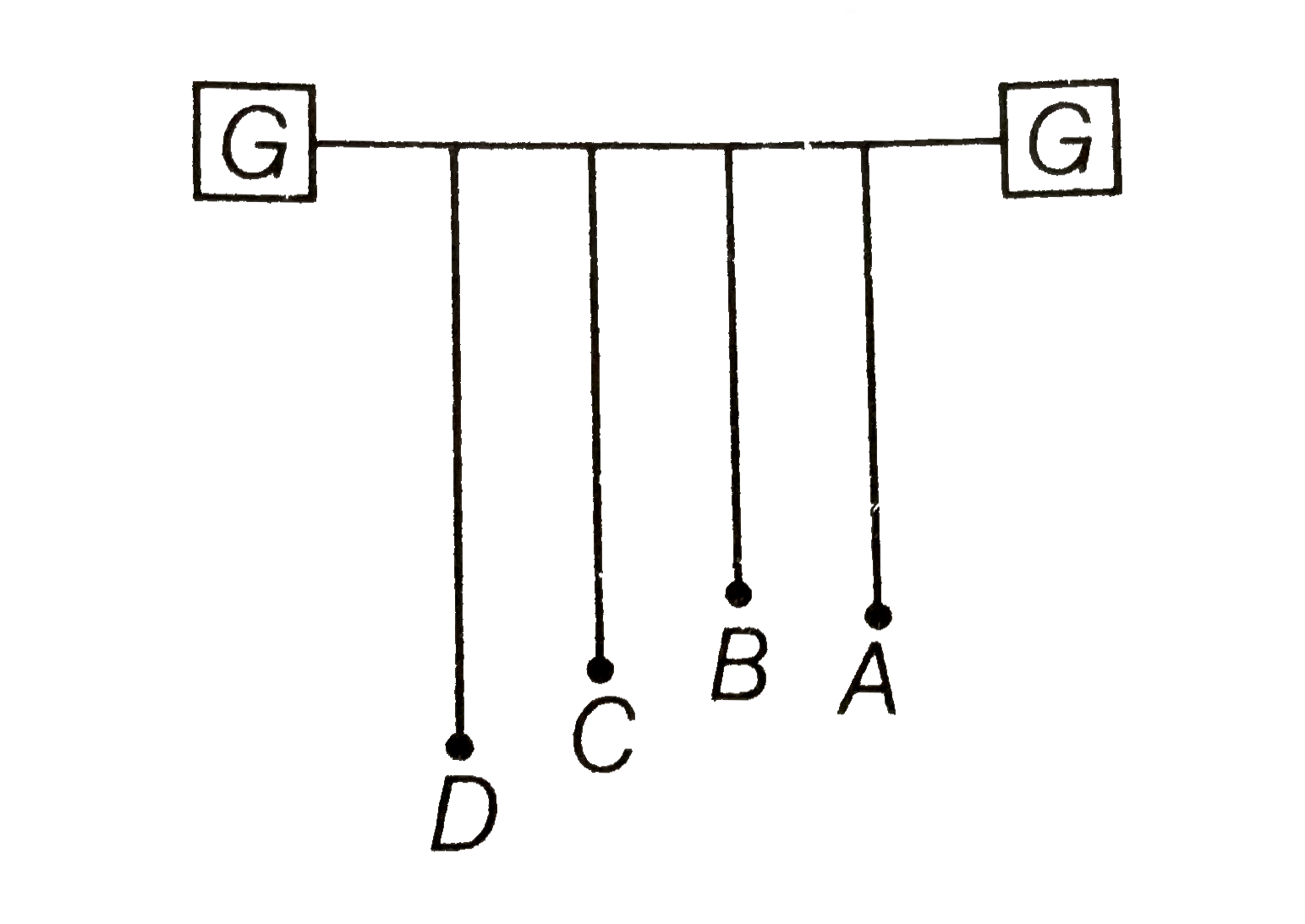
Four pendulums A, B, C and D are suspended from the same

elastic support as shown in figure. A and C are of the same length, while B is smaller than A and D is larger than A. If A is given a transverse displacement,

A

D will vibrate with maximum amplitude

B

C will vibrate with maximum amplitude

C

B will vibrate with maximum amplitude

D

All the four will oscillate with equal amplitude

Text Solution

Verified by Experts

The correct Answer is:
B

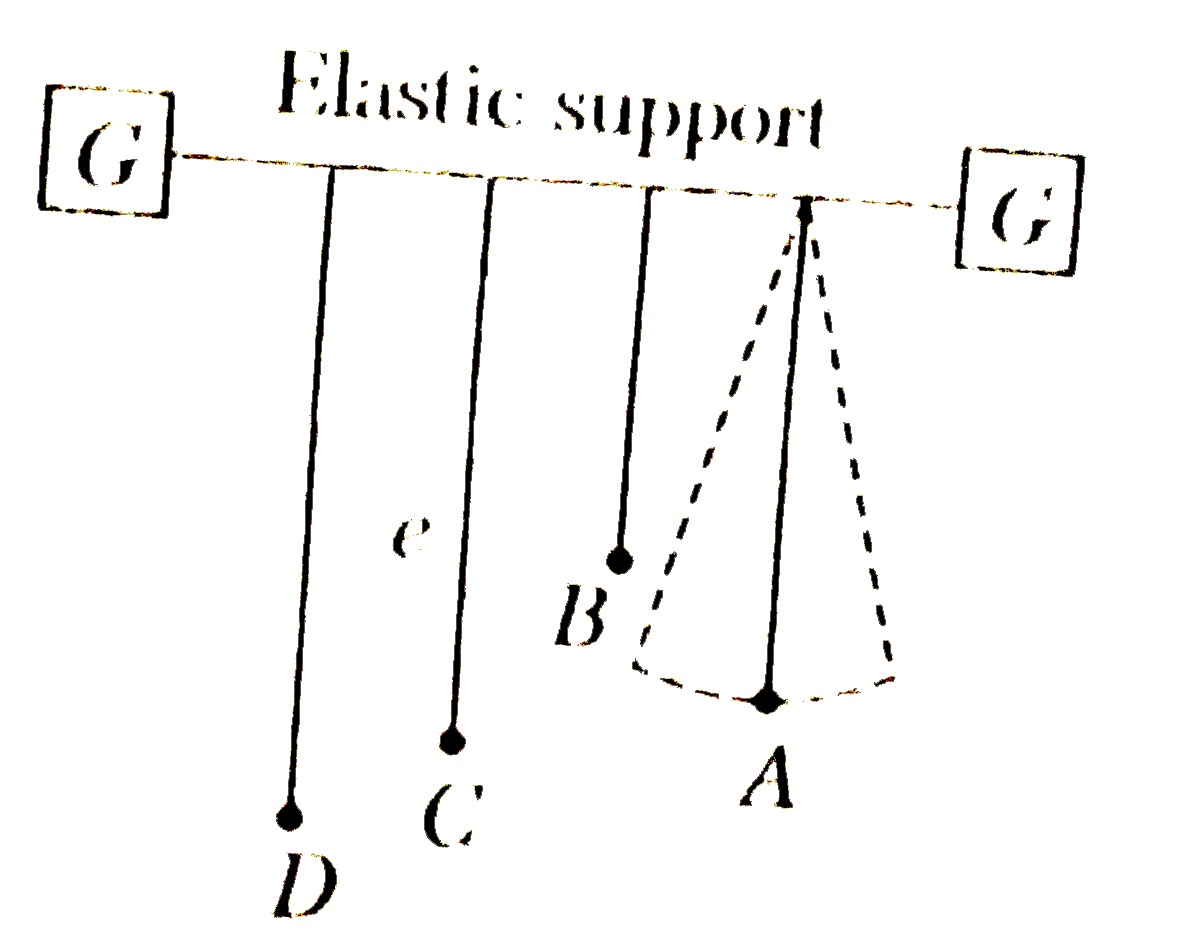
(b) According to the question , A is given a transverse displacment
Through the elastic support the disturbance is transferred to all the pendulums.

A and C are having same length, hence they will be in resonance, because their time period of oscillation.
`T=2pisqrt((l)/(g))` and hence, frequency is same.
So, amplitude of A and C will be maximum.
Note In this problem we have assumed that the support is perfectly elastic and there is no damping.Hence, oscillation is considered as undamped.
Promotional Banner

Similar Questions

Explore conceptually related problems

In the diagram below, A, B, C, D are four pendulums suspended from the same elastic string PQ. The length of A and Care equal to each other while the length of pendulum B is smaller than that of D. Pendulum A is set into a mode of vibrations. State the reason for the type of vibrations in pendulums B and C.

In the diagram below, A, B, C, D are four pendulums suspended from the same elastic string PQ. The length of A and Care equal to each other while the length of pendulum B is smaller than that of D. Pendulum A is set into a mode of vibrations. Name the type of vibrations taking place in pendulums B and D?

In the diagram below, A, B, C, D are four pendulums suspended from the same elastic string PQ. The length of A and Care equal to each other while the length of pendulum B is smaller than that of D. Pendulum A is set into a mode of vibrations. What is the state of pendulum C?

Two pendulums C and D are suspended from a wire as shown in the figure given below. Pendulum C is made to oscillate by displacing it from its mean position. It is seen that D also starts oscillating. If the length of D is made equal to C then what difference will you notice in the oscillations of D?

Two pendulums C and D are suspended from a wire as shown in the figure given below. Pendulum C is made to oscillate by displacing it from its mean position. It is seen that D also starts oscillating. What is the name of the phenomenon when the length of D is made equal to C ?

Two pendulums C and D are suspended from a wire as shown in the figure given below. Pendulum C is made to oscillate by displacing it from its mean position. It is seen that D also starts oscillating. Name the type of oscillation, D will execute.

Two pendulums C and D are suspended from a wire as shown in the figure given below. Pendulum C is made to oscillate by displacing it from its mean position. It is seen that D also starts oscillating. Name the type of oscillation, C will execute.

Identify the animals shown in the given figures A , B, C and D from the options given below

Two pendulums C and D suspended from a wire as shown in the figure given below. Pendulum C is made to oscillate by displacing it from its mean position. It is seen that D also starts oscillating. (i) Name the type of oscillation, C will execute. (ii) Name the type of oscillation, D will execute. (iii) If the length of D is made equal to C then what difference will you notice in the oscillations of D? (iv) What is the name of the phenomenon when the length of D is made equal to C?

The sides B A and D C of a quadrilateral A B C D are produced as shown in Figure. Prove that a+b=x+ydot Figure
