Home
Class 11
PHYSICS
Figure shows the circular motion of a pa...

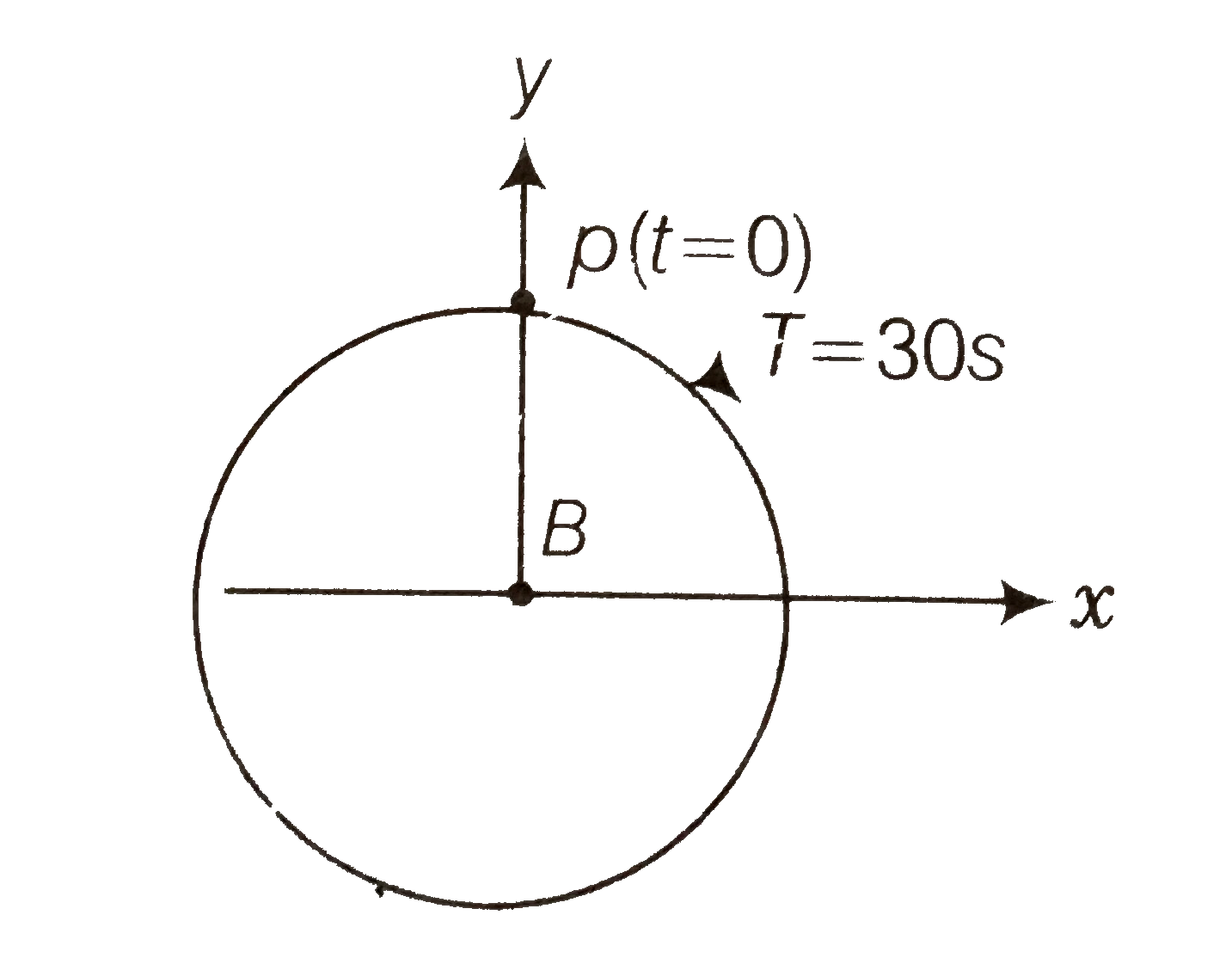
Figure shows the circular motion of a particle. The radius of the circle, the period, same of revolution and the initial position are indicated on the figure. The simple harmonic motion of the x-projection of the radius vector the rotating particle P is

A

`x(t)=B " sin"((2pit)/(30))`

B

`x(t)=B " cos"((pit)/(15))`

C

`x(t)=B"sin"((pi)/(15)+(pi)/(2))`

D

`x(t)=B "cos" ((pit)/(15)+(pi)/(2))`

Text Solution

Verified by Experts

The correct Answer is:
A

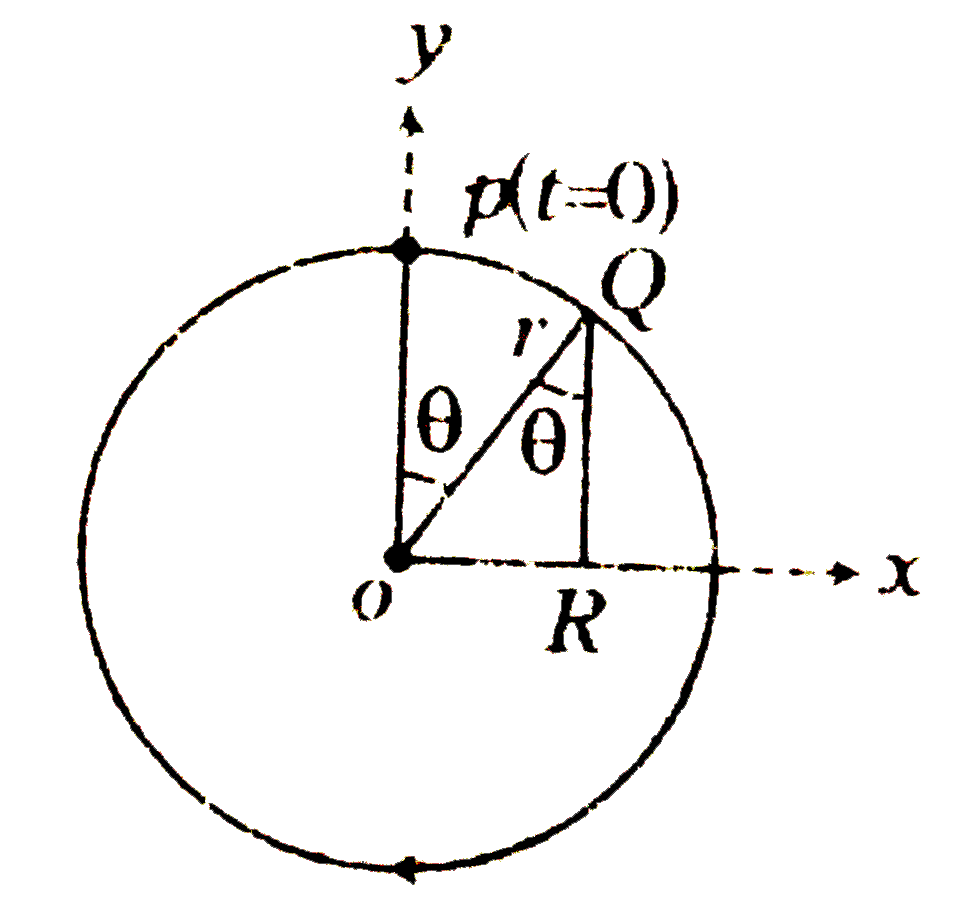
(a) Let angular velocity of the particle executing circular motion is `omega` and when it is at Q makes and angle `theta` as shown in the diagram.
Clearly , `theta=omegat`
Now, we can write OR
`=OQ "cos" (90-theta)=OQ "sin" theta=OQ "sin"omegat`
`=r"sin"omegat" "[because OQ=r]`

`impliesx=r"sin"omegat=B"sin"omegat" "[because r=B]`
`=B"sin"(2pi)/(T)t=B"sin"((2pi)/(30)t)`
Clearly, this equation represents SHM.
Promotional Banner

Similar Questions

Explore conceptually related problems

Figure shows the circular motion of a particle. The radius of the circle, the period, sense of revolution and the initial positionn are indicated in the figure. The simple harmonic motion off the x-projection of the radius vector of the rotating particle P is

The following figure depicts two circular motions. The radius of the circle, the period of revolutin the initial position and the sense of revolution are indicated on the figure. Obtain the simple harmoic motion of the x-projection of the radius vector of the rotating particle P in each case.

Figure depicts two circular motions. The radius of the circle, the period of revolution, the initial position and the sense of revolution are indicated on the figure. Obtain the SHMs of the x-projection of the radius vector of the rotating particle P in each case.

The radius of cirlcue, the period of revolution, initial position and sense of revolution are indicated in the figure. y-projection of the radius vector of rotating particle P is :

The displacement of a particle in simple harmonic motion in one time period is

The mass M shown in figure ocillates in simple harmonic motion with amplitude A. The amplitude of the point P is

The distance moved by a particle in simple harmonic motion in one time period is

The shape of graph plotted between velocity and position of a particle executing simple harmonic motion is

As shown in figure in a simple harmonic motion oscillator having identical four springs has time period

Figure. Shows the variation of force acting on a particle of mass 400 g executing simple harmonic motion. The frequency of oscillation of the particle is

