Home
Class 11
PHYSICS
In y= A sin omegat + A sin (omegat+(2pi)...

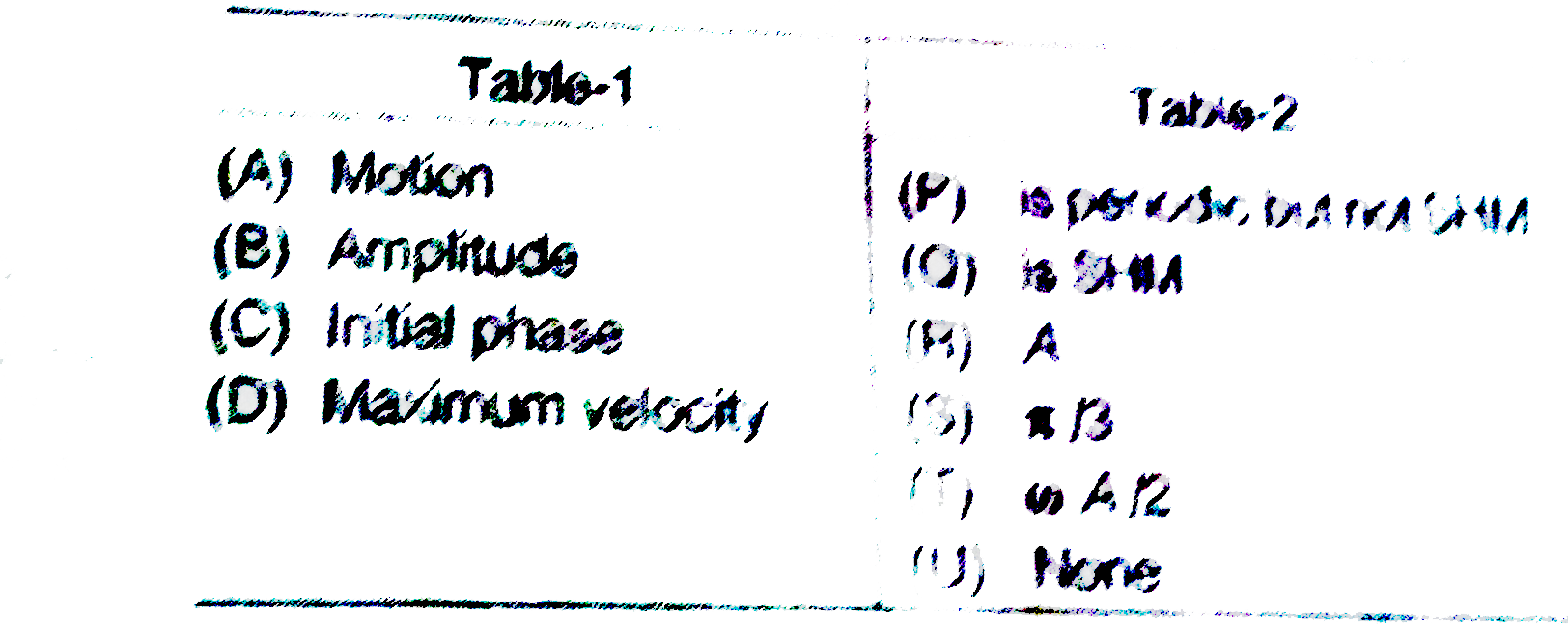
In y= A sin `omega`t + A sin (`omega`t+(2`pi`)/3)` match the following table.

Text Solution

Verified by Experts

The correct Answer is:

`(A rarr q, B rarr r, C rarr s, D rarr u)`

The given equation,
`y=A"sin"omegat+A"sin"(omegat+(2pi)/(3))` can also be written as.
`y=2A"sin"(omegat+(pi)/(3)) "cos" ((pi)/(3)) = A"sin"(omegat+(pi)/(3))`
Now, we can see that this is SHM with amplitude A and initial phase `(pi)/(3)`.
Promotional Banner

Similar Questions

Explore conceptually related problems

Consider the three waves z_(1), z_(2) "and" z_(3) as z_(1) = A "sin"(kx - omega t) z_(2) = A "sin"(kx + omega t) z_(3) = A "sin"(ky - omega t) Which of the following represents a standing wave?

A x and y co-ordinates of a particle are x=A sin (omega t) and y = A sin(omegat + pi//2) . Then, the motion of the particle is

A point mass is subjected to two simultaneous sinusoidal displacements in x - direction, x_1 (t) = A sin (omega)t and x_2 (t) = A sin ((omega t + (2 pi)/(3)) . Adding a third sinusoidal displacement x _3 (t) = B sin (omega t + phi) brings the mas to a complete rest. The values of (B) and (phi) are.

A partical is subjucted to two simple harmonic motions x_(1) = A_(1) sin omega t and x_(2) = A_(2) sin (omega t + pi//3) Find(a) the displacement at t = 0 , (b) the maximum speed of the partical and ( c) the maximum acceleration of the partical.

A particle is subjected to SHM as given by equations x_1 = A_1 sin omegat and x_2 = A_2 sin (omega t + pi//3) .The maximum acceleration and amplitude of the resultant motion are it a_("max") and A ,respectively , then

Two simple harmonic motions given by, x = a sin (omega t+delta) and y = a sin (omega t + delta + (pi)/(2)) act on a particle will be

Two particle A and B execute simple harmonic motion according to the equation y_(1) = 3 sin omega t and y_(2) = 4 sin [omega t + (pi//2)] + 3 sin omega t . Find the phase difference between them.

Find the displacement equation of the simple harmonic motion obtained by combining the motion. x_(1) = 2sin omega t , x_(2) = 4sin (omega t + (pi)/(6)) and x_(3) = 6sin (omega t + (pi)/(3))

A particle moves so that its position vector is given by vec r = cos omega t hat x + sin omega t hat y , where omega is a constant which of the following is true ?

A particle moves so that its position vector is given by vec r = cos omega t hat x + sin omega t hat y , where omega is a constant which of the following is true ?
