Home
Class 11
PHYSICS
A spring is stretched by applying a load...

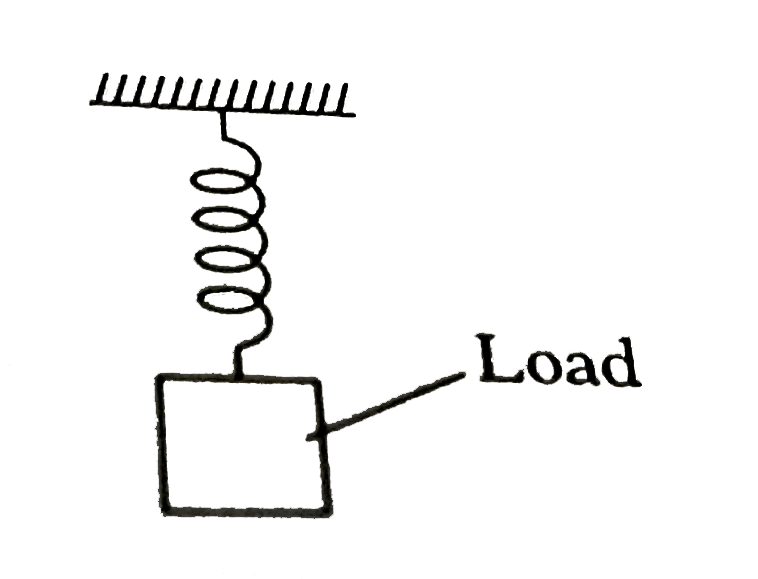
A spring is stretched by applying a load to its free end. The strain produced in the spring is

A

volumetic

B

shear

C

longitudinal and shear

D

longitudinal

Text Solution

Verified by Experts

The correct Answer is:
C

(c) Consider the diagram where a spring is stretched by applying a load to its free end. Clearly the length and shape of the spring changes.

The change in length corresponds to longitudinal strain and change in shape corresponds to shearing strain.
Promotional Banner

Topper's Solved these Questions

  • ELASTICITY

    DC PANDEY ENGLISH|Exercise Match the columns|4 Videos
  • ELASTICITY

    DC PANDEY ENGLISH|Exercise Medical entrances s gallery|21 Videos
  • ELASTICITY

    DC PANDEY ENGLISH|Exercise Check point 12.3|15 Videos
  • CURRENT ELECTRICITY

    DC PANDEY ENGLISH|Exercise All Questions|469 Videos
  • ELECTROSTATICS

    DC PANDEY ENGLISH|Exercise Integer|17 Videos

Similar Questions

Explore conceptually related problems

A spring has natural length 40 cm and spring constant 500 N//m . A block of mass 1 kg is attached at one end of the spring and other end of the spring is attached to a ceiling. The block is relesed from the position, where the spring has length 45 cm .

Two springs have their force constants in the ratio of 3:4 . Both the springs are stretched by applying equal force F. If elongation in first spring is x then elogation is second spring is

In the situation shown in figure all contact surfaces are smooth. The force constant of the spring is K. Two forces F are applied as shown. The maximum elongation produced in the spring is how many times of F//K (initially the spring is relaxed)?

A long spring is stretched by 3 cm and its potential energy is V . If the spring is stretched by 6 cm ,its potential energy will be

A long elastic spring is stretched by 2 cm and its potential energy is U . If the spring is stretched by 10 cm , the PE will be

A spring having a spring constant k is fixed to a vertical wall as shown in Fig. A block of mass m moves with velocity v torards the spring from a parallel wall opposite to this wall. The mass hits the free end of the spring compressing it and is decelerated by the spring force and comes to rest and then turns the spring is decelerated by the spring force and comes to rest and then turns back till the spring acquires its natural length and contact with the spring is broken. In this process, it regains its angular speed in the opposite direction and makes a perfect elastice collision on the opposite left wall and starts moving with same speed as before towards right. The above processes are repeated and there is periodic oscillation. Q. What is the time period of oscillation ?

A spring having a spring constant k is fixed to a vertical wall as shown in Fig. A block of mass m moves with velocity v torards the spring from a parallel wall opposite to this wall. The mass hits the free end of the spring compressing it and is decelerated by the spring force and comes to rest and then turns the spring is decelerated by the spring force and comes to rest and then turns back till the spring acquires its natural length and contact with the spring is broken. In this process, it regains its angular speed in the opposite direction and makes a perfect elastice collision on the opposite left wall and starts moving with same speed as before towards right. The above processes are repeated and there is periodic oscillation. Q. What is the maximum compression produced in the spring?

A long spring is stretched by 2 cm and the potential energy is V. IF the spring is stretched by 19 cm, its potential energy will be

A spring is stretched by distance x and then compressed to same distance from its original length. The work done by the spring force is (k=spring constant)

A solid sphere of mass 2 kg is rolling on a frictionless horizontal surface with velocity 6 m//s . It collides on the free end of an ideal spring whose other end is fixed. The maximum compression produced in the spring will be (Force constant of the spring = 36 N/m)

DC PANDEY ENGLISH-ELASTICITY-Chapter Exercise
  1. Mark the wrong statement

    Text Solution

    |

  2. The increase in length on stretching a wire is 0.05 %. If its poisson'...

    Text Solution

    |

  3. A spring is stretched by applying a load to its free end. The strain p...

    Text Solution

    |

  4. An elastic material of Young's modulus Y is subjected to a stress S. ...

    Text Solution

    |

  5. The temperature of a wire is doubled. 'The Young's modulus of elastic...

    Text Solution

    |

  6. When a pressure of 100 atmosphere is applied on a spherical ball, then...

    Text Solution

    |

  7. A 5 metre long wire is fixed to the ceiling. A weight of 10kg is hung ...

    Text Solution

    |

  8. A rectangular block of size 10 cm xx 8 cm xx 5 cm is kept in three dif...

    Text Solution

    |

  9. A uniform cube is subjected to volume compression. If each side is dec...

    Text Solution

    |

  10. The longitudinal extention of any elastic material is very small.In or...

    Text Solution

    |

  11. The maximum load that a wire can sustain is W. If the wire is cut to h...

    Text Solution

    |

  12. when a metal wire elongates by hanging a load Mg on it , the gravitati...

    Text Solution

    |

  13. A ball falling in a lake of depth 200m shown 0.1% decrease in its volu...

    Text Solution

    |

  14. A heavy mass is attached to a thin wire and is whirled in a vertical c...

    Text Solution

    |

  15. Two wires of copper having the length in the ratio 4 : 1 and their rad...

    Text Solution

    |

  16. The interatomic distance for a metal is 3 xx 10^(-10) m. If the intera...

    Text Solution

    |

  17. Young's modulus of rubber is 10^(4) N//m^(2) and area of cross section...

    Text Solution

    |

  18. Two wires of same diameter of the same material having the length l an...

    Text Solution

    |

  19. A force of 200 N is applied at one end of a wire of length 2m and havi...

    Text Solution

    |

  20. A beam of electrons moving with a momentum p enters a uniform magnetic...

    Text Solution

    |

