Home
Class 11
PHYSICS
A block of weight W produces an extensio...

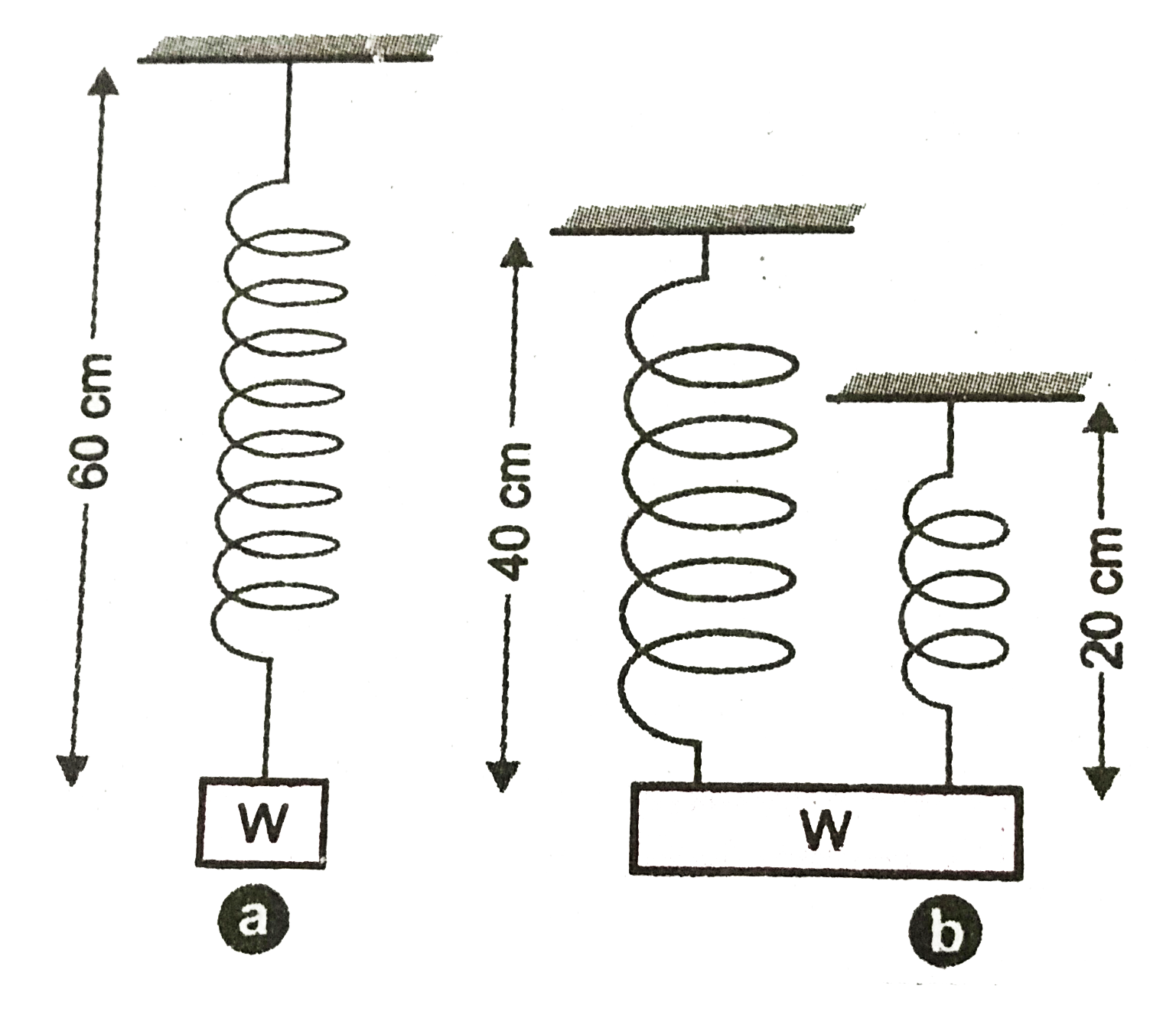
A block of weight `W` produces an extension of `9cm` when it is hung by an elastic spring of length of `60cm` and is in equilibrium. The spring is cut into two parts, one of length `40cm` and the other of length `20cm`. The same load `W` hangs in equilibrium supported by both parts as shwon in figure. The extension in `cm` noe is

A

9

B

6

C

5

D

2

Text Solution

Verified by Experts

The correct Answer is:

D

(d) Force constant ,`kprop(1)/(l)`
Let k be the force constant of original spring.
Then, `k_(40)=(60)/(40)k=(3)/(2)k" and "k_(20)=(60)/(20)k=3k`
`k_(net)=k_(40)+k_(20)=(9k)/(2)`
Now, `Deltal=(F)/(k) prop (1)/(k)`
`therefore Deltal'=((k)/(9k//2))(9 cm)=2 cm`
Promotional Banner

Topper's Solved these Questions

  • ELASTICITY

    DC PANDEY ENGLISH|Exercise Match the columns|4 Videos
  • ELASTICITY

    DC PANDEY ENGLISH|Exercise Medical entrances s gallery|21 Videos
  • ELASTICITY

    DC PANDEY ENGLISH|Exercise Check point 12.3|15 Videos
  • CURRENT ELECTRICITY

    DC PANDEY ENGLISH|Exercise All Questions|469 Videos
  • ELECTROSTATICS

    DC PANDEY ENGLISH|Exercise Integer|17 Videos

Similar Questions

Explore conceptually related problems

Two thin lenses, one of focal length + 60 cm and the other of focal length – 20 cm are put in contact. The combined focal length is

A load suspended by a massless spring produces an extention of xcm in equilibrium.When it is cut into two unequal parts ,the same load produces an extention of 7.5cm when suspended by the larger part of length 60cm .When it is suspended by the smaller part,the extention is 5cm.Then

When a 20 g mass hangs attached to one end of a light spring of length 10 cm, the spring stretches by 2 cm. The mass is pulled down until the total length of the spring is 14 cm. The elastic energy, (in Joule) stored in the spring is :

A spring of force constant K is cut in two parts at its one third length. When both the parts are stretched by same amount, the work done in the two parts, will be :-

In a spring- mass system , the length of the spring is L, and it has a mass M attached to it and oscillates with an angular frequency omega . The spring is then cut into two parts, one (i) with relaxed length alphaL and the other (ii) with relaxed length (1-alpha) L. The force constants of the two spring A and B are

A block of mass m , when attached to a uniform ideal apring with force constant k and free length L executes SHM. The spring is then cut in two pieces, one with free length n L and other with free length (1 - n)L . The block is also divided in the same fraction. The smaller part of the block attached to longer part of the spring executes SHM with frequency f_(1) . The bigger part of the block attached to smaller part of the spring executes SHM with frequency f_(2) . The ratio f_(1)//f_(2) is

If extension in the spring at equilibrium position is 6 cm then acceleration of block if it is released by further stretching 4 cm.

Potential energy of an ideal spring, when stretched by 1 cm is U. Spring is now cut in two equal parts and connected in parallel. If the new combination of spring is compressed by 2 cm, then potential energy stored is

A body of mass 50 kg, suspended by two strings of lengths 30 cm and 40 cm fastend to two points in the same horizontal line 50 cm apart, is in equilibrium. Find the tension (in Newtons) in each string.

In Fig.(i), a lens of focal length 10 cm is shown. It is cut into two parts and placed as shown in Fig.(ii). An object AB of light 1 cm is placed at a distance of 7.5 cm. The height of the image will be

DC PANDEY ENGLISH-ELASTICITY-Chapter Exercise
  1. The strain stress curves of three wires of different materials are sho...

    Text Solution

    |

  2. A string 1m long is drawn by a 300 Hz vibrator attached to its end. Th...

    Text Solution

    |

  3. The potential energy U between two molecules as a function of the dist...

    Text Solution

    |

  4. The diagram shows a force-extension graph for a rubber band. Conside...

    Text Solution

    |

  5. Consider two cylindrical rods of identical dimensions, one of rubbe...

    Text Solution

    |

  6. The adjacent graph shows the extension Deltal of a wire of length 1m...

    Text Solution

    |

  7. A brass of length 2 m and cross-sectional area 2.0 cm^(2) is attached ...

    Text Solution

    |

  8. One end of uniform wire of length L and of weight W is attached rigidl...

    Text Solution

    |

  9. The wire of a Young's modules appartus is elongated by 2 mm when a bri...

    Text Solution

    |

  10. A rigid bar of mass M is supported symmetrically by three wires each o...

    Text Solution

    |

  11. A wire of leng:h L has a linear mass density mu and area of cross-sect...

    Text Solution

    |

  12. The density of a metal at normal pressure is rho. Its density when it ...

    Text Solution

    |

  13. One end of a long metallic wire of length L is tied to the ceiling. Th...

    Text Solution

    |

  14. The length of a rubber cord is l(1) m when the tension is 4 N and l...

    Text Solution

    |

  15. A uniform elastic plank moves due to a constant force F(0) applied at...

    Text Solution

    |

  16. A uniform pressure p is exerted on all sides of a solid cube of a mate...

    Text Solution

    |

  17. A block of weight W produces an extension of 9cm when it is hung by an...

    Text Solution

    |

  18. A rectangular frame is to be suspended symmetrically by two strings of...

    Text Solution

    |

  19. Two wires of the same material (Young's modulus=Y) and same length L b...

    Text Solution

    |

  20. A mild steel wire of length 2L and cross-sectional area A is stretched...

    Text Solution

    |
