Home
Class 11
PHYSICS
Two different isotherms representing the...

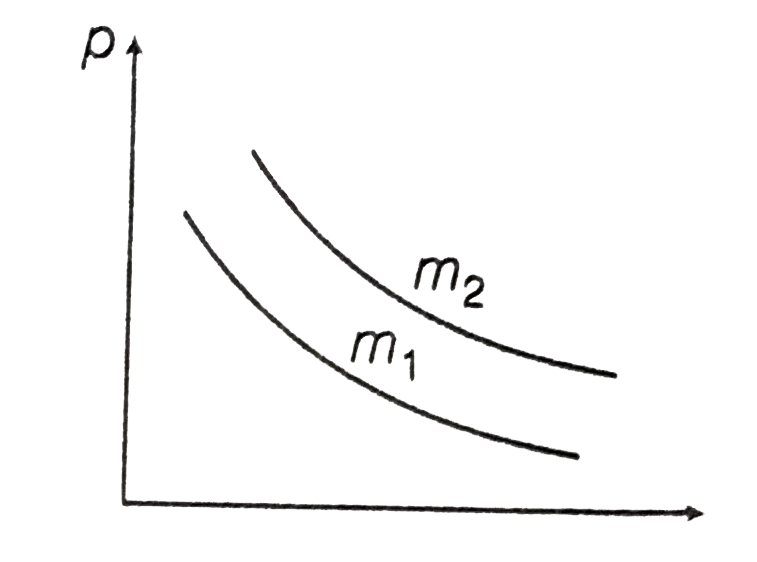
Two different isotherms representing the relationship between pressure p and volume V at a given temperature of the same ideal gas are shown for masses `m_(1)` and `m_(2)` then

A

`m_(1) gt m_(2)`

B

`m_(1) = m_(2)`

C

`m_(1) lt m_(2)`

D

Nothing can be predicted

Text Solution

Verified by Experts

The correct Answer is:
C

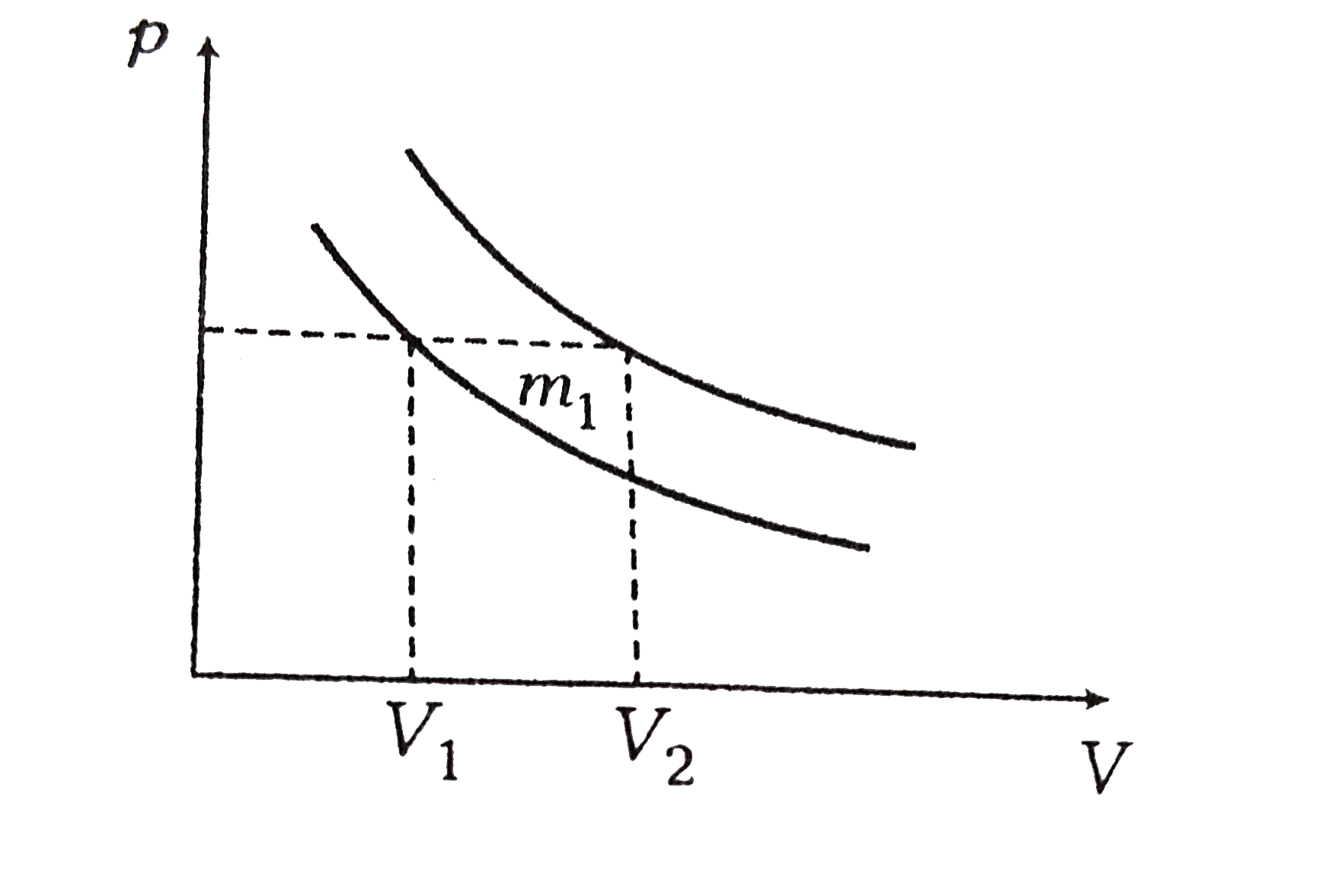
`pV = muRT = m/MRT`

For 1 st graph, `" "p=(m_(1))/(M)(RT)/(V_(1))`
For 2nd graph, `" "p=(m_(2))/(M)(RT)/(V_(1))`
Fore eqs. (i) and (ii), we get
`" " (m_(1))/(m_(2))=(V_(1))/(V_(2))rArrmpropV`
As `" "V_(2)gt V_(1) rArrm_(1)gtm_(2)`
Promotional Banner

Topper's Solved these Questions

  • THERMOMETRY THERMAL EXPANSION AND KINETIC THEORY OF GASES

    DC PANDEY ENGLISH|Exercise A Tacking it together|55 Videos
  • THERMOMETRY THERMAL EXPANSION AND KINETIC THEORY OF GASES

    DC PANDEY ENGLISH|Exercise B medical entrance special format questions|14 Videos
  • THERMOMETRY THERMAL EXPANSION AND KINETIC THEORY OF GASES

    DC PANDEY ENGLISH|Exercise Check point 14.3|20 Videos
  • SUPERPOSITION OF WAVES

    DC PANDEY ENGLISH|Exercise Level 2 Subjective|8 Videos
  • THERMOMETRY,THERMAL EXPANSION & KINETIC THEORY OF GASES

    DC PANDEY ENGLISH|Exercise Level 2 Subjective|9 Videos

Similar Questions

Explore conceptually related problems

Which of the following shown the correct relationship between the pressure 'P' and density rho of an ideal gas at constant temperature?

Figure shows volume - temperature (V-T) graph for same mass of an ideal gas at two different pressures P_1 and P_2 . Hence

An ideal gas in a thermally insulated vessel at internal pressure =P_(1) , volume =V_(1) and absolute temperature =T_(1) expands irreversibly against zero external pressure, as shown in the diagram. The final internal pressure, volume and absolute temperature of the gas are P_(2), V_(2) and T_(2) respectively. For this expansion.

An ideal gas in a thermally insulated vessel at internal pressure =P_(1) , volume =V_(1) and absolute temperature =T_(1) expands irreversibly against zero external pressure, as shown in the diagram. The final internal pressure, volume and absolute temperature of the gas are P_(2), V_(2) and T_(2) respectively. For this expansion.

An ideal gas in a thermally insulated vessel at internal pressure = P_(1) , volume = V_(1) and absolute temperature = T_(1) expands irreversibly against zero external pressure, as shown in the diagram. The final internal pressure, volume and absolute temperature of the gas are P_(2), V_(2) and T_(2) , respectively. For this expansion.

A given quantity of a ideal gas is at pressure P and absolute temperature T. The isothermal bulk modulus of the gas is

A given quantity of a ideal gas is at pressure P and absolute temperature T. The isothermal bulk modulus of the gas is

In the given pressure-temperature (P-T) diagram, what is the relation between volumes V_1 and V_2 for a fixed mass of a gas?

The density (rho) versus pressure (P) graphs of a given mass of an ideal gas is shown at two temperatures T_(1) and T_(2) . Then relation between T_(1) and T_2 may be

The expansion of an ideal gas of mass (m) at a constant pressure (p) is given by the straight line (B) Then, the expansion of the same ideal gas of mass 2 m at a pressure 2 p is given by the straight line. .

DC PANDEY ENGLISH-THERMOMETRY THERMAL EXPANSION AND KINETIC THEORY OF GASES-Check point 14.4
  1. The mean kinetic energy of one mole of gas per degree of

    Text Solution

    |

  2. The average translational kinetic energy of O(2) (molar mass 32) molec...

    Text Solution

    |

  3. A perfect gas at 27^(@)C is heated at constant pressure so as to tripl...

    Text Solution

    |

  4. 16 gram of oxygen, 14 gram of nitrogen and 11 gram of carbon dioxide a...

    Text Solution

    |

  5. A balloon is filled at 27^(@)C and 1 atm pressure by 500 m^(3) He. At-...

    Text Solution

    |

  6. Aperfect gas at 27^(@) C is heated at constant pressure soas to duuble...

    Text Solution

    |

  7. Figure shows graphs of pressure versus density for an ideal gas at two...

    Text Solution

    |

  8. From the p-T graph what conclusion can be drawn?

    Text Solution

    |

  9. A cylinder containe 20 kg of N(2) gas (M= 28 kg K^(-1) mol^(-1)) at a ...

    Text Solution

    |

  10. Two different isotherms representing the relationship between pressure...

    Text Solution

    |

  11. A gas is found to obey the law P^(2)V = constant. The initial temperat...

    Text Solution

    |

  12. A gas has volume V and pressure p. The total translational kinetic ene...

    Text Solution

    |

  13. A vessel contains a mixture of one mole of Oxygen and two moles of Nit...

    Text Solution

    |

  14. Two monoatomic gases are at absolute temperatures 300 K and 350 K res...

    Text Solution

    |

  15. At 27^(@)C temperature, the kinetic energy of an ideal gas is E(1^.) I...

    Text Solution

    |

  16. Temperature remaining constant, the pressure of gas is decreased by 20...

    Text Solution

    |

  17. One litre of an ideal gas st 27^(@)C is heated at a constant pressure ...

    Text Solution

    |

  18. In the given (V-T) diagram, what is the relation between pressure P(1)...

    Text Solution

    |

  19. The gas in a vessel is subjected to a pressure of 20 atmosphere at a t...

    Text Solution

    |

  20. The graph which represents the variation of mean kinetic energy of mol...

    Text Solution

    |

