Home
Class 11
PHYSICS
When water is heated from 0^(@)C to 10^(...

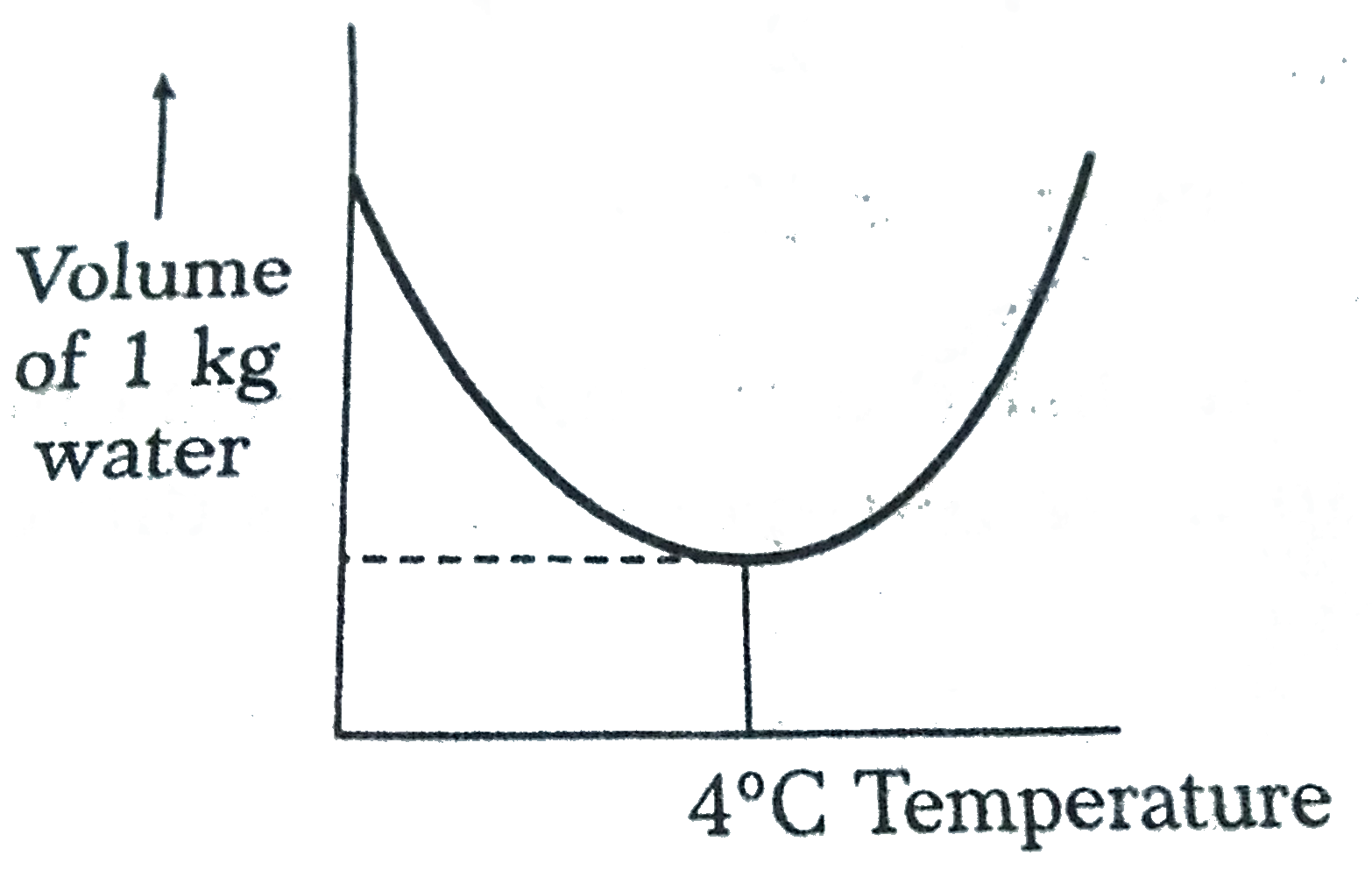
When water is heated from `0^(@)C` to `10^(@)C` , its volume

A

does not change

B

decreases

C

first decreases and then increases

D

increases

Text Solution

Verified by Experts

The correct Answer is:
C

Water is heated from `0^(@)C"to"10^(@)C,` then its volume first decrreases and then increass.
Promotional Banner

Topper's Solved these Questions

  • THERMOMETRY THERMAL EXPANSION AND KINETIC THEORY OF GASES

    DC PANDEY ENGLISH|Exercise Match the columns|5 Videos
  • SUPERPOSITION OF WAVES

    DC PANDEY ENGLISH|Exercise Level 2 Subjective|8 Videos
  • THERMOMETRY,THERMAL EXPANSION & KINETIC THEORY OF GASES

    DC PANDEY ENGLISH|Exercise Level 2 Subjective|9 Videos

Similar Questions

Explore conceptually related problems

1 kg of water is heated from 40^(@) C "to" 70^(@)C ,If its volume remains constant, then the change in internal energy is (specific heat of water = 4148 J kg^(-1 K^(-1)) a) 2.44 x 10^5 J b) 1.62 x 10^5 J c) 1.24 x 10^5 J d) 2.62 x 10^5 J

An aluminium sphere of 20cm diameter is heated from 0^(@)C to 100^(@)C . Its volume changes by (given that the coefficient of linear expanison for aluminium (alpha_(Al) = 23 xx 10^(-6//0)C)

On heating water from 0^(@)C to 100^(@)C its volume

When water is heated from O^° C to 10^° C, its density

Water is cooled from 4^(@)C to 0^(@)C it:

When water is heated from 0^(@)C to 4^(@)C and C_(P) and C_(V) are its specific heats at constant pressure and constant volume respectively , then :-

State the volume changes observed when a givenmass of water is heated from 0^(@)C to 10^(@)C . Sketch a temperature volume graph to show the behaviour.

A given mass of water is cooled from 10^(@)C to 0^(@)C . State the volume changes observed. Represent these changes on a temperature volume graph.

When water is cooled from 4^@C to 0^@C its volume decreases.

Water is heated from 0^(@)C ato 10^(@)C . How does the density of water change with temperature?

DC PANDEY ENGLISH-THERMOMETRY THERMAL EXPANSION AND KINETIC THEORY OF GASES-Medical entrance gallary
  1. The value of coefficient of volume expansion of glycerin is 5 xx 10^(-...

    Text Solution

    |

  2. Pressure remaining the constant, the volume of a given mass of an idea...

    Text Solution

    |

  3. When water is heated from 0^(@)C to 10^(@)C , its volume

    Text Solution

    |

  4. The length of s steel rod exceeds that of a brass rod by 5 cm. If the ...

    Text Solution

    |

  5. The density of water is maximum at:

    Text Solution

    |

  6. A metal rod if fixed rigidly at two ends so as to prevent its thermal ...

    Text Solution

    |

  7. Which one of the following is a wrong statement in kinetic theory of g...

    Text Solution

    |

  8. The mean free path of molecules of a gas (radius r) is inversely propo...

    Text Solution

    |

  9. Prove that the pressure of an ideal gas is numerically equal to two th...

    Text Solution

    |

  10. According to equipartition law of energy each particle in a system of ...

    Text Solution

    |

  11. When a liquid is heated in a glass vessel, its coefficient of apparent...

    Text Solution

    |

  12. Let gamma : coefficient of volume expansion of the liquid and alpha : ...

    Text Solution

    |

  13. The average kinetic energy of a molecule of a gas at absolute temperat...

    Text Solution

    |

  14. At what temperature. The rms velocity of gas molecules would be double...

    Text Solution

    |

  15. The average kinetic energy per mole of hydrogen at given temperature i...

    Text Solution

    |

  16. In kinetic theory of gases, it is assumed that molecular collisions ar...

    Text Solution

    |

  17. The number of molecules in a litre of a gas at temperature of 27^(@)C ...

    Text Solution

    |

  18. How many degress of freedom have the gas molecules, if under standard ...

    Text Solution

    |

  19. A non-conductiong body floats in a liquid at 25^(@)C with 1//3 of its ...

    Text Solution

    |

  20. During an experiment, an ideal gas is found to obey an additional law ...

    Text Solution

    |

