Home
Class 12
PHYSICS
For ferromagnetic material, the relative...

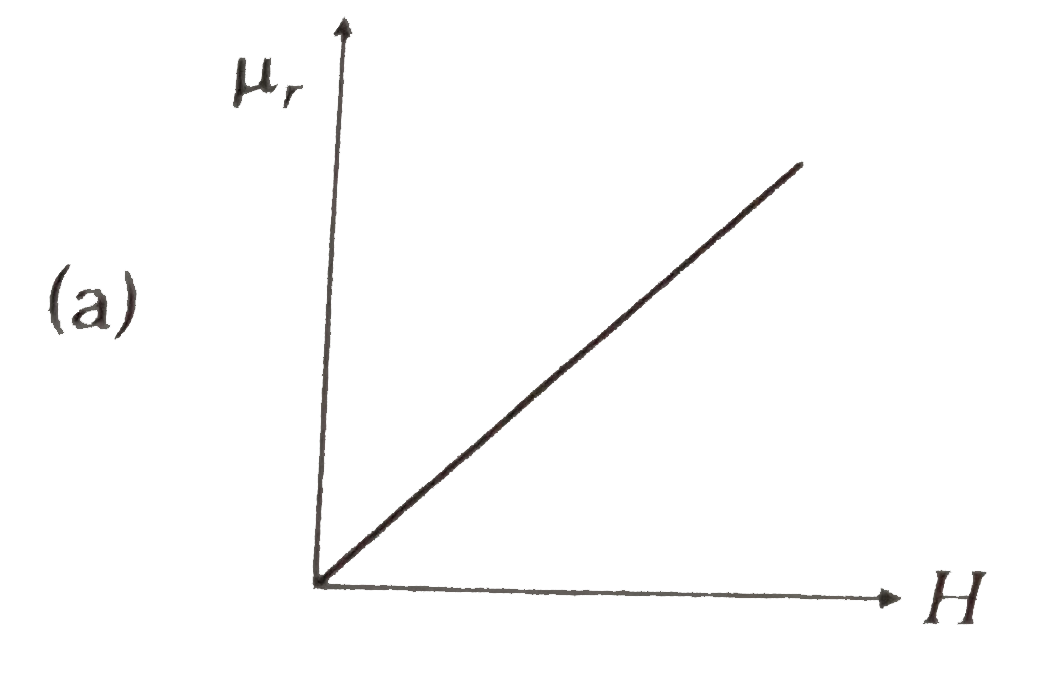
For ferromagnetic material, the relative permeability (mu_(r)), versus magnetic intensity (H) has the following shape

A

B

C

D

Text Solution

AI Generated Solution

The correct Answer is:

To analyze the relationship between relative permeability (μ_r) and magnetic intensity (H) for ferromagnetic materials, we can break down the problem into a series of steps. ### Step-by-Step Solution: 1. **Understanding Relative Permeability (μ_r)**: - Relative permeability (μ_r) is defined as the ratio of the permeability of the material (μ) to the permeability of free space (μ_0). It indicates how easily a material can be magnetized. 2. **Starting Condition**: - Initially, when the magnetic intensity (H) is low, the magnetization (I) of the ferromagnetic material is also low. In this region, the ratio I/H is very small. Therefore, we can express μ_r as: \[ μ_r = 1 + \frac{I}{H} \] - Since I/H is small, μ_r is approximately equal to 1, and it increases with increasing H. 3. **Magnetization and Saturation**: - As H increases, the material becomes increasingly magnetized. Eventually, the material reaches a point of saturation where the magnetization (I) becomes constant. At this stage, I does not increase with further increases in H. 4. **Behavior at Saturation**: - When the material is fully magnetized, the value of I is constant. Thus, the expression for μ_r becomes: \[ μ_r = 1 + \frac{I_{max}}{H} \] - Here, I_{max} is the maximum magnetization. As H continues to increase, the term I/H becomes smaller, leading to: \[ μ_r \propto \frac{1}{H} \] - This indicates that μ_r decreases as H increases beyond the saturation point. 5. **Graphical Representation**: - The graph of μ_r versus H will show an initial increase as H increases, reaching a peak at saturation, and then a decrease as H continues to increase. The shape of the graph resembles a curve that rises and then falls. ### Final Graph Shape: - The graph will start at a low value, rise steeply as H increases, reach a maximum (saturation point), and then decline as H continues to increase.
Promotional Banner

Similar Questions

Explore conceptually related problems

Ferromagnetic material and non-magnetic material

The relative permeability of iron is 6000. Its magnetic susceptibility is

A magnetising field intensity of 1000 A/m produces a magnetic flux density 0.25 (Wb)/ m^2 in a ferromagnetic substance. The relative permeability of ferromagnetic substance is (Approximately)

A Rowland ring of mean radius 15 cm has 3500 turns of wire wound on a ferromagnetic core of relative permeability 800. What is the magnetic field B in the core for a magnetising current of 1.2 A?

A Rowland ring of mean radius 16 cm has 4000 turns of wire wound on a ferromagnetic core of relative permeability 800 . What is magnetic field in the core for a magnetising current of 1.2 A ?

A ring of mean radius 15 cm has 3500 turns of wire wound on a ferromagnetic core of relative permeability 800. The magnetic field in the core for a magnetising current of 1.2 A is

A ferromagnetic material is placed in an external magnetic field. The magnetic domains

If a magnetic material is having magnetic susceptibility (chi)=-1 then the relative magnetic permeability (mu_(r)) and type of mangnetic material is

Out of the two magnetic materials. 'A' has relative permeability slightly greater than unity while 'B' has less than unity. Identify the nature of materials 'A' and 'B'. Will their susceptibilities be positive or negative?

When a ferromagnetic material goes through a hysteresis loop, the magnetic susceptibility
