
Home
Class 12
PHYSICS
An LC circuit (L = 0.01H, C = 1muF) is c...

An LC circuit `(L = 0.01H, C = 1muF)` is connected to an AC source of variable frequency. If the frequency is varied from 1 kHz, then show the consequent variation of impedance by a rough sketch.

Text Solution

Verified by Experts
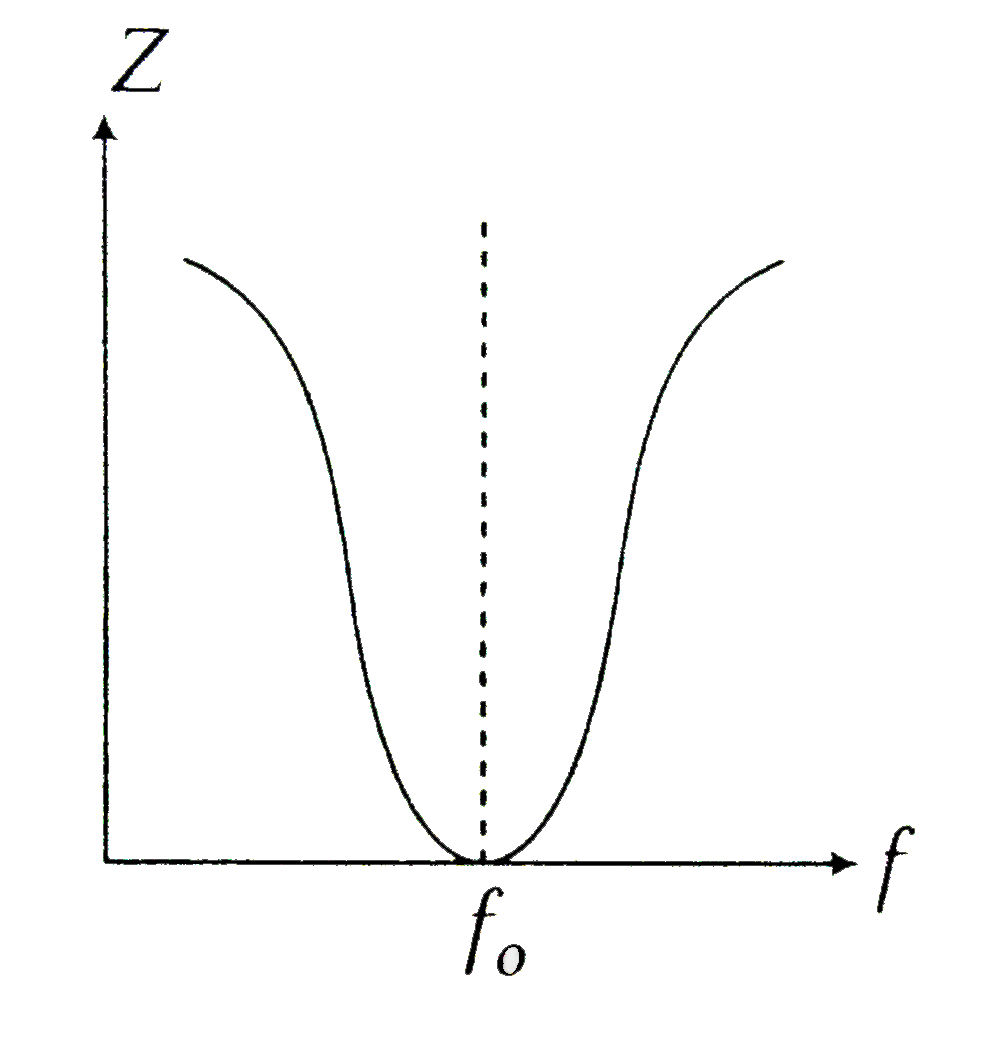
Impedance (Z) of the circut is
`1/Z = 1/X_(c) - 1/X_(L)`
At resonance, `X_(L)=X_(C)`
`rArr omegaL=1/(omegaC)`
`rArr omega=omega_(0)=1/(sqrt(LC))`
`rArr f_(0) = omega_(0)/(2pi)=1/(2pisqrt(LC))`
`=1/(2pisqrt(0.01 xx 10^(-6)))`
=1592 Hz=1.592 kHz
At `f=f_(0)`, impedance is minimum and equal to zero.
At `fltf_(0)`, `X_(C)gtX_(L)`, as frequency increases, impedance increases
`f=f_(0),X_(C)gtX_(L)`, as frequency increases, impedance decreases as shown below
Promotional Banner

Similar Questions

Explore conceptually related problems

(a) In a series LCR circuit connected across an AC source of variable frequency, obtain the expression for its impedance and draw a plot showing its variation with frequency of the AC source. (b) What is the phase difference between the voltages across inductor and the capacitor at resonance in the LCR circuit ? (c ) When and inductor is connected to a 200 V DC voltage, a current of 1Aflows trough it. when the same inductor is connected to a 200 V, 50 Hz AC source, only 0.5 A current flows. Explain, why ? Also, calculate the self inductance of the inductor.

A series LCR circuit with R=22Omega, L=1.5 H and C=40 mu F is connected to a variable frequency 220 V ac supply. When the frequency of the supply equals the natural frequency of the circuit, what is the average power transferred to the circuit in one complete cycle?

An LC- circuit (inductance 0.01 H and capacitance 1 muF ) is connected to a variable a.c. source as shown in fig. 14.8. Draw rough sketch of the current -variation as the frequency is changed from 1 kHz to 2 kHz.

A series LCR circuit with R = 20 Omega, L = 1.5 H and C = 35 mu F is connected to a variable frequency 200 V ac supply. When the frequency of the supply equals the natural frequency of the circuit, what is the average power in kW transferred to the circuit in one complete cycle?

A series LCR circuit with R = 20 Omega, L = 1.5 H and C = 35 mu F is connected to a variable frequency 200 V ac supply. When the frequency of the supply equals the natural frequency of the circuit, what is the average power in kW transferred to the circuit in one complete cycle?

A series LCR circuit with L = 4.0 H, C = 100 mu F and R = 60 Omega is connected to a variable frequency 240 V source. Calculate (i) angular frequency of the source which drives the circuit in resonance, (ii) current at the resonating frequency, (iii) rms potential drop across the inductance at resonance.

A series L-C-R circuit with R = 20 Omega , L = 1.5 H and C = 35muF is connected to a variable frequency 200 V, AC supply. When the frequency of the supply equals the natural frequency of the circuit, what is the average power transfered to the circuit, what is the average power transfered to the circuit in one complete cycle ?

Fig. shows series LCR circuit with L = 5.0 H, C = 80 mu F, R = 40 Omega connected to a variable frequency 240 V source. Calculate (i) the angular frequency of the source which drives the circuit at resonance. (ii) Current at the resonating frequency. (iii) the rms pot. drop across the capacitor at resonance.

In a series LCR circuit connected to an ac source of variable frequency and voltage v =v_(m) sin omega t, draw a plot showing the variation of current (I) with angular frequency (omega) for two different values of resistance R_(1) and R_(2) (R_(1) gt R_(2)) . Write the condition under which the phenomenon of resonance occurs. For which value of the resistance out of the two curves, a sharper resonance is produced ? Define Q-factor of the circuit and give its significance.

A series LCR circuit with L= 0.12H, C=480 nF, and R=23 Omega is connected to a 230V variable frequency supply. (a) What is the source frequency for which current amplitude is maximum? Find this maximum value. (b) What is the source frequency for which average power absorbed by the circuit is maximum? Obtain the value of maximum power. (c ) For which frequencies of the source is the power transferred to the circuit half the power at resonant frequency? (d) What is the Q-factor of the circuit?

