Home
Class 12
PHYSICS
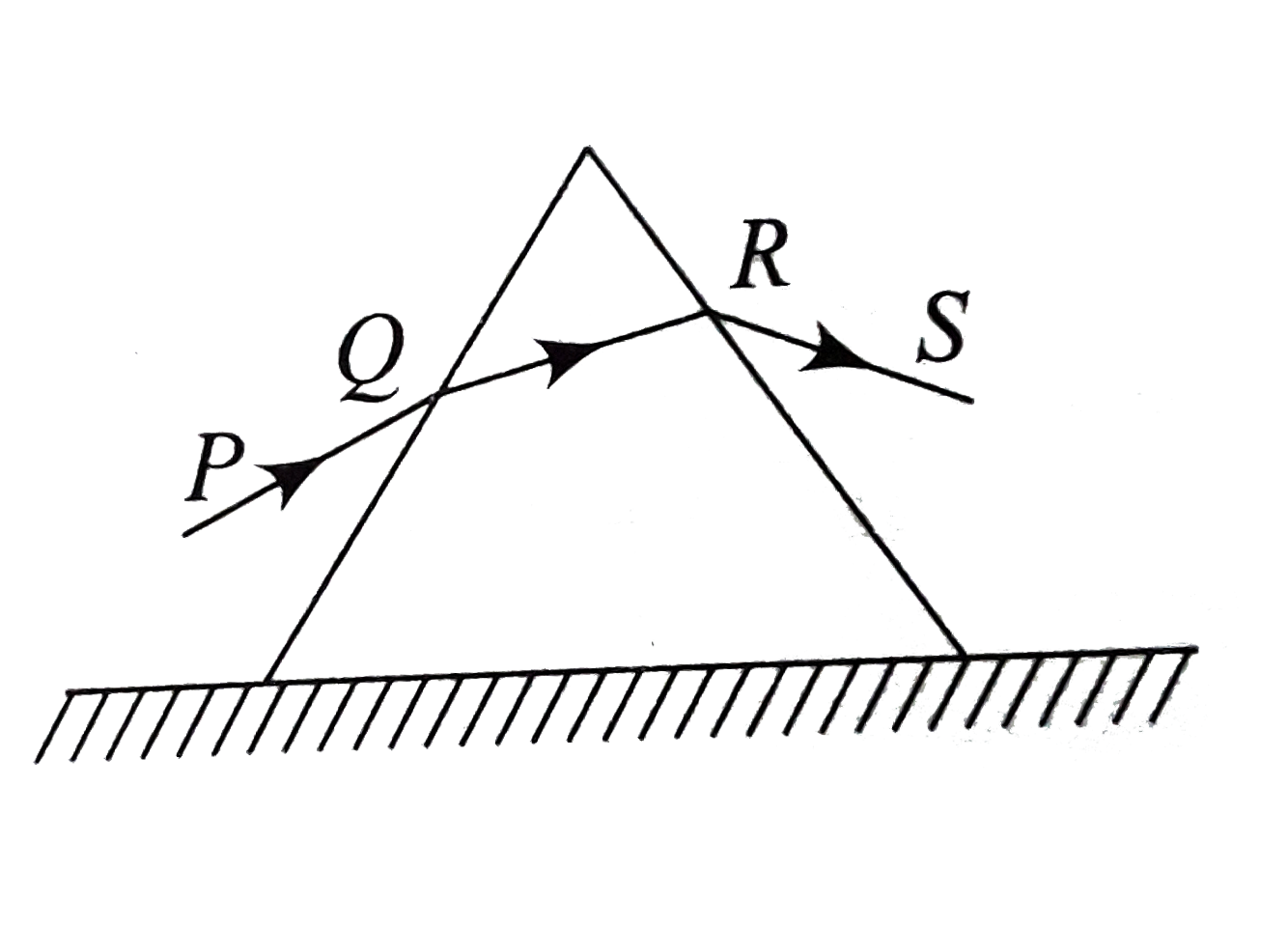
An equilateral prism is placed on a hori...

An equilateral prism is placed on a horizontal surface. A ray PQ is incident onto it. For minumum deviation,

A

PQ is horizontal

B

PR is horizontal

C

RS is horizontal

D

Either PQ or RS is horizontal

Text Solution

Verified by Experts

The correct Answer is:

B

(b) In minimum deviation position, refracted ray inside an isosceles prism is parallel to the base of the prism.
Promotional Banner

Topper's Solved these Questions

  • RAY OPTICS

    DC PANDEY ENGLISH|Exercise Checkpoint 9.6|20 Videos
  • RAY OPTICS

    DC PANDEY ENGLISH|Exercise Checkpoint 9.7|10 Videos
  • RAY OPTICS

    DC PANDEY ENGLISH|Exercise Checkpoint 9.4|20 Videos
  • NUCLEI

    DC PANDEY ENGLISH|Exercise C MADICAL ENTRANCES GALLERY|46 Videos
  • REFLECTION OF LIGHT

    DC PANDEY ENGLISH|Exercise Subjective|9 Videos

Similar Questions

Explore conceptually related problems

A ray of light is incident on an equilateral glass prism placed on a horizontal table. For minimum deviation which of the following is true:

An equilateral triangular prism is made of glass (mu = 1.5) . A ray of light is incident normally on one of the faces. The angle between the incident and emergent ray is

Figure alongside shows an equilateral prism ABC and the ray QR emerging out from the prism after suffering minimum deviation. Complete the diagram to show the refracted ray PQ inside the prism and the incident ray OP on the prism. State in words how have you completed the diagram to show the refracted ray PQ inside the prism and the incident ray OP on the prism. state in words how have you completed the diagram.

Angle of minimum deviation is equal to the angle prism A of an equilateral glass prism. The angle incidence at which minimum deviation will be obtained is

The ray PQ shown in the figure , surface minimum deviation in an equilateral prism A. Two more identical prism B and C and of the same material as A are now placed in contact as. Show in the figure . If prism A produces a minimum deviation delta_m , the deviation produced by the combination of prisms A, B and C will be

An equilateral prism produces a minimum deviation of 30^(@) . The angle of incidence is

Find the angle of minimum deviation for an equilateral prism made of a material of refractive index 1.732. What is the angle of incidence for this deviation ?

A equilateral glass prism has a refractive index sqrt(2) . A light ray is incident at 45^(@) on one face. Total deviation of ray is nxx15^(@) where n is

A beam of monochromatic light is incident at i= 50^(@) on one face of an equilateral prism, the angle of emergence is 40^(@) , then the angle of minimum deviation is :

A ray of light incident on one of the face of a prism as shown. After refraction through this surface ray is incident on base of the prism. The refractive index of the prism is sqrt(3) . The net deviation of the ray due to prism is
