Home
Class 12
PHYSICS
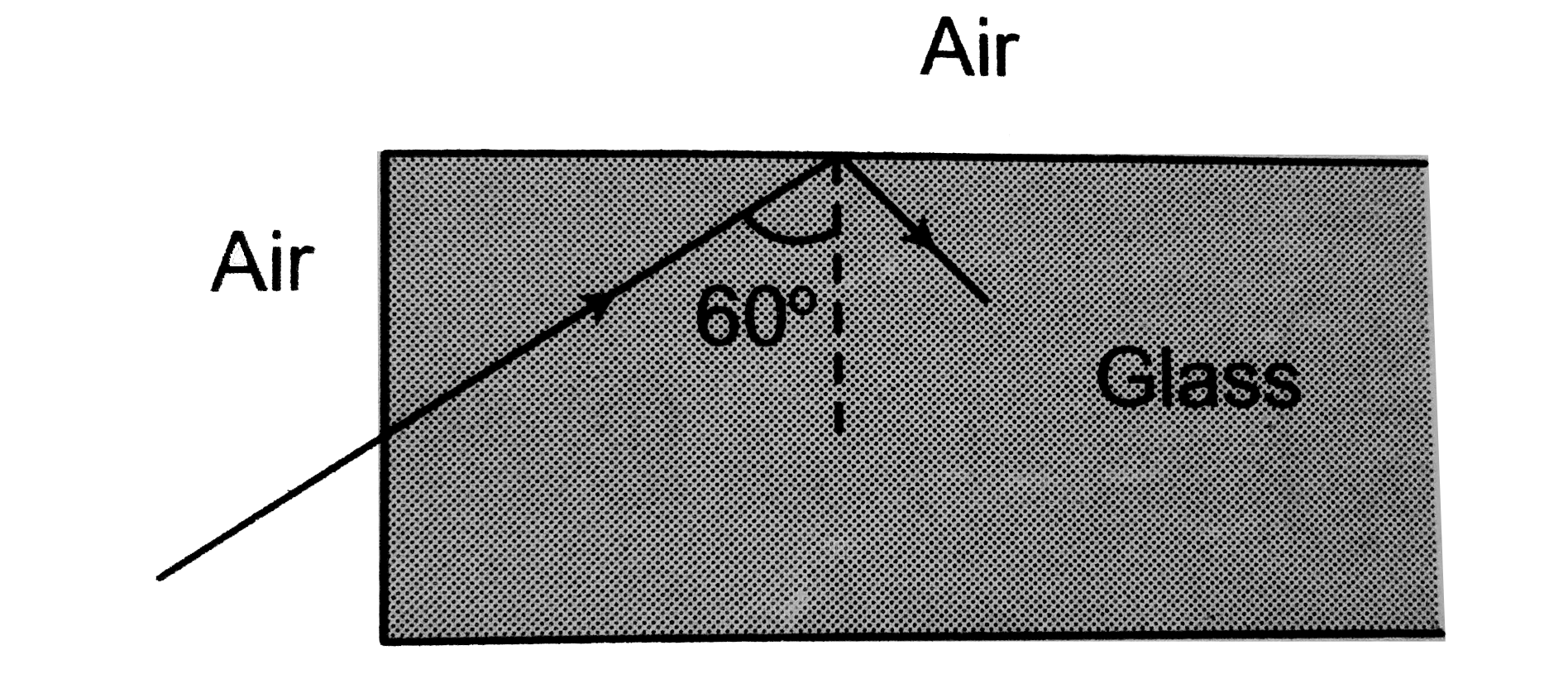
A light ray from air is incident (as sho...

A light ray from air is incident (as shown in figure ) at one end of a glass fiber ( refractive index `mu=1.5)` making an incidence angle of `60^(@)` on the lateral surface, so that it undergoes a total internal reflection. How much time would it take to traverse the straight fiber of length `1 km `?

A

3.3 `mu`s

B

6.6 `mu`s

C

5.7 `mu`s

D

3.85 `mu`s

Text Solution

Verified by Experts

The correct Answer is:

D

(d) When total internal reflection just takes place from lateral surface, i=C i.e., `60^(@)=C`
`rArr sin 60^(@)=sinC= 1/murArrmu=2/sqrt3`
Time taken by light to traverse some distance in a medium,
`t=(mux)/c=(2/sqrt3xx10^(3))/(3xx10^(8))=3.85mus`
Promotional Banner

Topper's Solved these Questions

  • RAY OPTICS

    DC PANDEY ENGLISH|Exercise medical entrance special format question|23 Videos
  • RAY OPTICS

    DC PANDEY ENGLISH|Exercise Medical entrance gallary|76 Videos
  • RAY OPTICS

    DC PANDEY ENGLISH|Exercise Checkpoint 9.7|10 Videos
  • NUCLEI

    DC PANDEY ENGLISH|Exercise C MADICAL ENTRANCES GALLERY|46 Videos
  • REFLECTION OF LIGHT

    DC PANDEY ENGLISH|Exercise Subjective|9 Videos

Similar Questions

Explore conceptually related problems

A light ray is incident on a glass sphere of reflective index mu = sqrt3 at an angle of incidence 60^(@) as shown in Fig. Find the angles r, r^(') e and the total deviation after two refractions.

A light ray is incident on a transparent sphere of index = sqrt(2) , at an angle of incidence = 45^(@) , What is the deviation of a tiny fraction of the ray, which enters the sphere, undergoes two internal reflections and then refracts out into air?

The refractive index of the core of an optical fibre is mu_(2) and that of the cladding is mu_(1) . The angle of incidence on the face of the core of that the light ray just under goes total internal reflection at the cladding is

A ray EF of monochromatic light is incident on the refracting surface AB of a regular glass prism ( refractive index =1.5 ) at angle of incidence i=55^(@) (Figure). If it emerges the adjacent face AC, calculate the angle of emergence .e..

A light source S is placed at the centre of a glass sphere of radius R and refractive index mu . The maximum angle theta with the x-axis (as shown in the figure) an incident light ray can make without suffering total internal reflection is

A ray R_(1) is incident on the plane surface of the glass slab (kept in air) of refractive index sqrt(2) at angle of incident equal to the critical angle for this air glass system. The refracted ray R_(2) undergoes partial reflection & refraction at the other surface. The angle between the reflected ray R_(3) and the refracted ray R_(4) at that surface is :

A ray R_(1) is incident on the plane surface of the glass slab (kept in air) of refractive index sqrt(2) at angle of incident equal to the critical angle for this air glass system. The refracted ray R_(2) undergoes partial reflection & refraction at the other surface. The angle between the reflected ray R_(3) and the refracted ray R_(4) at that surface is :

A glass prism has a refractive angle of 90^(@) and a refractive index of 1.5. A ray is incident at an angle of 30^(@) . The ray emerges from an adjacent face at an angle of

A slab of water is on the top of a glass slab of refractive index 2. At what angle to the normal must a ray be incident on the top sureface of th eglass slab so that it is reflected from the bottom surface as shown in figure ?

A ray of light travelling in a transparent medium of refractive index mu , falls on a surface separating the medium from air at an angle of incidence of 45^(@) . For which of the following value of mu the ray can undergo total internal reflection ?

DC PANDEY ENGLISH-RAY OPTICS-Exercise
  1. A short linear object of length b lies along the axis of a concave mir...

    Text Solution

    |

  2. A mirror is inclined at an angle of theta with the horizontal. If a ra...

    Text Solution

    |

  3. A light ray from air is incident (as shown in figure ) at one end of a...

    Text Solution

    |

  4. A thin convergent glass lens (mug=1.5) has a power of +5.0D. When this...

    Text Solution

    |

  5. The figure shows an equi-convex lens. What should be the condition of ...

    Text Solution

    |

  6. A ray of light makes an angle of 10^@ with the horizontal and strikes ...

    Text Solution

    |

  7. In the measurement of the angle of a prism using a spectrometer, the r...

    Text Solution

    |

  8. A thin rod of length d//3 is placed along the principal axis of a conc...

    Text Solution

    |

  9. The graph shown part of variation of v with change in u for a concave ...

    Text Solution

    |

  10. When an object is at distances x and y from a lens, a real image and a...

    Text Solution

    |

  11. A symmetric double convex lens is cut in two equal parts by a plane pe...

    Text Solution

    |

  12. A ray incident at a point at an angle of incidence of 60^(@) enters a ...

    Text Solution

    |

  13. The graph in Fig. shows how the inverse of magnification 1//m produced...

    Text Solution

    |

  14. A convex lens of focal length 30 cm forms a real image three times lar...

    Text Solution

    |

  15. An object is placed at 21 cm in front of a concave mirror of radius of...

    Text Solution

    |

  16. A thin prism P with angle 4^(@) and made from glass of refractive inde...

    Text Solution

    |

  17. A convex lens produces an image of a real object on a screen with a ma...

    Text Solution

    |

  18. An infinitely long rod lies along the axis of a concave mirror of foca...

    Text Solution

    |

  19. A plane mirror is placed horizontally inside water (mu=4/3). A ray fal...

    Text Solution

    |

  20. A point object is moving with a speed v before an arrangement of two m...

    Text Solution

    |
