Home
Class 12
PHYSICS
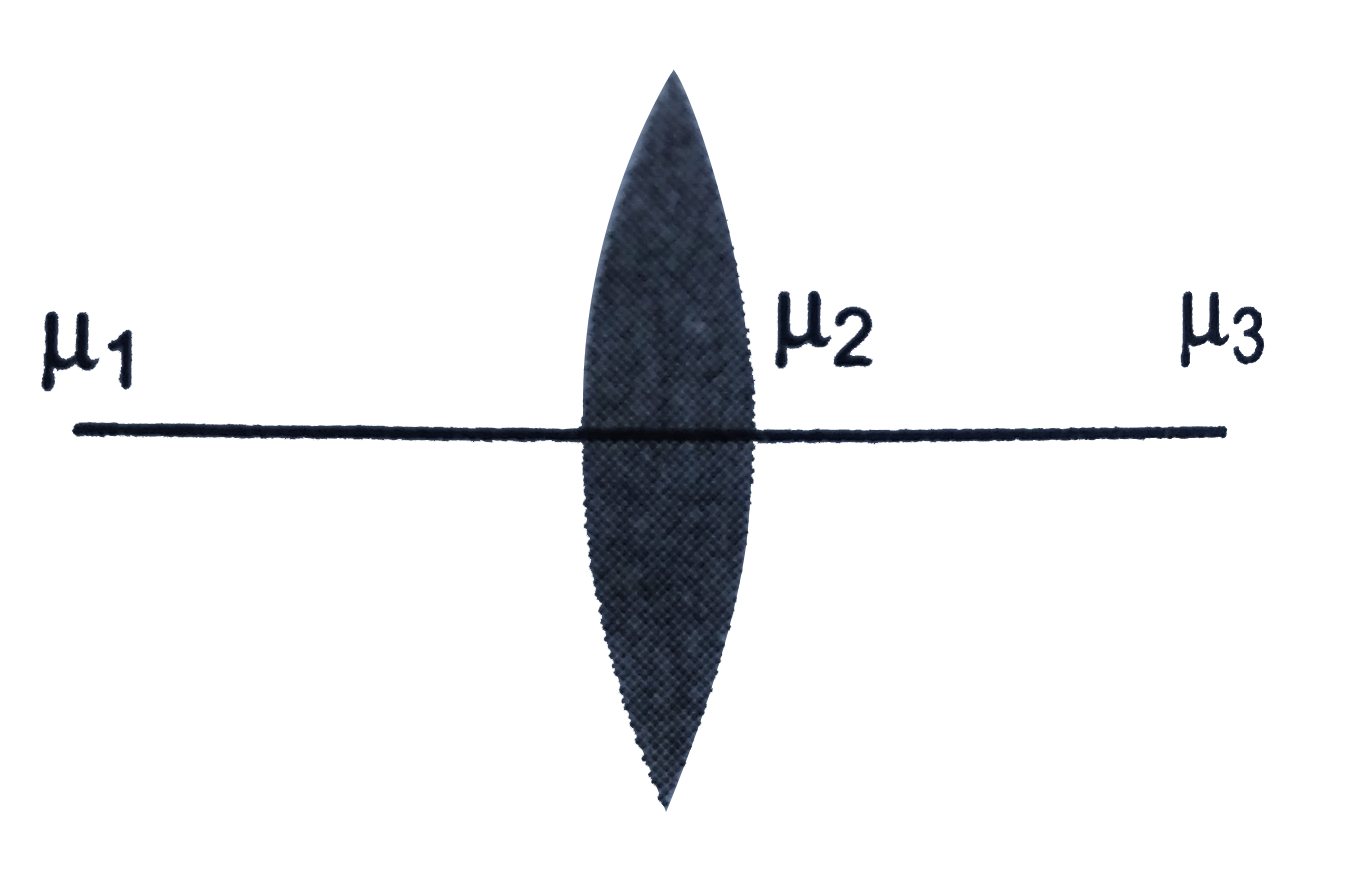
The figure shows an equi-convex lens. Wh...

The figure shows an equi-convex lens. What should be the condition of the refractive indices so that the lens becomes diverging?

A

`2mu_(3)gtmu_(1)-mu_(2)`

B

`2mu_(2)ltmu_(1)+mu_(3)`

C

`2mu_(2)gt2mu_(1)_mu_(3)`

D

None of the above

Text Solution

Verified by Experts

The correct Answer is:

B

(b) We have, `mu_(2)/v_(1)-mu_(1)/oo=(mu_(2)-mu_(1))/R`
and `mu_(3)/f-mu_(2)/v_(1)=(mu_(3)-mu_(2))/(-R)`
From Eqs. (i) and (ii) we get
`mu_(3)/f=(mu_(2)-mu_(1)-mu_(3)+mu_(2))/R=(2mu_(2)-(mu_(1)+mu_(3)))/R`
Lens will become diverging, if f is negative
i.e., `2mu_(2)lt(mu_(1)+mu_(3))`
Promotional Banner

Topper's Solved these Questions

  • RAY OPTICS

    DC PANDEY ENGLISH|Exercise medical entrance special format question|23 Videos
  • RAY OPTICS

    DC PANDEY ENGLISH|Exercise Medical entrance gallary|76 Videos
  • RAY OPTICS

    DC PANDEY ENGLISH|Exercise Checkpoint 9.7|10 Videos
  • NUCLEI

    DC PANDEY ENGLISH|Exercise C MADICAL ENTRANCES GALLERY|46 Videos
  • REFLECTION OF LIGHT

    DC PANDEY ENGLISH|Exercise Subjective|9 Videos

Similar Questions

Explore conceptually related problems

The diagram shows an equiconvex lens. What should be the condition on the refractive indices so that the lens becomes diverging?

Figure, shows a concavo-convex lens mu_(2) . What is the condition on the refractive indiecs so the at the lens is diverging?

Object O is kept in air in fron of a thin plano convex lens of radius of curvature 10cm. It's refractive index is 3//2 and the medium toward right of plane surface is water of refractive indec 4//3 . What should be the distance x of the object so that the rays become parrallel finall?

The power in dioptre of an equi-convex lens with radii of curvature of 10cm and refractive index 1.6 is

An object O is kept in air in front of a thin plano-convex lens of radius of curvature 10 cm. Its refractive index at 3//2 and the medium towards right of the plane surface is water of refractive index 4//3. What should be distance x of the object so that the rays becomes parallel finally?

A plano-convex lens is made of refractive index of 1.6. The focal length of the lens is

The radius of curvature of the curved surface of a plano-convex lens is 20 cm . If the refractive index of the material of the lens be 1.5 , it will

Find the radius of curvature of the convex surface of a plan-convex lens, whose focal length is 0.3 m and the refractive index of the material of the lens is 1.5.

A parallel beam of light falls successively on a thin convex lens of focal length 40 cm and then ono a thin convex lens of focal length 10cm as shown in figure. In figure, the second lens is an equi-concave lens of focal length 10cm and made of a material of refractive index 1.5. In both the cases, the second lens has an aperture equal to 1cm. Q. Compare the area illuminated by the beam of light on the screen, which passes through the second lens in the two cases. The ratio (A_(2)//A_(1)) will be

A parallel beam of light falls successively on a thin convex lens of focal length 40 cm and then ono a thini convex lens of focal length 10cm as shown in figure. In figure, the second lens is an equiconcave lens of focal length 10cm and made of a material of refractive index 1.5. In both the cases, the second lens has an aperture equal to 1cm. Q. Now, a liquid of refractive index mu is filled to the right of the second lens in case B such that the area illuminated in both the cases is the same. Determing the refractive index of the liquid.

DC PANDEY ENGLISH-RAY OPTICS-Exercise
  1. A light ray from air is incident (as shown in figure ) at one end of a...

    Text Solution

    |

  2. A thin convergent glass lens (mug=1.5) has a power of +5.0D. When this...

    Text Solution

    |

  3. The figure shows an equi-convex lens. What should be the condition of ...

    Text Solution

    |

  4. A ray of light makes an angle of 10^@ with the horizontal and strikes ...

    Text Solution

    |

  5. In the measurement of the angle of a prism using a spectrometer, the r...

    Text Solution

    |

  6. A thin rod of length d//3 is placed along the principal axis of a conc...

    Text Solution

    |

  7. The graph shown part of variation of v with change in u for a concave ...

    Text Solution

    |

  8. When an object is at distances x and y from a lens, a real image and a...

    Text Solution

    |

  9. A symmetric double convex lens is cut in two equal parts by a plane pe...

    Text Solution

    |

  10. A ray incident at a point at an angle of incidence of 60^(@) enters a ...

    Text Solution

    |

  11. The graph in Fig. shows how the inverse of magnification 1//m produced...

    Text Solution

    |

  12. A convex lens of focal length 30 cm forms a real image three times lar...

    Text Solution

    |

  13. An object is placed at 21 cm in front of a concave mirror of radius of...

    Text Solution

    |

  14. A thin prism P with angle 4^(@) and made from glass of refractive inde...

    Text Solution

    |

  15. A convex lens produces an image of a real object on a screen with a ma...

    Text Solution

    |

  16. An infinitely long rod lies along the axis of a concave mirror of foca...

    Text Solution

    |

  17. A plane mirror is placed horizontally inside water (mu=4/3). A ray fal...

    Text Solution

    |

  18. A point object is moving with a speed v before an arrangement of two m...

    Text Solution

    |

  19. If a ray of light in a denser medium strikes a rarer medium at an angl...

    Text Solution

    |

  20. A ray PQ incident on the refracting face BA is refracted in the prism ...

    Text Solution

    |
