

Home
Class 12
PHYSICS
A radioactive sample has N0 active at t ...

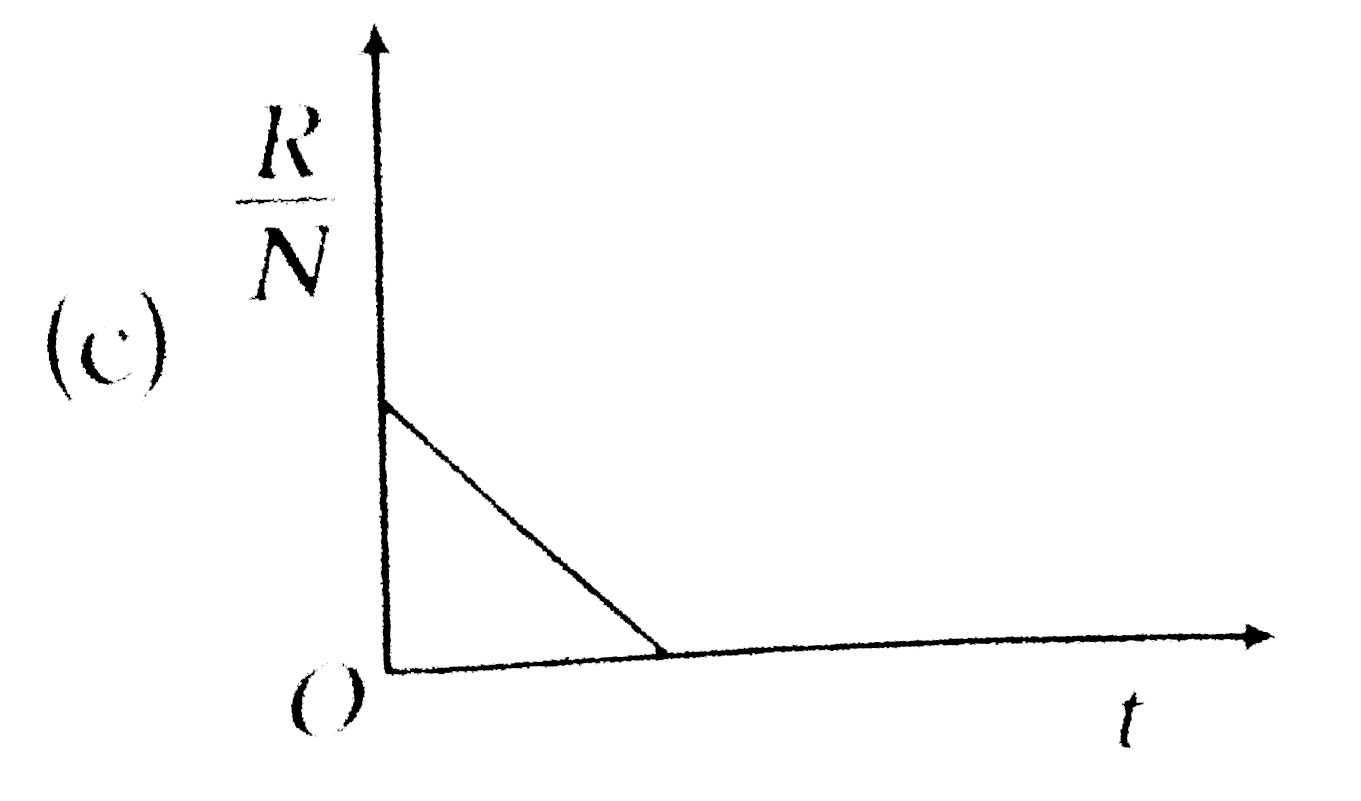
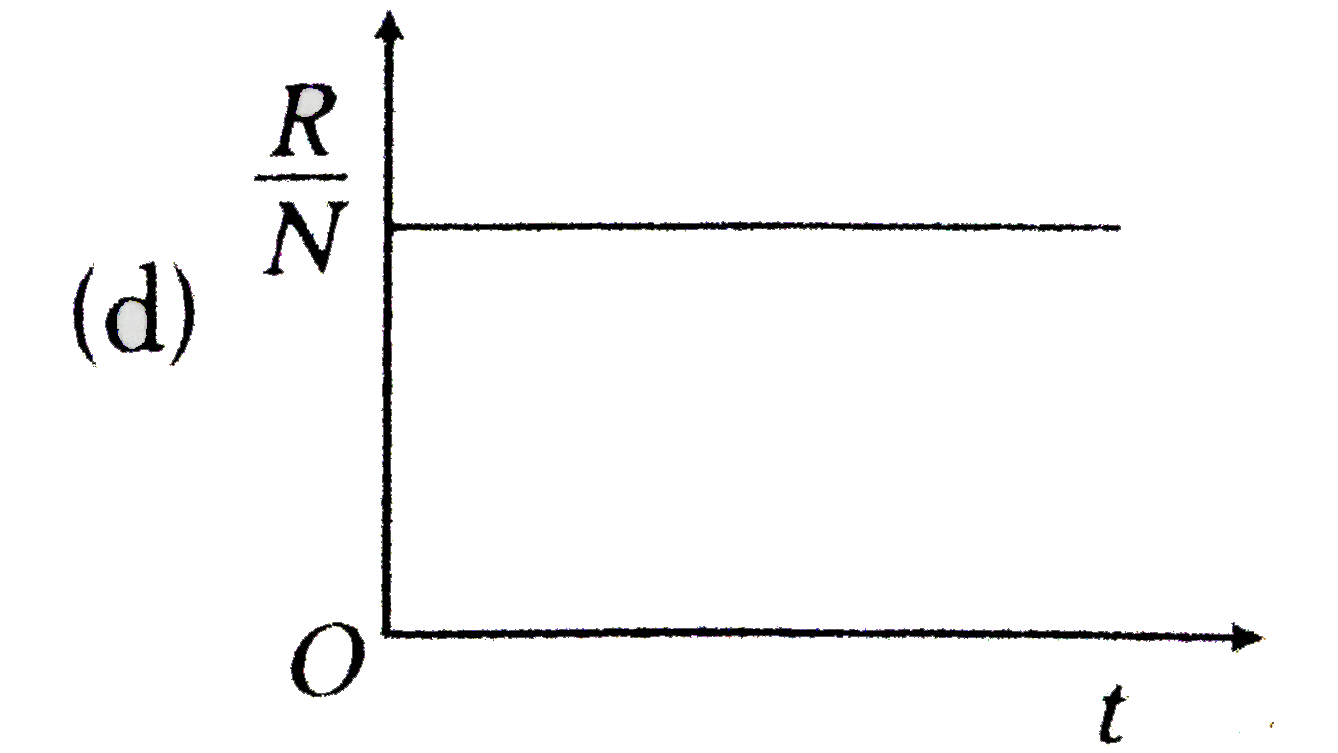
A radioactive sample has `N_0` active at `t = 0` . If the rate of disintegration at any time is `R` and the number of atoms is `N`, them the ratio `R//N` varies with time as.

A

B

C

D

Text Solution

AI Generated Solution

The correct Answer is:

To solve the problem step by step, we need to analyze the relationship between the rate of disintegration \( R \) and the number of radioactive atoms \( N \) over time. ### Step 1: Understand the relationship between \( R \) and \( N \) The rate of disintegration \( R \) is defined as the number of disintegrations per unit time. According to the principles of radioactive decay, the rate of disintegration can be expressed as: \[ R = -\frac{dN}{dt} \] This equation states that the rate of disintegration is equal to the negative rate of change of the number of atoms \( N \). ### Step 2: Express \( N \) in terms of time The number of radioactive atoms \( N \) at any time \( t \) can be expressed using the exponential decay formula: \[ N(t) = N_0 e^{-\lambda t} \] where \( N_0 \) is the initial number of atoms at \( t = 0 \) and \( \lambda \) is the decay constant. ### Step 3: Differentiate \( N(t) \) to find \( R \) To find the rate of disintegration \( R \), we differentiate \( N(t) \): \[ R = -\frac{dN}{dt} = -\frac{d}{dt}(N_0 e^{-\lambda t}) = N_0 \lambda e^{-\lambda t} \] ### Step 4: Find the ratio \( \frac{R}{N} \) Now, we can find the ratio \( \frac{R}{N} \): \[ \frac{R}{N} = \frac{N_0 \lambda e^{-\lambda t}}{N_0 e^{-\lambda t}} = \lambda \] This shows that the ratio \( \frac{R}{N} \) is equal to the decay constant \( \lambda \). ### Step 5: Analyze the result Since \( \lambda \) is a constant, we conclude that the ratio \( \frac{R}{N} \) does not vary with time. It remains constant as time progresses. ### Final Answer Thus, the ratio \( \frac{R}{N} \) varies with time as a constant value \( \lambda \). ---

To solve the problem step by step, we need to analyze the relationship between the rate of disintegration \( R \) and the number of radioactive atoms \( N \) over time. ### Step 1: Understand the relationship between \( R \) and \( N \) The rate of disintegration \( R \) is defined as the number of disintegrations per unit time. According to the principles of radioactive decay, the rate of disintegration can be expressed as: \[ R = -\frac{dN}{dt} \] This equation states that the rate of disintegration is equal to the negative rate of change of the number of atoms \( N \). ...
Promotional Banner

Topper's Solved these Questions

  • NUCLEI

    DC PANDEY ENGLISH|Exercise B Medical entrance special format questions|9 Videos
  • NUCLEI

    DC PANDEY ENGLISH|Exercise MATCH THE COLUMNS|4 Videos
  • NUCLEI

    DC PANDEY ENGLISH|Exercise CHECK POINT 13.3|15 Videos
  • MODERN PHYSICS - 2

    DC PANDEY ENGLISH|Exercise Level 2 Subjective|10 Videos
  • RAY OPTICS

    DC PANDEY ENGLISH|Exercise Medical entrance gallary|76 Videos

Similar Questions

Explore conceptually related problems

The rate of disintegration of a radioactive substance is …………………………… to the number of atoms present at that time .

The radioactive of a sample is R_(1) at a time T_(1) and R_(2) at a time T_(2) . If the half-life of the specimen is T , the number of atoms that have disintegrated in the time (T_(2)-T_(1)) is equal to (n(R_(1)-R_(2))T)/(ln4) . Here n is some integral number. What is the value of n?

The radioactivity of a sample is R_(1) at a time T_(1) and R_(2) at time T_(2) . If the half-life of the specimen is T, the number of atoms that have disintegrated in the time (T_(2) -T_(1)) is proporational to

When the quantity of a radioactive substance is increased two times, the number of atoms disintegrating per unit time is

A radioactive sample has initial concentration N_(0) of nuclei. Then,

A radioactive sample at any instant has its disintegration rate 5000 disintegrations per minute After 5 minutes , the rate is 1250 disintegration per minute. Then , the decay constant (per minute)

The activity of a radioactive sample is measures as N_0 counts per minute at t = 0 and N_0//e counts per minute at t = 5 min . The time (in minute) at which the activity reduces to half its value is.

The activity of a radioactive sample is measures as N_0 counts per minute at t = 0 and N_0//e counts per minute at t = 5 min . The time (in minute) at which the activity reduces to half its value is.

Half-life of a radioactive substance is T. At time t_1 activity of a radioactive substance is R_1 and at time t_2 it is R_2 . Find the number of nuclei decayed in this interval of time.

In a radioactive disintegration, the ratio of initial number of atoms to the number of atoms present at an instant of time equal to its mean life is

DC PANDEY ENGLISH-NUCLEI-CHAPTER EXERCISES
  1. The radioactivity of an element becomes (1)/(64)th of its original va...

    Text Solution

    |

  2. In the reaction ""(1)^(2)H+""(1)^(3)H to ""(2)^(4)He+""(0)^(1)n. If th...

    Text Solution

    |

  3. A radioactive sample has N0 active at t = 0 . If the rate of disintegr...

    Text Solution

    |

  4. The plot of the number (N) of decayed atoms versus activity (R) of a r...

    Text Solution

    |

  5. The graph between the instantaneous concentration (N) of a radioactive...

    Text Solution

    |

  6. Two redioactive materials X(1)andX(2) have decay constants 10lamdaandl...

    Text Solution

    |

  7. Two radioactive nuclei A and B are taken with their disintegration con...

    Text Solution

    |

  8. What is the binding energy per nucleon in ""2He^4 ? Given , Mass of ...

    Text Solution

    |

  9. A radio istoper X with a half-life 1.4xx10^(8) yr decays of Y which is...

    Text Solution

    |

  10. The energy released by the fission of a single uranium nucleus is 200 ...

    Text Solution

    |

  11. A common example of beta-"decay" is ""(15)P^(32)to""(16)P^(32)+x+y ...

    Text Solution

    |

  12. A nucleus with Z =92 emits the following in a sequence: alpha,beta^(...

    Text Solution

    |

  13. Two identical blocks A and B of equal masses are placed on rough incli...

    Text Solution

    |

  14. Tritium is an isotope of hydrogen whose nucleus triton contains 2 neut...

    Text Solution

    |

  15. The gravitational force between a H-atom and another particle of mass ...

    Text Solution

    |

  16. In a sample of radioactive material, what fraction of initial number o...

    Text Solution

    |

  17. In a radioactive sample, the fraction of initial number of redioactive...

    Text Solution

    |

  18. At any instant, the ratio of the amounts of two radioactive substance ...

    Text Solution

    |

  19. A radioactive isotope X with half-life 1.5xx10^(9) yr decays into a st...

    Text Solution

    |

  20. Find the decay rate of the substance having 4xx10^15 atoms. Half life ...

    Text Solution

    |
