Home
Class 12
PHYSICS
Match the Clumn I of the nuclear process...

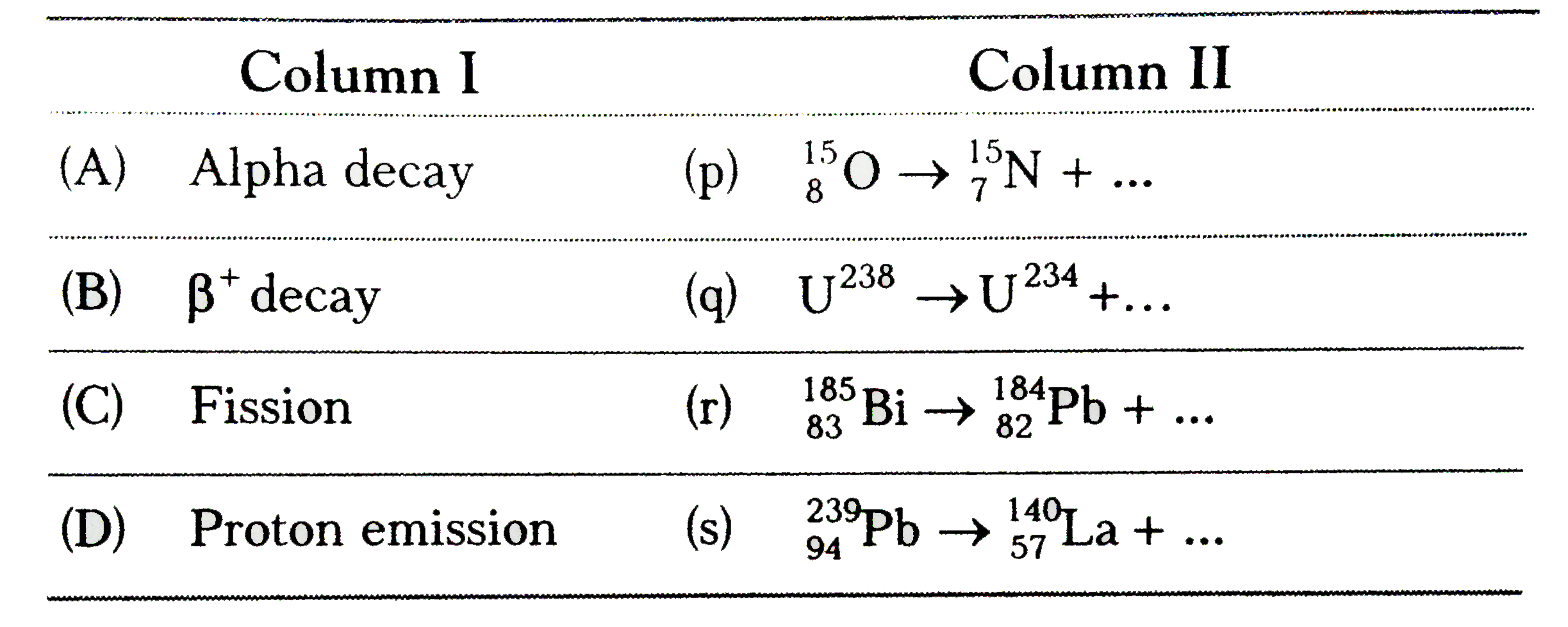
Match the Clumn I of the nuclear processes with Column II containing parent nucleus and one of the end products of each process.

Text Solution

Verified by Experts

The correct Answer is:

`(Atoq; Bto p; Cto s; Dto r)`

In `alpha` decay mass number decrease by 4 and atomic number decrease by 2.
in `beta^(+)` decay mass number remains unchanged while atomic number decrease by 1.
in fission parent nucleus break into almost two equal fragments in proton emission both mass number and atomic number decrease by 1.
Promotional Banner

Topper's Solved these Questions

  • NUCLEI

    DC PANDEY ENGLISH|Exercise C MADICAL ENTRANCES GALLERY|46 Videos
  • NUCLEI

    DC PANDEY ENGLISH|Exercise B Medical entrance special format questions|9 Videos
  • MODERN PHYSICS - 2

    DC PANDEY ENGLISH|Exercise Level 2 Subjective|10 Videos
  • RAY OPTICS

    DC PANDEY ENGLISH|Exercise Medical entrance gallary|76 Videos

Similar Questions

Explore conceptually related problems

Match List I of the nuclear processes with List II containing parent nucleus and one of the end produces of each process and then select the correct answer using the codes gives below the list:

Match the catalysts ( column I ) with products ( Column II)

Match the catalysts (column I) with products (Column II)

Match the catalyst given in Column I with the processes given in Column II.

Column I gives some devices and Column II gives some processes on which the functioning of these devices depend. Match the devices in Column I with the processes in Column II and indicate your answer by darkening appropriate bubbles in the 4 xx 4 matrix given in the ORS.

Match the terms given in Column I with their physiological processes given in Column II and choose the correct answer

Match the column in radioactive decay process of nucleus with atomic number Z and mass number A.

Match the reactions in Column I with nature of the reactions // type of the products in Column II.

Match the reactions in Column I with nature of the reactions // type of the products in Column II.
