Home
Class 12
CHEMISTRY
Based on the nature of order present in ...

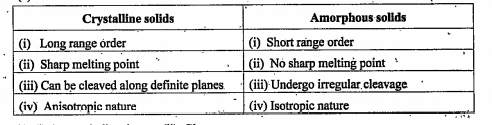
Based on the nature of order present in the arrangement of the constituent particles, solid are classified into two crystalline and amorphous.
List out any four points of difference between crystalline and amorphous solids.

Text Solution

Verified by Experts
Promotional Banner

Topper's Solved these Questions

  • SURFACE CHEMISTRY

    A N EXCEL PUBLICATION|Exercise QUESTION BANK|65 Videos

Similar Questions

Explore conceptually related problems

Based on the nature of order, present in the arrangement of the constituent particles, solids are classified into two, crystalline and amorphous. List out any four points of difference between crystalline end amorphous solids. b) Alist of solids are given below : Quartz, glass, iodine, ice. From this, identify crystal (s) i) having sharp melting point. ii) which is/are isotropic

List out any three important differences between order and molecularity.

List any two points of difference between Lithium and other alkali metals. Give reasons.

Some solids have regular order arrangement and others not. List out the difference between CCP and HCP solids.

Based on the nature of reproduction, organisms are classified as continuous breeders and seasonal breeders. Write the difference between the two.

Frenkel defect and Shottky defects are two stoichiometric defects found in crystalline solids. Write any two differences between Frenkel defect and Schottky defect.

In a class room discussion about order and molecularity of a chemical reaction, Ramu argued that “there are reactions which appear to be of higher order but actually follow first order kinetics.List out any three Important differences between order and molecularity.

Classify the following into crystalline and amorphous solids. NaCl ,Graphite , Plastic, Diamond, Rubber, KCI, Wood, CaC0_3 , Iodine .

Assertion : In crystalline solids, the value of resistance is different in different directions. Reason : Crystalline solids are isotropic in nature.

Based on the nature of Infermolecular forces classify the solids into different categories.Potassium sulphate, Tin, Brass, Naphthalene, Ammonia, Water, Zinc sulphide, Graphite, Argon, Silicon carbide, Phosphorus.

A N EXCEL PUBLICATION-THE SOLID STATE-QUESTION BANK
  1. Schematic alignment of magnetic moments of ferromagnetic, antiferromag...

    Text Solution

    |

  2. Schematic alignment of magnetic moments of ferromagnetic, antiferromag...

    Text Solution

    |

  3. Based on the nature of order present in the arrangement of the constit...

    Text Solution

    |

  4. A list of solids are given below: Quartz, glass, iodine, ice. From...

    Text Solution

    |

  5. A list of solids are given below: Quartz, glass, iodine, ice. From...

    Text Solution

    |

  6. Crystal defects give rise to certain special properties in the solids....

    Text Solution

    |

  7. Crystal defects give rise to certain special properties in the solids....

    Text Solution

    |

  8. Crystal defects give rise to certain special properties in the solids....

    Text Solution

    |

  9. A cubic unit cell is characterised by a=b=c and alpha=beta=gamma=90^@ ...

    Text Solution

    |

  10. A cubic unit cell is characterised by a=b=c and alpha=beta=gamma=90^@ ...

    Text Solution

    |

  11. A cubic unit cell is characterised by a=b=c and alpha=beta=gamma=90^@ ...

    Text Solution

    |

  12. Solids can be classified into three types on the basis of their electr...

    Text Solution

    |

  13. Solids can be classified into three types on the basis of their electr...

    Text Solution

    |

  14. Schottky and frenkel defects are stoichiometric defects. Write any tw...

    Text Solution

    |

  15. Schottky and frenkel defects are stoichiometric defects. When pure NaC...

    Text Solution

    |

  16. NaCl has fcc structure. Calculate the number of NaCl unit cell of NaCl

    Text Solution

    |

  17. Calculate the density of NaCl, if the edge length of NaCl unit cell is...

    Text Solution

    |

  18. Unit cell can be broadly classified into 2 categories-primitive and ce...

    Text Solution

    |

  19. Unit cell can be broadly classified into 2 categories-primitive and ce...

    Text Solution

    |

  20. The unit cell dimension of a particular crystal system is a=b=c, alpha...

    Text Solution

    |

