Home
Class 12
CHEMISTRY
Transition elements are d-block elements...

Transition elements are d-block elements, with some exceptions. Usually they are paramagnetic. They show variable oxidation states. They and their compounds show catalytic property. Which is more paramagnetic: `Fe^(2+)or Fe^(3+)`. Why?

Text Solution

Verified by Experts
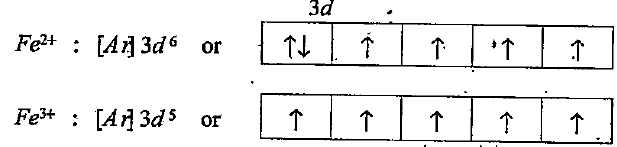
The electronic configurations of `Fe^(2+)` and `Fe^(3+)` are given below: Since `Fe^(3+)` has more unpaired electrons, it is more paramagnetic.
Promotional Banner

Topper's Solved these Questions

  • COORDINATION COMPOUNDS

    A N EXCEL PUBLICATION|Exercise QUESTION BANK|86 Videos
  • ELECTROCHEMISTRY

    A N EXCEL PUBLICATION|Exercise QUESTION BANK|80 Videos

Similar Questions

Explore conceptually related problems

Transition elements are d-block elements, with some exceptions. Usually they are paramagnetic. They show variable oxidation states. They and their compounds show catalytic property What is the reason for their catalytic property?

Transition elements are d-block elements, with some exceptions. Usually they are paramagnetic. They show variable oxidation states. They and their compounds show catalytic property Zn (atomic number 30) is not a transition element, though it is a d-block element. Why?

Which elements shows +2 oxidaion state?

Which elements shows -2 oxidaion state?

Write the reason for the statement given below: Transition elements shows variable oxidation state.

Magnanese, a d-block elements exhibits different oxidation state.Why?

Transition elements generally have high enthalpy of atomisation and they show variable oxidation states Why do transition elements exhibit higher enthalpies of atomisation?

Name transition element which does not exhibit variable oxidation state.

Transition elements generally have high enthalpy of atomisation and they show variable oxidation states Which element of the 3d series shows the largest number of oxidation states? Explain the reason for it.

Transition elements show variable oxidation state. a) Do you agree with, this statement? b) Illustrate with an example

A N EXCEL PUBLICATION-D AND F - BLOCK ELEMENTS-QUESTION BANK
  1. E^@ (standard electrode potential) values generally become less negati...

    Text Solution

    |

  2. Transition elements are d-block elements, with some exceptions. Usuall...

    Text Solution

    |

  3. Transition elements are d-block elements, with some exceptions. Usuall...

    Text Solution

    |

  4. Which of the 3d series of elements exhibits the largest number of oxid...

    Text Solution

    |

  5. Transition elements are d-block elements, with some exceptions. Usuall...

    Text Solution

    |

  6. Describe the method of preparation of potassium dichromate from chromi...

    Text Solution

    |

  7. Write any one consequence of lanthanoid contraction.

    Text Solution

    |

  8. Transition elements are d- block elements Write any four characteristi...

    Text Solution

    |

  9. Account for the following: Atomic radius decreases from left to right ...

    Text Solution

    |

  10. Account for the following trends in atomic and ionic radii of transiti...

    Text Solution

    |

  11. Account for the following trends in atomic and ionic radii of transiti...

    Text Solution

    |

  12. Lanthanides and actinoids are f-block elements What is the common oxi...

    Text Solution

    |

  13. Name two important compounds of transition elements.

    Text Solution

    |

  14. Transition elements form a large number of complex compounds. Why?

    Text Solution

    |

  15. d- block elements belong to groups 3-12 in the periodic table, in whic...

    Text Solution

    |

  16. Potassium dichromate is an orange coloured crystal and is an important...

    Text Solution

    |

  17. Potassium dichromate is an orange colour crystal and is an important c...

    Text Solution

    |

  18. What are the characteristics of transition elements?

    Text Solution

    |

  19. Potassium permanganate and potassium dichromate are two transition met...

    Text Solution

    |

  20. Potassium permanganate and potassium dichromate are two transition met...

    Text Solution

    |

