

Home
Class 12
BIOLOGY
The picture given below shows the techni...

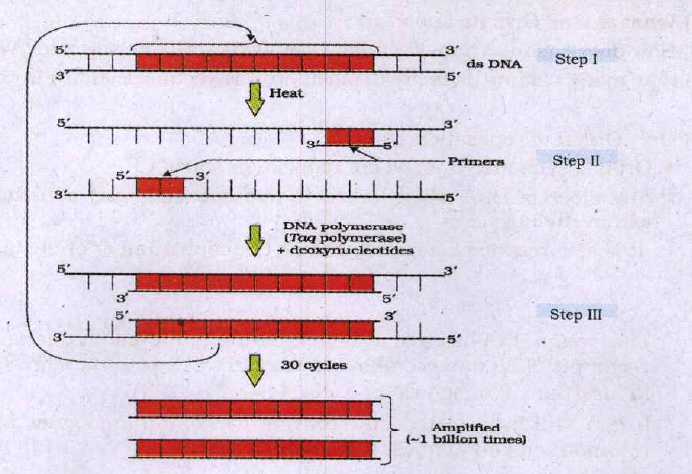
The picture given below shows the technique used for generating multiple copies of the gene of interest.

(a) What is the technique called?
(b) Name the reactions at step I, step II and step III.
(c.) Explain the principle underlying this techniques of DNA amplification.

Promotional Banner

Similar Questions

Explore conceptually related problems

Multiple copies of the gene of interest in synthesized in vitro using DNA polymerase enzyme. Which are the three steps of the above process?

Use of thermostable DNA polymerase from the bacterium Thermus aquatics,made it possible to generate billion copies of DNA in a very short time using a process. (a) Name the Process. (b) Name the three important steps involved in this process.

The preparation of herbarium is called herbarium technique. a. Give the various steps in herbarium technique. b. Name the largest herbarium of the world. c. Name the largest herbarium in India.

By observing the given diagram and answer the following questions: (a) Name the technique mentioned in the given diagram. (b) The last step of this identified technique is Elution. What is meant by elution.

Names of some minerals are given below. .i) Haematite ii) bauxite iii) Dolomite a. Identify the mineral of Iron (Fe) b. Name the reducing agent mainly used in the extraction of iron from its ore. c. What is the role of powdered lime stone in the extraction process of iron?

Following are the various steps of recombinant DNA technology. Arrange them in correct sequential order. i. Obtaining the foreign gene product ii. Amplification of gene of interest using PCR. iii. Cutting of DNA at specific locations. iv. Downstream processing. v. Insertion of recombinant DNA into the host cell/organism. vi. Isolation of genetic material.

The details of the hydrocarbon 'P' are given below. i) There are 3 carbon atoms. ii) The family of compounds with 'P' as a member has a general formula C_(n)H_(2n) iii) The IUPAC name of 'P' is propene. a) Write the condensed formula of the compound b) Write the IUPAC name of the compound which is before 'P' in the homologous series. c) Give the molecular formula of the compound succeeding 'P' in the series.