Home
Class 11
CHEMISTRY
The first IE and second IE (Kj mol^(-1)...

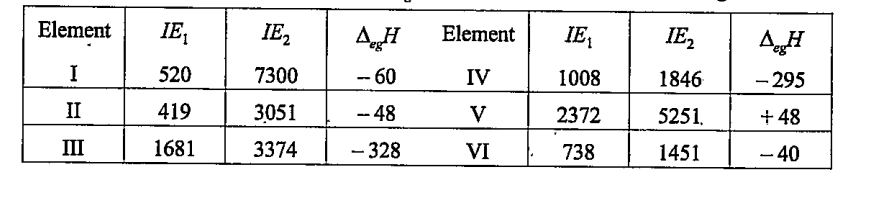
The first IE and second IE `(Kj mol^(-1))` and `dalta_egH(kJ mol^(-1))` of a few elements are given below:
Which of the above is likely to be the metal that can from perdominantly stable covalent halide (MX) ?

Text Solution

Verified by Experts

Element I (low `IE_1,high IE_2` So it is an alkali metal)
Promotional Banner

Topper's Solved these Questions

  • CHEMICAL BONDING AND MOLECULAR STRUCTURE

    A N EXCEL PUBLICATION|Exercise QUESTION BANK|65 Videos
  • ENVIRONMENTAL CHEMISTRY

    A N EXCEL PUBLICATION|Exercise QUESTION BANK |31 Videos

Similar Questions

Explore conceptually related problems

The first IE and second IE (Kj mol^(-1)) and dalta_egH(kJ mol^(-1)) of a few elements are given below: Which of the above is likely to be the metal that can from stable binary halide (MX_2)

The first IE and second IE (Kj mol^(-1)) and dalta_egH(kJ mol^(-1)) of a few elements are given below: Which of the above is likely to be the least reactive element

The first IE and second IE (Kj mol^(-1)) and dalta_egH(kJ mol^(-1)) of a few elements are given below: Which of the above is likely to be the least reactive non-metal

Which of the following statements are correct? Fuel cells are galvanic cells in which the chemical energy of fuel is directly converted into electrical energy. Type of fuel cell is a hydrogen - oxygen fuel cell. It consists of two electrodes made up of two porous graphite impregnated with a catalyst (platinum, silver, or metal oxide). The electrodes are placed in aqueous solution of NaOH. Oxygen nad hydrogen are continuously fed into the cell. Hydrogen gets oxidized to H^(oplus) which is neutralized by overset(Θ)(OH) , ie., anodic reaction. H_(2) hArr 2H^(oplus) + 2e^(-) 2H^(oplus) + 2 overset(Θ)(OH) hArr 2H_(2)O H_(2) + 2 overset(Θ)(OH) hArr 2H_(2)O + 2e^(-) At cathode, O_(2) gets reduced to overset(Θ)(OH) i.e., O_(2) + 2H_(2)O + 4e^(-) hArr overset(Θ)(4)OH Hence, the net reaction is 2H_(2) + O_(2) hArr 2H_(2)O The overall reaction has Delta H= -285.6kJ mol^(-1) and Delta G= -237.4kJ mol^(-1) " at " 25^(@)C A fuel cell is I. A voltaic cell in which continuous supply of fuels are sent at anode to perform oxidation II. A voltaic cell in which fuels such as CH_(4), H_(2) and CO are used up at anode. III. One which involves the reaction of H_(2)- O_(2) fuel cell such as: Anode 2H_(2) + 4 overset(Θ)(OH) rarr 4H_(2)O(I) + 4e^(-) cathode : O+ 2H_(2)O(I) + 4e^(-) rarr 4 overset(Θ)(OH) IV. The efficiency of H_(2)-O_(2) fuel cell is 70 to 75%

The first IE (Kj mol^(-1)) of group 13 elements are B/801 Al/577 Ga/579 In/558 Tl/589 How would you explain the deviation from general trend ?

A catalyst lowers the activation energy from 20 kJ mol^(-1) to 15 kJ mol^(-1) of the forward direction of the reaction A rarr B which of the following statement regarding the reaction is correct

Fuel cells are galvanic cells in which the chemical energy of fuel is directly converted into electrical energy. Type of fuel cell is a hydrogen - oxygen fuel cell. It consists of two electrodes made up of two porous graphite impregnated with a catalyst (platinum, silver, or metal oxide). The electrodes are placed in aqueous solution of NaOH. Oxygen nad hydrogen are continuously fed into the cell. Hydrogen gets oxidized to H^(oplus) which is neutralized by overset(Θ)(OH) , ie., anodic reaction. H_(2) hArr 2H^(oplus) + 2e^(-) 2H^(oplus) + 2 overset(Θ)(OH) hArr 2H_(2)O H_(2) + 2 overset(Θ)(OH) hArr 2H_(2)O + 2e^(-) At cathode, O_(2) gets reduced to overset(Θ)(OH) i.e., O_(2) + 2H_(2)O + 4e^(-) hArr overset(Θ)(4)OH Hence, the net reaction is 2H_(2) + O_(2) hArr 2H_(2)O The overall reaction has Delta H= -285.6kJ mol^(-1) and Delta G= -237.4kJ mol^(-1) " at " 25^(@)C Suppose the concentration of hydroxide ion in the cell is doubled, then the cell voltage will be

A N EXCEL PUBLICATION-CLASSIFICATION TO ELEMENTS AND PERIODICITY IN PROPERTIES-QUESTION BANK
  1. The first IE and second IE (Kj mol^(-1)) and daltaegH(kJ mol^(-1)) of...

    Text Solution

    |

  2. The first IE and second IE (Kj mol^(-1)) and daltaegH(kJ mol^(-1)) of...

    Text Solution

    |

  3. The first IE and second IE (Kj mol^(-1)) and daltaegH(kJ mol^(-1)) of...

    Text Solution

    |

  4. Predict the formulae of stable binary compounds that would be the form...

    Text Solution

    |

  5. Predict the formulae of stable binary compounds that would be the form...

    Text Solution

    |

  6. Predict the formulae of stable binary compounds that would be the form...

    Text Solution

    |

  7. Predict the formulae of stable binary compounds that would be the form...

    Text Solution

    |

  8. Predict the formulae of stable binary compounds that would be the form...

    Text Solution

    |

  9. Predict the formulae of stable binary compounds that would be the form...

    Text Solution

    |

  10. In the modern periodic table, the period indicates the value of

    Text Solution

    |

  11. The size of iso electronic species F-Ne and Na^+ is affected by

    Text Solution

    |

  12. Considering the elements B,Al,Mg and K, the correct order of their me...

    Text Solution

    |

  13. considering the elements F,Cl, O and N, the correct order their chemic...

    Text Solution

    |

  14. Account for the following: Ionisation enthalphy of nitrogen is greater...

    Text Solution

    |

  15. Account for the following: Atomic radius decreases from left to right ...

    Text Solution

    |

  16. Account for the following: Electronic gain enthalphy of F is less nega...

    Text Solution

    |

  17. Development of priodic table have made the study of elements and their...

    Text Solution

    |

  18. Development of priodic table have made the study of elements and their...

    Text Solution

    |

  19. Development of priodic table have made the study of elements and their...

    Text Solution

    |

  20. A graph of aromic radius versus atomic number is given blow: What do y...

    Text Solution

    |

