Home
Class 11
PHYSICS
A system goes from A and B via two proce...

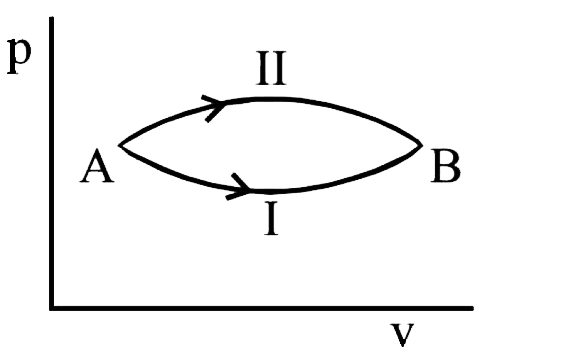
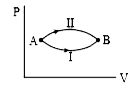
A system goes from A and B via two processes. I and II as shown in figure. If `DeltaU_1 and DeltaU_2` are the changes in internal energies in the processes I and II respectively, then

A

`DeltaU_(1)=DeltaU_(2)`

B

relation between `DeltaU_(1) and DeltaU_(2)` cannot be determined

C

`DeltaU_(2) gt DeltaU_(1)`

D

`DeltaU_(2) lt DeltaU_(1)`

Text Solution

Verified by Experts

The correct Answer is:
A


`:' (DeltaU)_(I)=(DeltaU)_(II)`
& [depends only on path not upon initial and final state]
Promotional Banner

Similar Questions

Explore conceptually related problems

A system goes from A and B via two processes. I and II as shown in figure. If DeltaU_1 and DeltaU_2 are the changes in internal enregies in the processes I and II respectively, then

A system goes from A to B via two processes I and II as shown in the figure. If DeltaU_(1) and DeltaU_(2) are the changes in the internal energies in the processes I and II respectively, then -

A system goes from state A to B via two processes I and II, as shown in Fig. 12.25, How are delta mu_1 and delta mu_2 (the changes in internal energies in the processes I and II) related to each other ?

Refer to let DeltaU_(1) and DeltaU_(2) be the changes in internal energy of the system in the processes A and B. then

Two path 1 and 2 are shown in figure. If the change in internal energies are U_1 , and U_2 for path 1 and 2 respectively, then

An ideal gas goes from State A to state B via three different process as indicate in the P-V diagram. If Q_(2), Q_(3) indicates the heat absorbed by the gas along the three processes and DeltaU_(1), DeltaU_(2), DeltaU_(3) indicates the change in internal energy along the three processes respectively, then

shows two processes A and B on a system.Let DeltaQ_(1) and DeltaQ_(2) be the heat given to the system in processes A and B respectively. Then

What will be nature of change in internal energy in case of processes shown below ?

Observe the given figure and identify the process (I) and (II)

VIDYAMANDIR CLASSES (VMC MODULES)-QUIZ-PHYSICS
  1. In the following cyclic process is The above process in the P-T c...

    Text Solution

    |

  2. An ideal gas is expanded so that amount of heat given is equal to the ...

    Text Solution

    |

  3. In adiabatic process, the pressure is increased by 2//3%. If gamma=3/...

    Text Solution

    |

  4. A system goes from A and B via two processes. I and II as shown in fig...

    Text Solution

    |

  5. A diatomic ideal gas is heated at constant at constant volume until th...

    Text Solution

    |

  6. Four spring connect with mass as shown in figure. Find frequency of S....

    Text Solution

    |

  7. A uniform rod of length 2.0 m is suspended through an end and is set i...

    Text Solution

    |

  8. A uniform spring whose unstretched length is l has a force constant k....

    Text Solution

    |

  9. A clock with an iron pendulum keeps correct time at 20^(@)C. How much ...

    Text Solution

    |

  10. A particle executes SHM along a straight line so that its period is 12...

    Text Solution

    |

  11. A conducting shell of radius R carries charge -Q. A point charge +Q is...

    Text Solution

    |

  12. A uniformly charged and infinitely long line having a linear charge de...

    Text Solution

    |

  13. For a uniformly charged non conducting sphere of radius R which of fol...

    Text Solution

    |

  14. Two point charges q and –q are at positions (0,0,d) and (0,0, –d) resp...

    Text Solution

    |

  15. Two particles of mass m and 2m with charges 2q and q are placed in a u...

    Text Solution

    |

  16. A thin spherical conducting shell of radius R has a charge q. Another ...

    Text Solution

    |

  17. Two connectric spheres of radii R and r have similar charges with equa...

    Text Solution

    |

  18. An electric dipole of dipole moment 2xx10^(-10) coulomb is placed be...

    Text Solution

    |

  19. A rod of length 'l' is placed along x-axis. One of its ends is at the...

    Text Solution

    |

  20. The electirc potential at a point (x, y, z) is given by V = -x^(2)y ...

    Text Solution

    |

