Home
Class 12
CHEMISTRY
Explain the mechanism of SN1 reaction ta...

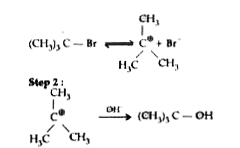
Explain the mechanism of `S_N1` reaction taking 2-bromo-2-methyl propane (t-butyl bromide)

Text Solution

Verified by Experts

Detailed Answer:
Tertiary butyl bromide. When treated with aqueous KOH, tertiary butyl alcohol is formed.
`(CH_(3))_(3)C-Br+KOH to (CH_(3))C-OH+KBr`.
The `S_(N.)` reaction mechanism involves two steps.
Step-(i): Formation of Carbonation.
Tertiary butyl bromide undergoes ionization to form tertiary carbo cation of bromide ion.
`CH_(3)-underset(CH_(3))underset(|)overset(CH_(3))overset(|)C-Br overset("Slow")to CH_(3)-underset(CH_(3))underset(|)overset(CH_(3))overset(|)C+Br^(-)`
This step is the slow step is hence is a rate determining step.
Step- (ii): Attack of nuclephile on carbocation.
The nucleophile `OH^(-)` attacks the positive centre of carbocation from any one of the direction forming the final product i.e., tertiary butyl alcohol.
`CH_(3)-underset(CH_(3))underset(|)overset(CH_(3))overset(|)(C^(+))+OH^(-) overset("Fast")to CH_(3)-underset(CH_(3))underset(|)overset(CH_(3))overset(|)C-OH`
Promotional Banner

Topper's Solved these Questions

  • SOLVED PAPER II PUC APRIL-2016

    OSWAAL PUBLICATION|Exercise PART-C |13 Videos
  • Solved Paper 4

    OSWAAL PUBLICATION|Exercise exercise|62 Videos
  • SOLVED PAPER II PUC JULY - 2016

    OSWAAL PUBLICATION|Exercise PART -E|19 Videos

Similar Questions

Explore conceptually related problems

Rate of S_(N^2) reaction is :

(a) Write the equations for the steps involved in the S_(N)1 mechanism of hydrolysis of 2-bromo 2 methyl propane. (b) (i) Name the product formed for the reaction of isopropyl iodide on alcoholic KOH. (ii) What is the condition to be satisfied for a compound to be chiral? (c) What is racemic mixtures?

The chain isomer of 2-methyl propanal is

a) Write S_(N)1 mechanism for the hydrolysis of 2-Bromo-2-methyl propane. Why are S_(N)1 reactions generally carried in polar protic solvents?

S_(N^1) and S_(N^2) reactions are

OSWAAL PUBLICATION-SOLVED PAPER II PUC APRIL-2016 -PART-D
  1. Derive an integrated rate equation for the rate constant of a zero ord...

    Text Solution

    |

  2. Draw a graph of potential energy v/s reaction co-ordinate showing the ...

    Text Solution

    |

  3. Mention any three differences between lyophilic and lyophobic colloids...

    Text Solution

    |

  4. What is heterogeneous catalysis ? Give an example.

    Text Solution

    |

  5. Explain the mechanism of SN1 reaction taking 2-bromo-2-methyl propane ...

    Text Solution

    |

  6. Explain wurtz-Fitting's reaction

    Text Solution

    |

  7. Write the general formula of Grignard reagent

    Text Solution

    |

  8. How is phenol manufactured by Cumene process?

    Text Solution

    |

  9. Among alcohols and phenols which one is more acidic?

    Text Solution

    |

  10. Explain the mechanism of addition of HCN to a carbonyl group in presen...

    Text Solution

    |

  11. How is bezamide obtained from benzoic acid ?

    Text Solution

    |

  12. Explain Carbyl amine reaction

    Text Solution

    |

  13. What is the action of bromine water on Benzenamine (Aniline) at room t...

    Text Solution

    |

  14. The pkb values of Ammonia, methanamine and Benzenamic (aniline) are 4....

    Text Solution

    |

  15. How do you show that glucose contains a linear chain of six carbon ato...

    Text Solution

    |

  16. What are essential amino acids?Is glycine an essential amino acid ?

    Text Solution

    |

  17. Write the general formula of Zwitter ionic form of an amino acid

    Text Solution

    |

  18. Explain addition polymerisation with an example.

    Text Solution

    |

  19. Name the monomers usedl in the manufacture of Nylon-6, 6.

    Text Solution

    |

  20. Write the partial structure of Neoprene

    Text Solution

    |

