Home
Class 12
CHEMISTRY
Write equations for the steps in S(N)1 m...

Write equations for the steps in `S_(N)1` mechanism of conversion of tertiary butyl bromide into tertiary butyl alcohol.

Text Solution

Verified by Experts
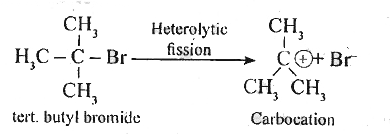
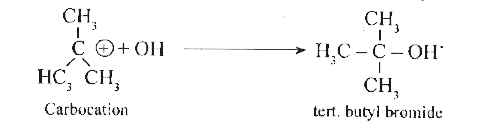
Steps involvoed in SN1 mechanism
Step 1 : Formation of carbocation

Step 2 : Attack of nucleophile to the carbocation for tertiary butyl alcohol.
Promotional Banner

Topper's Solved these Questions

  • SUPPLEMENTARY EXAM QUESTION PAPER JULY - 2018

    SUNSTAR PUBLICATION|Exercise PART - C|11 Videos
  • K-CET-CHEMISTRY-2019

    SUNSTAR PUBLICATION|Exercise Question|60 Videos
  • SUPPLEMENTARY EXAM QUESTION PAPER JULY - 2015

    SUNSTAR PUBLICATION|Exercise PART - D|30 Videos

Similar Questions

Explore conceptually related problems

a) i) write the equations for the steps in SN1 mechanism of the conversion of tertiary butyl bromide in to tertiary butyl alcohol. ii) Haloarenes are less reactive towards nucleophilic substitution reactions than Haloalkanes. Give a reason.

Write equations for the steps in SN^1 mechanism of the conversion of tert.butyl bromide into tert.butyl alcohol.

Write the equations for the steps in SN-1 mechanism of the convertion of tert-Butyl bromide into tert-butyl alcohol.

Write steps involved in S_(N)1 mechanism to the conversion of tertiary butyl bromide into tertiary butyl alcohol and mention its order.

(a) Write the equations for the steps involved in SN^(1) mechanism for the conversion of tert-butyl bromide to tert-butyl alcohol.

Write the equations for the steps in SN^(1) mechanism of the conversion of the conversion of tert -butyl bromide into tert-butyl alcohol.

(a) Explain S_(N)1 mechanism for the conversion of tertiary butyl bromide to tertiary butyl alcohol. (b) Complete the following reactions : (i) CH_(3) - CH = CH_(2) + HI rarr (ii) (iii) CH_(3)CH_(2)Br underset("Aq Ethanol")overset(AgCN)rarr

Write SN^(2) mechanism of the conversion of methyl chloride to methyl alcohol.

SUNSTAR PUBLICATION-SUPPLEMENTARY EXAM QUESTION PAPER JULY - 2018-PART - D
  1. Draw a graph of potential energy V/S reaction co - ordinates showing t...

    Text Solution

    |

  2. Write any two characteristics of chemical adsorption.

    Text Solution

    |

  3. What is Brownain movement ? What is the cause for it ?

    Text Solution

    |

  4. What is homogenous catalysis? Give an example.

    Text Solution

    |

  5. Write equations for the steps in S(N)1 mechanism of conversion of tert...

    Text Solution

    |

  6. Explain Wurtz-Fitting reaction with equation.

    Text Solution

    |

  7. CH(3)Cl + NaI overset("Dry acetone")rarr CH(3)I + NaCl. Name the above...

    Text Solution

    |

  8. Write the mechanism of acid catalysed dehydration of ethanol to ethene...

    Text Solution

    |

  9. How does anisole react with bromine in ethanoic acid ? Give equation.

    Text Solution

    |

  10. Complete the following equations : (i) (iii) CH(3)COONa overset(N...

    Text Solution

    |

  11. Explain esterification reaction with an example.

    Text Solution

    |

  12. How is methylamine prepared by Hoffmann bromamide degradation reaction...

    Text Solution

    |

  13. How is aniline converted to Benzene diazonium chloride ? Give equation...

    Text Solution

    |

  14. b) What is Hinsberg's reagent? Between CH(3)NH(2) and C(6)H(5)NH(2) wh...

    Text Solution

    |

  15. Write Haworth structure for maltose.

    Text Solution

    |

  16. What are non - essential amino acids? Name naturally occurring cc - am...

    Text Solution

    |

  17. Which vitamin deficiency causes the disease 'scurvy' ?

    Text Solution

    |

  18. How is nylon 6,6 prepared ? Give equation.

    Text Solution

    |

  19. Write the partial structure of i) Polythene ii) Neoprene.

    Text Solution

    |

  20. Name the monomer present in natural rubber.

    Text Solution

    |