

Home
Class 9
MATHS
In the picture below, the lines parallel...

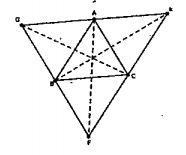
In the picture below, the lines parallel to each side of the blue triangle through the opposite vertex are drawn to make the big triangle.
How many triangles in the picture have the same area as that of the blue triangle.

Promotional Banner

Topper's Solved these Questions

  • CIRCLES

    MAXIMUM PUBLICATION|Exercise EXAMPLE|10 Videos

Similar Questions

Explore conceptually related problems

In the picture below, the lines, parallel to side of triangle A B C through the оррosite vertex are drawn to make the triangle PQR. a) Draw this picture, Draw the lines BQ, CP and AR. b) The triangles. ABP, AQC and BRC have the same arẹa as that of triangle A B C. Why? c) Find another 4 triangles of same area as that of triangle A B C from the picture which you have drawn and write their names.

Prove that the two triangles shown below have the same area

Calculate the perimeter and area of the triangle in the picture.

Calculate.the perimeter and area of the triangle in the picture.

We have seen how we can draw a series of right triangles as in the picture. What are the lengths of the sides of the tenth triangle? .

The perpendicular from the square corners of a right angle triangle cuts the opposite side into two parts of 2 and 3 cm length.Prove that two small triangles cut by the perpendicular have the same angles.

In the picture below, two lines are drawn from the top vertex of a triangle to the bottom side: Prove that the ratio in which these lines divide the length of the bottom side is equal to the ratio of the area of the three smaller triangles in the picture.

In the picture below, the top vertex of a triangle is joined to the midpoint of the bottom side of the triangle and then the midpoint of this line is joined to the other two vertices. Prove that the areas of all four triangles obtained thus are equal to a fourth of the area of the whole triangle.

In the picture below, the top vertex of a triangle is joined to the midpoint of the bottom side of the triangle and then the midpoint of this line is joined to the other two vertices. Prove that the areas of all four triangles obtained thus are equal to a fourth of the area of the whole triangle.

MAXIMUM PUBLICATION-AREA-EXAMPLE
  1. Draw the triangle shown below in your note book. Draw triangle ABP, BC...

    Text Solution

    |

  2. Draw a circle and a triangle with one vertex at the center of the circ...

    Text Solution

    |

  3. In the picture below, the lines parallel to each side of the blue tria...

    Text Solution

    |

  4. Draw a rhombus of sides 6 centimeters and one angle 60^@ then draw a...

    Text Solution

    |

  5. Draw a regular pentagon and then a triangle of the same area. Calculat...

    Text Solution

    |

  6. The picture shows a rectangle divided into two parts. Instead of the...

    Text Solution

    |

  7. In the picture below, the top vertex of a triangle is joined to the mi...

    Text Solution

    |

  8. In the picture below, the top vertex of a triangle is joined to the mi...

    Text Solution

    |

  9. Prove that the lengths of the perpendiculars from any point on the bis...

    Text Solution

    |

  10. In this picture the horizontal lines at the top and bottom are paralle...

    Text Solution

    |

  11. In the picture below, the side AC of the triangle ABC is extended by D...

    Text Solution

    |

  12. The picture below shows a trapezium divided into four parts by the dia...

    Text Solution

    |

  13. Draw a square of sides 5 centimeters. Draw an isosceles triangle of th...

    Text Solution

    |

  14. Prove that the two triangles shown below have the same area

    Text Solution

    |

  15. Draw triangleABC with AB = 4 cm, BC = 5 cm, AC = 6 cm, Draw an isosc...

    Text Solution

    |

  16. Draw a square of sides 5 centimeters. Draw an right angled triangle of...

    Text Solution

    |

  17. Draw a rectangle of sides 4 cm and 3 cm. Draw a right triangle of the ...

    Text Solution

    |

  18. In the figure AD is the bisector of angle A. If AB = 5.6 cm, AC = 4 ...

    Text Solution

    |

  19. In the figure given below, ABCD is a parallelogram. AB= 10cm. The dist...

    Text Solution

    |

  20. Draw a quadrilateral ABCD with AB = 5.5 cm, BC = 6.5 cm, CD = 7 cm, AD...

    Text Solution

    |