Home
Class 11
BIOLOGY
In the figure, masses m(1), m(2) and M a...

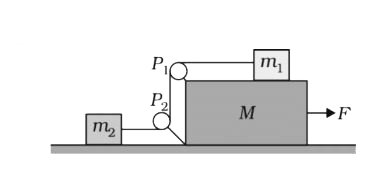
In the figure, masses `m_(1), m_(2)` and M are 20kg, 5kg, and 50kg respectively. The coefficient of friction between M and ground is zero. The coefficient of friction between `m_(1)` and M and that between `m_(2)` and ground is 0.3. The pulleys and the strings are massless. The string is perfectly horizontal between `P_(1)` and `m_(1)` also between `P_(2)` and `m_(2)`. The string is perfectly vertical between `P_(1)` and `P_(2)`. An external horizontal force F is applied to the mass M. Let the magnitude of the force of friction between `m_(1)` and M be `f_(1)` and that between `m_(2)` and ground be `f_(2)`. For a particular F it is found that `f_(1) = 2f_(2)`. [Take `g = 10 m/s^(2)`]
(i) Find `f_(1)` in Newton
(ii) Find `f_(2)` in Newton
(iii) Find F in Newton
(iv) Find tension in the string in Newton
(v) Find acceleration of the masses in `m//s^(2)`

Text Solution

Verified by Experts

The correct Answer is:

TRUE
Promotional Banner

Topper's Solved these Questions

  • STRUCTURAL ORGANISATION IN ANIMALS

    ICSE|Exercise Test Your Progress (Very Short Answer Type Questions )|64 Videos
  • STRUCTURAL ORGANISATION IN ANIMALS

    ICSE|Exercise Test Your Progress (Short/Long Answer Type Questions )|35 Videos
  • STRUCTURAL ORGANISATION IN ANIMALS

    ICSE|Exercise Test Your Progress (Fill in the blanks with appropriate words) |20 Videos
  • SELF ASSESSMENT PAPER-3

    ICSE|Exercise PART II (SECTION C)|4 Videos
  • STRUCTURE ORGANISATION IN ANIMALS -ANIMAL TISSUES

    ICSE|Exercise REVIEW QUESTIONS (LONG ANSWER TYPE QUESTIONS)|12 Videos

Similar Questions

Explore conceptually related problems

In the figure masses m_(1),m_(2) and M are kg. 20 Kg, 5 kg and 50 kg respectively. The co-efficient of friction between M and ground is zero. The co-efficient of friction between m_(1) and M and that between m_(2) and ground is 0.3. The pulleys and the string are massless. The string is perfectly horizontal between P_(1) and m_(1) and also between P_(2) and m_(2). The string is perfectly verticle between P_(1) and P_(2). An externam horizontal force F is applied to the mass M. Take g=10m//s^(2). (i) Drew a free-body diagram for mass M, clearly showing all the forces. (ii) Let the magnitude of the force of friction between m_(1) and M be f_(1) and that between m,_(2) and ground be f_(2). For a particular F it is found that f_(1)=2f_(2). Find f_(1) and f_(2). Write down equations of motion of all the masses. Find F, tension in the string and accelerations of the masses.

In the figure masses m_1 , m_2 and M are 20 kg, 5kg and 50kg respectively. The coefficient of friction between M and ground is zero. The coefficient of friction between m_1 and M and that between m_2 and ground is 0.3. The pulleys and the strings are massless. The string is perfectly horizontal between P_1 and m_1 and also between P_2 and m_2 . The string is perfectly vertical between P_1 and P_2 . An external horizontal force F is applied to the mass M. Take g=10m//s^2 . (a) Draw a free body diagram for mass M, clearly showing all the forces. (b) Let the magnitude of the force of friction between m_1 and M be f_1 and that between m_2 and ground be f_2 . For a particular F it is found that f_1=2f_2 . Find f_1 and f_2 . Write equations of motion of all the masses. Find F, tension in the spring and acceleration of masses.

In the figure masses m_1 , m_2 and M are 20 kg, 5kg and 50kg respectively. The coefficient of friction between M and ground is zero. The coefficient of friction between m_1 and M and that between m_2 and ground is 0.3. The pulleys and the strings are massless. The string is perfectly horizontal between P_1 and m_1 and also between P_2 and m_2 . The string is perfectly vertical between P_1 and P_2 . An external horizontal force F is applied to the mass M. Take g=10m//s^2 . (a) Draw a free body diagram for mass M, clearly showing all the forces. (b) Let the magnitude of the force of friction between m_1 and M be f_1 and that between m_2 and ground be f_2 . For a particular F it is found that f_1=2f_2 . Find f_1 and f_2 . Write equations of motion of all the masses. Find F, tension in the spring and acceleration of masses.

When force F applied on m_(1) and there is no friction between m_(1) and surface and the coefficient of friction between m_(1)and m_(2) is mu. What should be the minimum value of F so that there is on relative motion between m_(1) and m_(2)

Two blocks of masses m_(1) and m_(2) are placed in contact with each other on a horizontal platform as shown in figure The coefficent of friction between m_(1) and platform is 2mu and that between block m_(2) and platform is mu .The platform moves with an acceleration a . The normal reation between the blocks is

In fig. both pulleys and the string are massless and all the surfaces are frictionless. Given m_(1)=1kg, m_(2)= 2kg, m_(3)=3kg . Find the tension in the string

In fig. both pulleys and the string are massless and all the surfaces are frictionless. Given m_(1)=1kg, m_(2)= 2kg, m_(3)=3kg . The acceleration of m_(1) is

In fig. both pulleys and the string are massless and all the surfaces are frictionless. Given m_(1)=1kg, m_(2)= 2kg, m_(3)=3kg . The acceleration of m_(3) is

If coeffiecient of friction between the block of mass 2kg and table is 0.4 then out acceleration of the system and tension in the string. (g=10m//s^(2))

Two block A and B of mass 50 kg and 300 kg respectively are placed as shown in figure. Coefficient of friction between all surface is (1)/(2) Then (take g = 10 m//s )
