Home
Class 12
PHYSICS
Prove that the magnitude of the hydrosta...

Prove that the magnitude of the hydrostatic pressure is proportional to the height of the column of liquid (or gas) and is independent of the vessel's shape. 

Text Solution

Verified by Experts
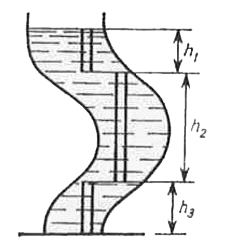
No matter what the shape of the vessel is, one can always imagine it to be made up of small vertical columns of liquid for which the formula `p = rho gh` was derived (see Fig.). But since the pressure at all points at a given depth is the same (a corollary of Pascal.s law), to compute the pressure at the depth h one should add up the pressures of all the upper layers:
`p = p_1 + p_2 + p_3 + … =  rho g(h_1 + h_2 + h_3 + ….) = rho gh`
Promotional Banner

Similar Questions

Explore conceptually related problems

Pressure of a gas at constant volume is proportional to

1 torr is the hydrostatic pressure exerted by a mercury column of height.

The hydrostatic pressure exerted by a liquid does not depend upon the

A liquid has been poured into a cylindrical vessel of mass M (the mass of the vessel bottom can be ighored) and height H. The linear density of the liquid, that is, the ratio of the mass of the liquid column to its height, is delta. What is the height x of the column of liquid at which the common center of gravity of the liquid plus the vessel is in the lowest position?

Prove that the pressure exerted by water at the bottom of the container depends on the height of its column.

A vessel in the shape of a hollow hemisphere surmounted by a once is held with the axis vertical and vertex uppermost. If it be filled with a liquid so as to submerge half the axis of the cone in the liquid, and the height of the cone be double the radius of its base, find the liquid on the vessel is x times the weight of the liquid that the hemisphere can hold.

Assertion : The blood pressure in humans is greater at the feet than at the brain. Reason : Pressure of liquid at any point is proportional to height, density of liquid and acceleration due to gravity.

A liquid is kept in a cylindrical vessel which is rotated along its axis. The liquid rises at the side. If the radius of the vessel is 5 cm and the speed of rotation is 4 rev//s , then the difference in the height of the liquid at the centre of the vessel and its sides is

