Home
Class 12
PHYSICS
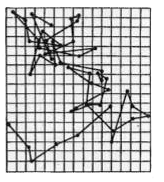
Figure shows the results of a series of ...

Figure shows the results of a series of observations of a migrating Brownian particle. The observations were made at intervals of 30 s, the temperature of water was `25^@C`, the radius of a Brownian particle is `4.4 xx 10^(-7)m`. Measuring the "steps" of the particle in the scale specified, find the square of the r.m.s. displacement for a given time, and calculate the Boltzmann constant and the Avogadro number. The scale is as follows: 1 mm on the graph corresponds to a i displacement of `1.25 mu m`.
 

Text Solution

Verified by Experts

Consider 10 successive steps starting with the lower left. Measure their lengths in millimetres as accurately as possible and transform them to scale into actual dimensions (see Table).

Hence the square of the r.m.s displacement is `Delta^2 = 1.04 xx 10^(-9) m^2`. Substituting `Delta^2 and t = 300 s`. into Einstein.s formula we obtain
`k (pi eta r Delta^2)/(Tt) = (pi xx 8.9 xx 10^(-4) xx 4.4 xx 10^(-7) xx 1.04 xx 10^(-9))/(300 xx 300) = 5.9 xx 10^(26) "k mole"^(-1)`.
We would advise the reader to carry out similar calculations using other parts of the graph and to assess the inherent error in the method.
Promotional Banner

Similar Questions

Explore conceptually related problems

In brownian motion , the paths of the particles are :

velocity time graph of a particle is shown in figure. Find displacement of the particle.

Velocity time graph for a particle moving in a line is given. Calculate the displacement of the particle and distance travelled in first 4 seconds.

Figure shows the position time graph for a particle in one dimensional motion. What is the displacement of the particle in first 4 seconds ?

The displacement of a particle is s = (a+bt)^(6) , where a and b are constants. Find acceleration of the particle as a function of time.

Calculate the energy of an a-particle if in a collision of this particle with gold nucleus, the distance of closest approach is 4.95 xx 10^(-12) m.

A particle moves in a straight line with constant speed of 4 m//s for 2 s, then with 6 m//s for 3 s. Find the average speed of the particle in the given time interval.

The displacement time graph of a particle executing S.H.M. is as shown in the figure The corresponding force-time graph of the particle is

