Home
Class 12
PHYSICS
The electron beam in the device shown in...

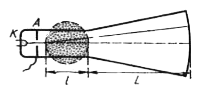
The electron beam in the device shown in Fig. 28.7a is deflected upwards by a transverse magnetic field. The field is effective along a length l= 20 mm, the distance of the deflection system from the screen being L =175 mm. The magnetic induction is `10^(-3)T,` the anode voltage is 500 V. Find the deflection of the electron beam on the screen.

Text Solution

Verified by Experts

The correct Answer is:
51mm.

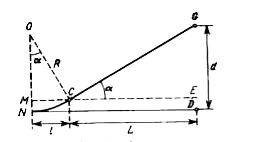
The electrons in this problem are nonrelativistic, they enter the magnetic field at a speed `u=sqrt(2e Psi//m)=1.33 xx 10^(7) m//s`. In the magnetic field they move along an arc of a circle of radius `R=um//eB` (Fig 28.7b). The electrons are deflected through an anle `angleGCE=alpha`. But the angle `angleGCE` is congruent to the angle `angleCOM` (as angles with mutually perpendicular sides). Therefore `sin alpha=(MC)/(OC)=l/R=(e Bl)/(m_(e)u)=(e Bl)/sqrt(2m_(e)e Psi)`
As is evident from the figure, GD=GE+EB, or
`d=L tan alpha +R (1-cos alpha)=L tan alpha+l (1-cos alpha)/(sin alpha)=L tan alpha+l tan ""pi/2`
Knowing the parameters of the device one may easily calculate the displacement sought.
Promotional Banner

Similar Questions

Explore conceptually related problems

Two electrons Beams having velocities in the ratio 1:2 are subjected to the same transverse magnetic field . The ratio of the deflections is

An electron beam projected along positive x-axis deflects along the positive y-axis. If this deflection is caused by a magnetic field, what is the direction of the field?

An electron is projected into a magnetic field of B= 5×10^-3 T and rotates in a circle of radius of R=3 mm. Find the work done by the force due to magnetic field.

A currrent I is passed through a silver strip of width d and area of cross section A. The number of free electrons per unit volume is n. (a) Find the drift velocity v of the electrons. (b) If a magnetic field B exists in the region as shown in what is the average magnetic force on the free electrons? (c) Due to the magnetic force, the free electrons get accumulated on one side of the conductor along its length. This produces a transverse electric field in the conductor which opposes the magnetic force on the electrons. Find the magnitude of the electric field which will be the potential diference developed across the width of the conductor due to the electron- accumulation? The appearance of a transverse emf, when a current-carrying wire is placed in a magnetic field, is called hall effect.

In a cathode ray tube the length of deflection plates is 78 mm and their separation is 0.24 m , while the distance form the centre orf the plate to the screen is 0.33 m . No deflection of the electron beam is observed when the potential difference is 2800 V and the magnitude field is 8.2xx10^(-4) Wb m^(-2) . When only the magnetic field is applied, deflection on the screen is 28 mm . Find e//m .

Following experiment was performed by J.J. Thomson in order to measure ratio of charge e and mass m of electron. Electrons emitted from a hot filament are accelerated by a potential difference V. As the electrons pass through deflecting plates, they encounter both electric and magnetic fields. the entire region in which electrons leave the plates they enters a field free region that extends to fluorescent screen. The entire region in which electrons travel is evacuated. Firstly, electric and magnetic fields were made zero and position of undeflected electron beam on the screen was noted. The electric field was turned on and resulting deflection was noted. Deflection is given by d_(1) = (eEL^(2))/(2mV^(2)) where L = length of deflecting plate and v = speed of electron. In second part of experiment, magnetic field was adjusted so as to exactly cancel the electric force leaving the electron beam undeflected. This gives eE = evB . Using expression for d_(1) we can find out (e)/(m) = (2d_(1)E)/(B^(2)L^(2)) A beam of electron with velocity 3 xx 10^(7) m s^(-1) is deflected 2 mm while passing through 10 cm in an electric field of 1800 V//m perpendicular to its path. e//m for electron is

Following experiment was performed by J.J. Thomson in order to measure ratio of charge e and mass m of electron. Electrons emitted from a hot filament are accelerated by a potential difference V. As the electrons pass through deflecting plates, they encounter both electric and magnetic fields. the entire region in which electrons leave the plates they enters a field free region that extends to fluorescent screen. The entire region in which electrons travel is evacuated. Firstly, electric and magnetic fields were made zero and position of undeflected electron beam on the screen was noted. The electric field was turned on and resulting deflection was noted. Deflection is given by d_(1) = (eEL^(2))/(2mV^(2)) where L = length of deflecting plate and v = speed of electron. In second part of experiment, magnetic field was adjusted so as to exactly cancel the electric force leaving the electron beam undeflected. This gives eE = evB. Using expression for d_(1) we can find out (e)/(m) = (2d_(1)E)/(B^(2)L^(2)) If the electron is deflected downward when only electric field is turned on, in what direction do the electric and magnetic fields point in second part of experiment

