

Home
Class 10
CHEMISTRY
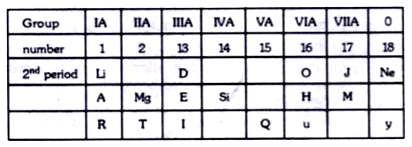
• In this table H does not represent hyd...


• In this table H does not represent hydrogen.
• Some elements are given in their own symbol and position in the periodic table.
• While others are shown with a letter.
With reference to the table answer the following questions :
How many valence electrons are present in Q?

Promotional Banner

Topper's Solved these Questions

  • PERIODIC PROPERTIES AND VARIATIONS OF PROPERTIES (PHYSICAL AND CHEMICAL)

    ICSE|Exercise Questions from Previous ICSE Board Papers (2014) |7 Videos
  • PERIODIC PROPERTIES AND VARIATIONS OF PROPERTIES (PHYSICAL AND CHEMICAL)

    ICSE|Exercise Questions from Previous ICSE Board Papers (2015) |7 Videos
  • PERIODIC PROPERTIES AND VARIATIONS OF PROPERTIES (PHYSICAL AND CHEMICAL)

    ICSE|Exercise Questions from Previous ICSE Board Papers (2012) |7 Videos
  • PART B (STIOCHIOMETRY) PRECENTAGE COMPOSITION - EMPIRICAL & MOLECULAR FORMULA CHEMICAL EQUATION CALCULATIONS

    ICSE|Exercise Questions (G : Chemical Equations)|17 Videos
  • PERIODIC PROPERTIES OF ELEMENTS

    ICSE|Exercise QUESTIONS FOR PRACTICE ON EXAMINATION PATTERN (SECTION II)|70 Videos

Similar Questions

Explore conceptually related problems

• In this table H does not represent hydrogen. • Some elements are given in their own symbol and position in the periodic table. • While others are shown with a letter. With reference to the table answer the following questions : Identify the most electronegative element.

• In this table H does not represent hydrogen. • Some elements are given in their own symbol and position in the periodic table. • While others are shown with a letter. With reference to the table answer the following questions : Identify the noble gas of the fourth period.

• In this table H does not represent hydrogen. • Some elements are given in their own symbol and position in the periodic table. • While others are shown with a letter. With reference to the table answer the following questions : Identify the most reactive element of group 1.

• In this table H does not represent hydrogen. • Some elements are given in their own symbol and position in the periodic table. • While others are shown with a letter. With reference to the table answer the following questions : Identify the element from period 3 with least atomic size.

In this table H does not represent hydrogen. Some elements are given in their own symbol and position in the periodic table. While others are shown with a letter. With reference to the table answer the question : Identify the least reactive element of group 1.

• In this table H does not represent hydrogen. • Some elements are given in their own symbol and position in the periodic table. • While others are shown with a letter. With reference to the table answer the following questions : Which element from group 2 would have the least ionization energy?

• In this table H does not represent hydrogen. • Some elements are given in their own symbol and position in the periodic table. • While others are shown with a letter. With reference to the table answer the following questions : In the compound between A and H what type of bond would be formed and give the molecular formula for the same.

Consider the section of the periodic table given below. Note : In this table B does not represent boron C does not represent carbon F does not represent fluorine H does not represent hydrogen K does not represent potassium You must see the position of the element in the periodic table. Some elements are given in their own symbol and position in the periodic table, while others are shown with a letter. With reference to the table: How many valence electrons are present in G?

Some elements are given in the above table in their own symbol & position in the periodic table, while others [shaded] are shown with a letter. With reference to the table. How many valence electrons are present in G

In the above table - H does not represent hydrogen. Some elements are in their own symbol & position in the periodic table while others are shown with a letter. Identify The most reactive element of group I.