Home
Class 12
CHEMISTRY
(i) E^@ (Cu^(2+),Cu)=0.34V (ii) E^@(Cu...

`(i) E^@ (Cu^(2+),Cu)=0.34V`
(ii) `E^@(Cu^+,Cu)=+0.52V`
`(iii) E^@[O_2(g)+H^+ +4e to 4OH^(-) ]=+1.23V`
`(iv) E^@[O_2(g) +2H_2O +4e to 4OH^(-) ]=+0.40V`
(v) `E^@ (Cr^(3+), Cr)=-0.74V`
`(vi) E^@ (Cr^(2+), Cr)=+0.91V`
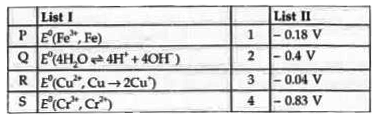
Match `E^@` of the redox pair is List I with the values given in List II and select the correct answer using the code given below the lists.

A

P Q R S
4 1 2 3

B

P Q R S
2 3 4 1

C

P Q R S
1 2 3 4

D

P Q R S
3 4 1 2

Text Solution

Verified by Experts

D
Promotional Banner

Topper's Solved these Questions

  • ELECTROMOTIVE FORCE

    BODY BOOKS PUBLICATION|Exercise PROBLEMS |50 Videos
  • ELECTROCHEMISTRY

    BODY BOOKS PUBLICATION|Exercise EXAMPLES|134 Videos
  • General Principles and Processes of Isolation of Elements

    BODY BOOKS PUBLICATION|Exercise Example|108 Videos

Similar Questions

Explore conceptually related problems

From the following E^@ values of half cells (i) A^(3-)to A^(2-) +e, E^@=1.5V (ii) B^(+)+e to B, E^@=0.5V (iii) C^(2+) +e to C^(+), E^@=+0.5V (iv) D to D^(2+) +2e, E^@=-1.5 V What combination of two half cells would result in a cell with the largest potential

From the following E^@ values of half cells, (i) A+e to A^(-) , E^@=-0.24V (ii) B^(-) +e to B^(2-) , E^@=+1.25V (iii) C^(-) +2e to C^(3-) , E^@=-1.25V (iv) D+2e to D^(2-) , E^@=+0.68V What combination of two half cells would result in a cell with the largest potential?

From the following E^@ values of half cells (i) A to A^(+)+e, E^@=+1.2V (ii) B^(-) to B+e, E^@=-2.1V (iii) C to C^(2+) +2e, E^@=0.38V (iv) D^(-2) to D^(-) +e, E^@=-0.59V What combination of two half cells would result in a cell with the largest potential?

Given: E^(@) (Ag^(+)|Ag)=0.80 V and E^(@) (I^(-)|Agl Ag)-0.15 V . The value of standard solubility product Agl would be about

Given: E_(Cl_2,Cl^-)^@=1.36V, E_(Cr^(3+),Cr)^@=-0.74V E_(Cr_2O_7,Cr^(3+))^@=1.33V, E_(MnO_4^-,Mn^(2+))^@=1.51V Among the following the strongest reducing agent is

Zn^(2+)toZn_((s)),E^(@)=-0.76V Cu^(2+)toCu_((s)),E^(@)=-0.345V Which of the following is spontaneous?

Given E_((Cr^(3+)) / (Cr)=-0.72 V . E_(Fe^(2+)//Fe)^(@)=-0.42 V The potential for the cell, Cr∣Cr^(3+) (0.1M)∣∣Fe ^(2+) (0.01M)∣Fe is:

fE^circ of some elements are, given: fI,+2 e^- 2 fI-, fE^circ=+0.54 fV endaligned MnO_4^-+8 H^++5 e^r Mn^2++4 H_2 O, E_1^circ=+1,52 ~V Fe^3++e^- Fe^2+, E^circ=+0.77 ~V Sn^4++2 e^- Sn^2 *, E^circ=+0.1 ~V 'a) Select the strongest reductant and oxidant. in these. b) Select the weakest reductant and oxidant in these. c) Select the spontaneous reaction from the changes given below: i. Sn^4+2 Fe^2 * Sn^2 *+2 Fe^h ii. 2 Fe^2 *+I_2 .2 Fe^2++2 I^- iii. Sn^4++2 I_- Sn^2++I_2

BODY BOOKS PUBLICATION-ELECTROMOTIVE FORCE -EXERCISE
  1. From the following E^@ values of half cells, (i) A+e to A^(-) , E^@=...

    Text Solution

    |

  2. From the following E^@ values of half cells (i) A to A^(+)+e, E^@=+1...

    Text Solution

    |

  3. From the following E^@ values of half cells (i) A^(3-)to A^(2-) +e,...

    Text Solution

    |

  4. IF the following half cells have the E^@ values as Fe^(3+)+e to Fe^(...

    Text Solution

    |

  5. E^@ (red.) values of the half cells Mg^(2+)//Mg and Cl2//Cl^- are resp...

    Text Solution

    |

  6. For the cell reaction Zn(s)+Mg^(2+) (1M)=Zn^(2+) (1M) +Mg, the emf has...

    Text Solution

    |

  7. E^@ for F2+2e=2F^(-) is 2.8V, E^@ for 1/2 F2+e=F^(-) is

    Text Solution

    |

  8. Delta G^@ of the cell reaction AgCl(s)+1/2H2(g)=Ag(s)+H^+ +Cl^(-) is ...

    Text Solution

    |

  9. The value of equilibrium constant for the feasible cell reaction is

    Text Solution

    |

  10. E^@ for the reaction Fe+Zn^(2+)=Zn+Fe^(2+) is -0.35 V. The given cell...

    Text Solution

    |

  11. A galvanic cell is composed of two hydrogen electrodes, one of which i...

    Text Solution

    |

  12. 1/2 H2(g)+AgCl(s)=H^+ (aq)+Cl^(-) (aq)+Ag(s) occurs in the galvanic c...

    Text Solution

    |

  13. For the cell Tl|Tl^(+) (0.001M) ||Cu^(2+) (0.1M) |Cu. E(cell) at 25^@C...

    Text Solution

    |

  14. (i) E^@ (Cu^(2+),Cu)=0.34V (ii) E^@(Cu^+,Cu)=+0.52V (iii) E^@[O2(...

    Text Solution

    |

  15. Given below the half cell reactions Mn^(2+)+2e to Mn, E^@=-1.18V 2...

    Text Solution

    |

  16. In a galvanic cell, the salt bridge

    Text Solution

    |

  17. Galvanisation is applying a coating of

    Text Solution

    |

  18. For the following electrochemical cell at 298 K Pt (s)|H2(g) (1 ba r...

    Text Solution

    |

  19. Given: E(Cl2,Cl^-)^@=1.36V, E(Cr^(3+),Cr)^@=-0.74V E(Cr2O7,Cr^(3+))^...

    Text Solution

    |

  20. For the following cell Zn(s)|ZnSO4 (aq) ||CuSO4 (aq)|Cu(s) When [Z...

    Text Solution

    |

