Home
Class 11
CHEMISTRY
Guanidine (I) and its conjugate acid (II...

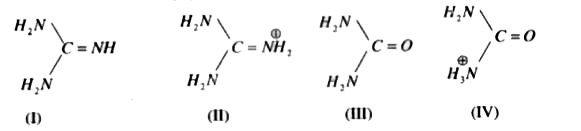
Guanidine (I) and its conjugate acid (II) are given below along with urea(III) and its conjugate base (IV)

Basic properties of I & II compounds are mainly influenced by resonance and the acidity of the bases depends upon lone pair of electrons.
Urea is mono basic because

A

It contain only one lone pair which can accept proton

B

It is mainly due to inductive effect of `-NH_(2)` and C = O groups

C

It is mainly due to lone pair and `pi` bond conjugation

D

All of the above

Text Solution

Verified by Experts

The correct Answer is:

C

Mainly due to lone pair and T-bond conjugation
Promotional Banner

Topper's Solved these Questions

  • ELECTRONIC EFFECTS AND REACTION INTERMEDIATES

    AAKASH SERIES|Exercise LECTURE SHEET ( EXERCISE-III (LEVEL-II (ADVANCED)) (Matrix Matching Type Questions)|2 Videos
  • ELECTRONIC EFFECTS AND REACTION INTERMEDIATES

    AAKASH SERIES|Exercise LECTURE SHEET ( EXERCISE-III (LEVEL-II (ADVANCED)) (Integer Type Questions)|6 Videos
  • ELECTRONIC EFFECTS AND REACTION INTERMEDIATES

    AAKASH SERIES|Exercise LECTURE SHEET ( EXERCISE-III (LEVEL-II (ADVANCED)) (More than correct answer Type Questions)|6 Videos
  • ELECTRON MIGRATION EFFECTS

    AAKASH SERIES|Exercise QUESTIONS FOR DESCRIPTIVE ANSWERS|10 Videos
  • ELEMENTS OF BORON FAMILY

    AAKASH SERIES|Exercise OBJECTIVE EXERCISE - 3|7 Videos

Similar Questions

Explore conceptually related problems

Guanidine (I) and its conjugate acid (II) are given below along with urea(III) and its conjugate base (IV) Basic properties of I & II compounds are mainly influenced by resonance and the acidity of the bases depends upon lone pair of electrons. The strongest base of the following is

Guanidine (I) and its conjugate acid (II) are given below along with urea(III) and its conjugate base (IV) Basic properties of I & II compounds are mainly influenced by resonance and the acidity of the bases depends upon lone pair of electrons. The strongest base of the following is

Guanidine (I) and its conjugate acid (II) are given below along with urea(III) and its conjugate base (IV) Basic properties of I & II compounds are mainly influenced by resonance and the acidity of the bases depends upon lone pair of electrons. Which of the following is more resonance stabilized

Guanidine (I) and its conjugate acid (II) are given below along with urea(III) and its conjugate base (IV) Basic properties of I & II compounds are mainly influenced by resonance and the acidity of the bases depends upon lone pair of electrons. Which of the following is more resonance stabilized

A basic buffer solution contains a weak base B and its conjugate acid BH^(+) . On adding some HCI. which of the following reactions takes place to maintain constant Pt ?

Hyperconjugation describes the orbital interactions between the p-systems and the adjacent s-bond of the substituent group(s) in organic compounds. Hyperconjugation is also called as Baker and Nathen effect. The necessary and sufficient condition for the hyperconjugation are : i) Compound should have at least on sp2 hybrid carbon of either alkene, carbocation or alkyl free radical. ii) A-carbon with respect to sp2 hybrid carbon should have at least one hydrogen. Hyperconjugation are of three types: (i) s(C-H), p-conjugation. (iii) s(C-H), positive charge conjugation iv) s(C-H), odd electron conjugation The hyperconjugation may be represented as Number of resonating structures due to hyperconjugation = (n + 1) where n is the number of a-hydrogen. Greater is the number of such forms, more is the stability of the species under considersation. Hyperconjugation is possible in which of the following species ?

Choose the correct statement (s) (i) The energy of an electron in an atom is always negative, because it is negatively charged. (ii) The charge of an electron in an atom is positive (iii) When an electron is at an infinite distance from the nucleus so that there is no electrical interaction , then orbitarily the energy of electron is taken to be zero (iv) As the electron moves closer to the nucleus, energy is released and so its energy becomes less than zero i.e., negative.
