Home
Class 12
BIOLOGY
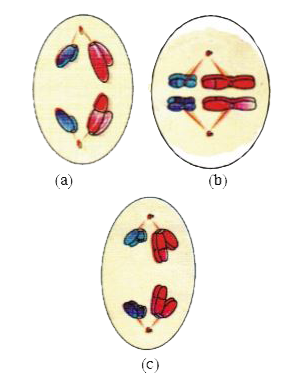
Match the above figures (a, b, c) with t...


Match the above figures (a, b, c) with their events given below :-
(I) Nucleolus disappear
(II) Formation of tetrad of cell
(III) Homologous chromosomes separate
(IV) Microtubules attached to the kinetochore of sister chromatids
(V) Separation of sister chromatids
(VI) Bivalent chromosomes align on theequatorial plate

A

a - I b - III c - IV

B

a - VI b - I c- IV

C

a - V b - VI c - III

D

a - III b - V c - I

Text Solution

Verified by Experts

The correct Answer is:

C
Promotional Banner

Similar Questions

Explore conceptually related problems

The figure given below represents the stage of cell division. Read the following statements. (i) Nucleolus, Golgi complex and ER reform. (ii) Chromatids move to the opposite pole. (iii) The activity of the recombinase enzyme. (iv) Homologous chromosomes separate while sister chromatids remains associated at their centromere. (v ) Initiated of the assembly of the mitotic spindle. How many of the above statements is not true with respect to the above figure-

The cytoskeletal elements are involved in : (i) Amoeboid movement (ii) separation of chromosomes (iii) Ciliary movement (iv) Formation of cell plate

At anaphase stage of mitosis I. The centromeres split into two and the spindle fibres pull the daughter centromeres to opposite poles. II. Chromosomes shorten and thicken by coiling and tighten packaging of their components. III. The separated chromatids are pulled along behind the centromeres. IV. Chromosomes line up around the equator of the spindle. Choose the option which correct statement(s).

Following are some events of mitotic cell division, select the correct order in which these events occur . (i) Condensation of chromosomes is completely (ii) chromosomes lose their identity as discrete elements (iii) Sister chromatids separate (iv) Initiation of the assembly of the mitotic spindle

Four different steps that occur during meiosis are given in the following list. (i) Complete separation of chromatids (ii) Pairing of homologous chromosomes (iii) Lining up of paired chromosomes on equator (iv) Crossing over between chromatids Select the correct sequential arrangement of the steps.

What is the correct sequence of the steps given here? Also work out the process depicted in the steps (i) Homologous chromosomes move forward opposite poles of the cell: chromatids do not separte II. Chromosomes gather together at the two poles of the cell and the nuclear membranes reform III. Homologous chromosomes pair and exchange segments IV. Homologous chromosomes allign on a central plate V. the haploid cells separte completely .

Answer the following questions regarding the events carried out in the labelled parts of the ab ove given diagram. (1) DNA synthesis occurs in (2) Condenstaion of chromosomal material takes place in (3) Attachement of spindle fibres to kinetochores of chromosomes during (4) Initiation of the assembly of mitotic spindle during (5). Splitting of centromere and separation of chromatids in (6) Movement of chromatids to opposite poles during (7) Reformation of nucleolus, Golgi complex and ER occurs in (8) Alignment of chromosomes along metaphase plate during (9) During of cytoplasm during (10) Preparation of cell division takes place during.

Name the stage of cell cycle at which one of the following events occur: (i) Chromosomes are moved to spindle equator (ii) Centromere splits and chromatids separate (iii) Pairing between homologous chromosomes takes place (iv) Crossing over between homologous chromosomes takes place
