Home
Class 12
PHYSICS
Applying to the system two force couples...

Applying to the system two force couples having torques equal in magnitude and opposite in sign,

Text Solution

Verified by Experts
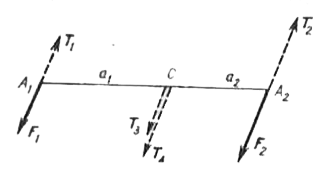
The solid arrows in Fig. show the forces `F_1` and `F_2` applied to a rigid body at points `A_1 and A_2` Apply the forces `T_1 and T_2` at the same points and the forces `T_3 and T_4` at the point C so that is `T_1= T_3= F_1 and T_2 = T_4 = F_2` . The point C is chosen so that `F_1a_1 = F_ya_y` . Show that the now nystem of six forces is equivalent to the old one, i.e. that
`(F_1,F_2,T_1,T_2,T_3,T_4)~(F_1,F_2)`
Indeed, the system of these forces reduces to the former forces `F_1 and F_2` and to two force couples `(T_1, T_3) and (T_2, T_4)` whose moments are
`M_1=T_1a_1 sin alpha and M_2=-T_2a_2sin alpha`
But point was chosen go that `|M_1| = |M_2| ` Therefore these moments are compensated and do not act on the rigid body.
On the other hand, the system of six forces is equivalent to the system of forces `T_3 and T_4` , i.e.
`(F_1, F_2, T_1, T_2, T_3, T_4) ~ (T_3, T_4)`
Indeed, the forces `F_1` and `T_1` , as well as `F_1 and T_2` are compensated, only the forces `T_3 and T_4` remaining uncompensated.
Hence, the system of forces `(F_1, F_2)` is equivalent to the system `( T_3 T_4 )` , and this gives the solution to the problem.
Promotional Banner

Similar Questions

Explore conceptually related problems

For what value of m the roots of the equation I are equal in magnitude and opposite in signs?

The equation of the line through (6,1) having x- and y-intercepts eaual in magnitude but opposite in sign is

Equation of straight line passing through (2,1) and having intercepts equal in magnitude but opposite in sign in

If roots of ax^(2)+bx+c=0 are equal in magnitude but opposite in sign,then

Find the equation of a line which passes through the point (5,1) and cuts, equal in magnitude but opposite in sign, intercepts on axes.

Find the slope of a straight line, which cuts off from the axes : (i) equal intercepts (ii) intercepts equal in magnitude but opposite in sign.

Find the equation of the line which passes through the point (5,6) and the intercepts on the axes are equal in magnitude but opposite in sign.

Two measurements of a cylinder are varying in such a way that the volume is kept constant. If the rates of change of the radius (r ) and height (h) are equal in magnitude but opposite in sign, then

