

Home
Class 10
CHEMISTRY
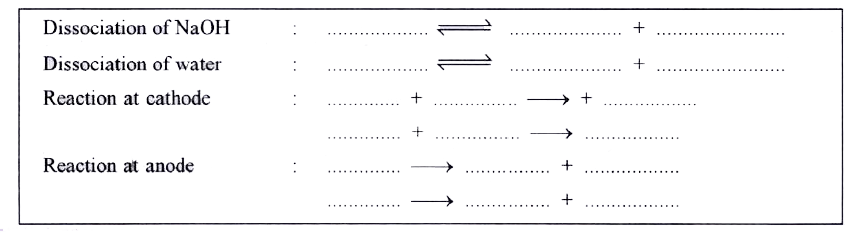
Aqueous sodium hydroxide using graphite ...

Aqueous sodium hydroxide using graphite electrode

Promotional Banner

Topper's Solved these Questions

  • ELECTROLYSIS

    ICSE|Exercise ADDITIONAL QUESTIONS FOR PRACTICE |49 Videos
  • ELECTROLYSIS

    ICSE|Exercise QUESTIONS FROM PREVIOUS ICSE BOARD PAPERS|96 Videos
  • ELECTROLYSIS

    ICSE|Exercise WORK SHEET -3 (Answer the following questions : )|4 Videos
  • CHEMISTRY-2015

    ICSE|Exercise SECTION-II (40 Marks) Attempt any four questions from this Section.|49 Videos
  • METALLURGY

    ICSE|Exercise UNIT TEST PAPER 6 - Metallurgy (Select the correct answer from the list A,B,C & given in each statement.) |5 Videos

Similar Questions

Explore conceptually related problems

Dilute sodium chloride using gaphite electrodes.

Which substance is obtained in the solution on electrolysis of aqueous CuSO_4 solution using graphite electrodes?

State the observations at the anode and at the cathode during the electrolysis of : fused lead bromide using graphite electrodes.

When sodium hydroxide solution is electrolysed :

Concentated aqueous sodium hydroxide cannot separate a mixture of

Choose the correct option : When dilute sodium chloride solution is electrolysed using graphite electrodes , the cation is discharged at the cathode most readily [ Na^(+) , OH , H^(+) , Cl^(-)]

A compound (X) with the molecular formula C_6 H_10 O_4 is a neutral liquid. On heating (X) , under reflux with aqueous sodium hydroxide and distilling the product. A colourless liquid is obtained which on warming with iodine and aqueous sodium hydroxide gives a pale yellow precipatate (Y) . The residue in the distilling flask is the sodium salt of an acid (Z) , which decolourises aqueous acidified potassium permaganate (VII) on heating. Identify (X), (Y) , and (Z) and give all the reactions involved.

When dilute sodium chloride is electrolysed using graphite electrodes, which cation is discharged at the cathode most readily?

Which chloroderivative of benzene among the following would undergo hydrolysis most readily with aqueous sodium hydroxide to furnish the corresponding hydroxyderivative ?

Select the correct answer from the list given in brackets : When dilute sodium chloride is electrolysed using graphite electrodes, the cation is discharged at the cathode most readily. [Na^(+) , OH^(-) , H^(+) , Cl^(-)] .