

Home
Class 10
CHEMISTRY
Salts P, Q,R,S,T,U and V undergo reactio...

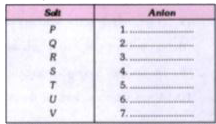
Salts P, Q,R,S,T,U and V undergo reactions (i) to (vii) respectively. Identify the cation present in these salts on the basis of these reactions. Tabulate your answer in the formate given below.
(i) When the salt Pis heated with sodium hydroxide solution a vigorous reaction takes place and a colourless gas is evolved with a pungent and suffocating smell that brings tears in our eyes. The evolved gas gives dense white fumes with a moist glass rod depped with hydrochloric acid.
(ii) Addition of sodium hydroxide solution to a solution of salt Q gives a thick white precipitae which is soluble in excess of sodium hydroxide solution to form a clear solution.
(iii) Addition of ammonium hydroxide solution to a solution of salt R gives a dark blue precipitate which is soluble is excess of ammonium hydroxide solution to form an intense deep blue solution.
(iv) Addition of ammonium hydroxide solution to a solution of 5 gives a dirty green [bottle green] precipitate which is insoluble even in the excess of ammonium hydroxide solution.
(v) Addition of ammonium hydroxide solution to a solution of T gives a reddish brown (rust precipitate] precipitate which is insoluble even in the excess of ammonium hydroxide solution.
(vi) Addition of ammonium hydroxide solution to a solution of V gives a geletaneous white precipitate which is soluble in excess of ammonium hydroxide solution to form a clear solution.
(vii) Addition of ammonium hydroxide solution to a solution of V gives no precipitate but it gives a chalky white precipitate with sodium hydroxide solution which is insoluble even in the excess of sodium hydroxide solution.

Promotional Banner

Topper's Solved these Questions

  • PRACTICAL CHEMISTRY

    ICSE|Exercise Questions from Previous ICSE Board Papers (2007) |1 Videos
  • PRACTICAL CHEMISTRY

    ICSE|Exercise Questions from Previous ICSE Board Papers (2008) |5 Videos
  • PRACTICAL CHEMISTRY

    ICSE|Exercise WORKSHEET (Tick the correct options) |5 Videos
  • PERIODIC TABLE (PERIODIC PROPERTIES AND VARIATION OF PROPERTIES)

    ICSE|Exercise UNIT TEST PAPER 1-Periodic Table|22 Videos
  • QUESTION PAPER 2022 TERM 1

    ICSE|Exercise MULTIPLE CHOICE QUESTIONS|40 Videos

Similar Questions

Explore conceptually related problems

Salts M, N, O, P and Q undergo reactiom (i) to (v) respectively. Identify the cation present in these salts on the basis of these reaction. Tabulate your answer in the format given below. 1. When sodium hydroxide solution is added to the salt M, and heated strongly a colourless gas with a pungent smell is evolved which turm red litmus paper blue and gives dense white fumes with a moist glass rod with hydrochloric acid. 2. Addition of dilute hydrochloric acid to a solution of N gives a thick white precipitate which is soluble in hot water. 3. When ammonium hydroxide solution is added to the solution of 0 a light blue precipitate is obtained which is soluble in excess of ammonium hydroxide to form an inteme deep blue solution. 4. When ammonium hydroxide solution is added to the solution of P reddish brown (mustard colour) precipitate is obtained which ,is insoluble even in the excess of ammonium hydroxide solution. 5. When sodium hydroxide solution is added to the solution of Q a which coloured gelatinous precipitate is obtained which is soluble in excess of sodium hydroxide to form a clear solution

Salts K, L, M, N and O undergo reaction (i) to (v) respectively with different reagents given below. Identify the cation present in these salts on the basis of these reaction. Tabulate your answer in the format given below: (i) Addition of potassium chromate solution to a solution of salt K gives a golden yellow precipitate. (ii) Addition of potassium ferrocyanide solution to a solution of slat L gives a chocolate brown precipitate. (iii) Addition of potassium ferricyanide solution to a solution of salt M gives an intese deep blue solution. (iv) Addition of potassium ferrocyanide solution to a solution of O gives a bluish white precipitate.

Choose the correct answer from the options given below : The salt solution which does not react with ammonium hydroxide is :

Identify P and (Q) respectively in the given reaction :

Identify the substance Q based on the information given below: The white crystalline solid Q is soluble in water. It liberates a pungent smelling gas when heated with sodium hydroxide solution.

Q. identify salt 'A'?

Identify the salts P from the observations given below: On performing the flame test salt P produces a lilac coloured flame and its solution gives a white precipitate with silver nitrate solution, which is soluble in Ammonium hydroxide solution.

When an ammonium salt is warmed with sodium hydroxide solution, ammonia gas is evolved. State three ways in which you could identify this gas.

What happen when 4 -nitrobenzene diazonium chloride reagent reacts with an ammonium salt in the presence of sodium hydroxide solution ?

ICSE-PRACTICAL CHEMISTRY -Additional Questions for Practice
  1. Salts A, B, C, D and E undergo reactions (i) to (v) respectively. Ide...

    Text Solution

    |

  2. Salts P, Q,R,S,T,U and V undergo reactions (i) to (vii) respectively....

    Text Solution

    |

  3. Salts K, L, M, N and O undergo reaction (i) to (v) respectively with ...

    Text Solution

    |

  4. How will you distinguish between the following pairs of gases: Sul...

    Text Solution

    |

  5. How will you distinguish between the following pairs of gases: Hydr...

    Text Solution

    |

  6. How will you distinguish between the following pairs of gases: Hydr...

    Text Solution

    |

  7. How will you distinguish between the following pairs of gases: Hydr...

    Text Solution

    |

  8. The metallic ions (the cations) can be identify by performing flame t...

    Text Solution

    |

  9. Match the following:

    Text Solution

    |

  10. Describe all that you would observe when the following compounds are ...

    Text Solution

    |

  11. Describe all that you would observe when the following compounds are ...

    Text Solution

    |

  12. Describe all that you would observe when the following compounds are ...

    Text Solution

    |

  13. Describe all that you would observe when the following compounds are ...

    Text Solution

    |

  14. Describe all that you would observe when the following compounds are ...

    Text Solution

    |

  15. Describe all that you would observe when the following compounds are ...

    Text Solution

    |

  16. Describe all that you would observe when the following compounds are ...

    Text Solution

    |

  17. What happens when ammonium hydroxide and sodium hydroxide solutions a...

    Text Solution

    |

  18. What happens when ammonium hydroxide and sodium hydroxide solutions a...

    Text Solution

    |

  19. What happens when ammonium hydroxide and sodium hydroxide solutions a...

    Text Solution

    |

  20. What happens when ammonium hydroxide and sodium hydroxide solutions a...

    Text Solution

    |