

Home
Class 12
PHYSICS
A block of mass 1kg slides down a curved...

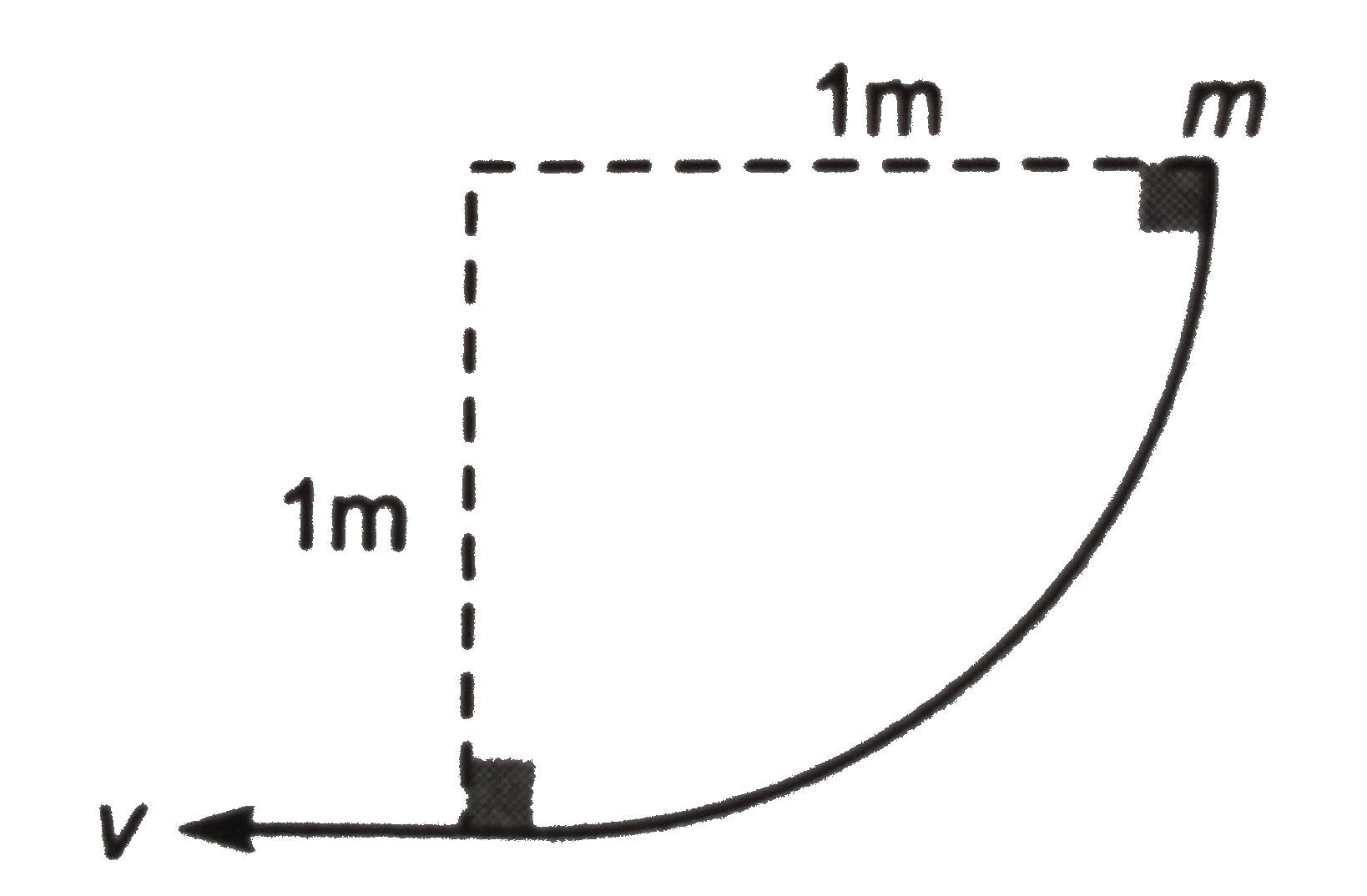
A block of mass `1kg` slides down a curved track which forms one quadrant of a circle of radius `1m` as shown in figure. The speed of block at the bottom of track is `v=2 ms^(-1)`. The work done by the of friction is
.

Promotional Banner

Similar Questions

Explore conceptually related problems

A block of mass 1 kg slides down a vertical curved track that is one quadrant of a circle of radius 1m. Its speed ast the the bottom si 2 m//s . The work done by frictional force is :

A body of mass 2kg slides down a curved track which is quadrant of a circle of radius 1 metre . All the surfaces are frictionless. If the body starts from rest, its speed at the bottom of the track is

A body slides down a fixed curved track that is one quadrant of a circle of radius R , as in the figure. If there is no friction and the body starts from rest, its speed at the bottom of the track is

A block of mass m slides down along the surface of the bowl from the rim to the bottom as shown in fig. The velocity of the block at the bottom will be-

A block of mass 1 Kg is fastened to one each of a wire of cross-sectional area of 2mm^(2) and is rotated in verticle circle of radius 20cm . The speed of the block at the bottom of the circle is 3.5ms^(-1) . The elongation of the wire when the block is at top of the circle

A block of mass 1 kg is placed at the point A of a rough track shown in the figure. If slightly pushed towards right, it stops at the point B of the track. The work done by the frictional force on the block during its transit from A to B is

A block of mass 1 kg is pushed towards another block of mass 2 kg from a 6 m distance as shown in the figure. If just after the collision, the velocity of 2 kg block is 4ms^(-1) , then

A block of mass m slides down a smooth vertical circular track. During the motion, the block is in

A block of mass m slides down a smooth vertical circular track. During the motion, the block is in: