Home
Class 9
PHYSICS
A small stone of mass m(=200g) is held u...

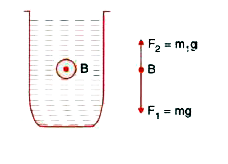
A small stone of mass m(=200g) is held under water in a jar and is allowed to fall as shown in fig. the forces acting on stone are also shown.

(i) What does `F_(2)` represent ?
(ii) What does `m_(1)` represent?
(iii) What is the net force acting on stone?
(iv) What is the acceleration of stone as it falls through water? Neglect the force due to viscosity. Assume that the volume of stone
`=80cm^(3)`, density of water `=1.0gcm^(-3)` and acceleration due to gravity `g=10ms^(-2)`

Text Solution

Verified by Experts

(i) `F_(2)` represents the upthrust on stone due to water.
(ii) `m_(1)` represents the mass of water displaced by stone
(iii) Net force acting on stone `=F_(1)-F_(2)` (downwards)
(iv) Given `V=80cm^(3),rho=1 g cm^(-3), g=10ms^(-2)`,
`m=200g=200/1000kg=0.2kg`
`:.` weight of stone `F_(1)=mg=0.2kgxx10ms^(-2)=2N`
Mass of water displaced `m_(1)=v rho =80xx1=80g`
`=80/1000kg=0.08kg`
upthrust `F_(2)=m_(1)g=0.08kgxx10ms^(-2)=0.8N`
Hence net downward force on stone
`=F_(1)-F_(2)`
`=2-0.8=1.2N`
`:.` Acceleration`=("Force")/("Mass")=(1.2N)/(0.2kg)=6m^(-2)`
Promotional Banner

Topper's Solved these Questions

  • UPTHRUST IN FLUIDS, ARCHIMEDES' PRINCIPLE AND FLOATATION

    ICSE|Exercise EXERCISE 5(A)|28 Videos
  • UPTHRUST IN FLUIDS, ARCHIMEDES' PRINCIPLE AND FLOATATION

    ICSE|Exercise EXERCISE 5(A) (Multiple Choice Question)|3 Videos
  • SOUND

    ICSE|Exercise TOPIC 2 Infrasonic and Ultrasonic Waves ( 3 Marks Questions) |3 Videos

Similar Questions

Explore conceptually related problems

A stone of mass 1 kg is lying on the floor of a train which is accelerating with 1ms^(-2) . The net force acting on the stone is

A stone is released from an elevator going up with an acceleration of g/2. What is the acceleration of the stone just after release ?

A cork of mass 10 g is floating on water. The net force acting on the cork is

(i) Name the type of a diode whose characteristics are shown in figure (a) and (b) (ii) What does the point P in fig. (a) represent ? (iii) What does the point P and Q in fig. (b) represent ?

A stone of mass 0.05 kg is thrown vertically upwards. What is the direction and magnitude of net force on the stone during its upward motion?

A stone is allowed to fall freely from rest. The ratio of the time taken to fall through the first metre and the second metre distance is

A stone is relaeased from an elevator gaing up with acceleration 5m//s^(2). The acceleration of the stone after the release is :

What is stone leprosy and how is it caused ?

A small block of mass m slides along a smooth frictional track as shown in the figure. If it starts from rest at P, what is the resultant force acting on it at Q?

Three blocks with masses m , 2m and 3m are connected by strings, as shown in the figure. After an upward force F is applied on block m , the masses move upward at costant speed v . What is the net force on the block of mass 2m ? ( g is the acceleration due to gravity). ltBrgt
