Home
Class 7
PHYSICS
The boundary line of an irregular lamina...

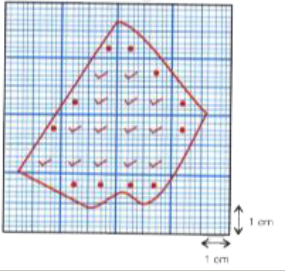
The boundary line of an irregular lamina, on a graph paper is shown in Fig. Find the approximate area of the lamina. In Fig. , the number of complete squares = 14
The number of squares more than half = 11

Text Solution

Verified by Experts

Total number of squares n = 14 + 11 = 25
Area of the square = 1 cm x 1 cm = `1 cm^2`
Area of lamina = `25 xx 1 cm^2 = 25 cm^2`
Promotional Banner

Topper's Solved these Questions

  • PHYSICAL QUANTITIES AND MEASUREMENT

    ICSE|Exercise TEST YOURSELF (TRUE OR FALSE)|9 Videos
  • PHYSICAL QUANTITIES AND MEASUREMENT

    ICSE|Exercise TEST YOURSELF (FILL IN THE BLANKS)|9 Videos
  • MOTION

    ICSE|Exercise TEST YOURSELF (NUMERICAL)|13 Videos
  • SOUND

    ICSE|Exercise EXERCISES (PICTURE STUDY)|4 Videos

Similar Questions

Explore conceptually related problems

Radha made a picture of an aeroplane with coloured paper as shown in Fig 12.15. Find the total area of the paper used.

Find the approximate area of an irregular lamina of which boundary line is drawn on the graph paper shown in Fig.

Find MI of a triangular lamina of mass M about the axis of rotation AB shown in Fig.

Describe the method in steps to find the area of an irregular lamina using a graph paper.

On a squared paper, draw (i) a rectangle, (ii) a triangle (iii) any irregular closed figure. Find the approximate area of each by counting the number of squares complete, more than half and exactly half.

A square lamina of side a and a circular lamina of diameter a are placed touching each other as shown in figure. Find distance of their centre of mass from point O, the centre of square.

Find the area of the shaded region given in Fig. 12.72, where ABCD is a square of side 14cm.

Find the area of the shaded region in Fig. 12.16, where ABCD is a square of side 14 cm.

Find two positive numbers whose sum is 14 and the sum of whose squares is minimum.

Find two positive numbers whose sum is 14 and the sum of whose squares in minimum.
