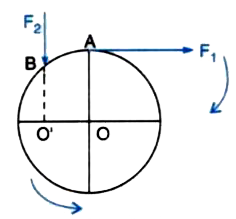
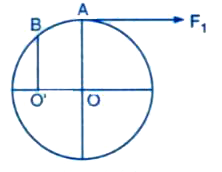
The force `F_1` applied at A produces a clockwise moment on the wheel. It can be balanced by applying the force `F_2` at B in a direction such that it produces an anticlockwise moment. Therefore the vertical force at B should be applied in the downward direction as shown in FIg.1.19 In equilibrium `F_1 times OA=F_2 times OO.`
(b) SInce the perpendicular forces `F_1` from O is greater than the perpendicular distance OO. of point of application of force `F_2` from O, so in magnitude, force `F_2` is greater than force `F_1`
(c) Moment of force `F_1` about `O= F_1 times OA` (clockwise )
Moment of force `F_2` about `O=F_2 times OO.` (anticlockwise)
When the wheel is in equilibrium position,
Clockwise moment= Anticlockwise moment
i.e., `F_1 times OA=F_2 times OO.`
`therefore F_2/F_1= (OA)/(OO.)`........(i)
Given OA=2.5 cm and OO.=2.0 cm
Substituting the values of OA and OO. in eqn. (i), the ratio of forces
`F_2/F_1=2.5/2.0 or F_2:F_1=5:4`